I have finally read the book and comment as follows:
Before I do just a word on the book itself; I agree this is a good book – as expected from the pen of O’Hara. As said above, the author writes in a very easy to read, logically ordered style. If one has an interest in naval warfare in World War II then the Mediterranean, like the Pacific (and indeed the Atlantic) provides the student with much to read about and ponder over.
For those aware of O’Hara’s work there is nothing really new here in terms of the central point he makes (namely that the RM performed well in WWII and indeed got better as the war progressed), and by focusing on the three 1942 Malta convoys, he seeks to add some detail to his thoughts on the performance of the Regia Marina and attempts to prove his point about their improved capability. I note that various comments made in this book do appear slightly inconsistent not only with other comments within the book, but also with his other works. That said, make no mistake, I do not consider O’Hara in any way shape or form a ‘shock jock’ who spouts nonsense to sell a book. The author has clearly researched his subject and has his interpretation of events.
It is always good to get views from all sides and O’Hara’s work gives one that and I would recommend this book too.
And so to the main question about the performance of the Italian armed forces – and particularly the Regia Marina and Regia Aeronautica.
It also might change your view of the Regia Marina and the Regia Aeronautica during the latter stages of Italy's participation in the war as a part of the Axis powers.
But before I comment on this, there is one key question that needs to be taken into account. Who is one judging? Mussolini? Supermarina? The Admirals? The officers and crews of the ships and aircraft? The fighting forces do not set the political agenda. Admirals and Generals can give to the politicians advice and the benefit of their ‘expertise’ but they cannot direct policy. In other words, they have to deal with the consequences of what is decided by others.
And the obvious example with regard to the Mediterranean War is Malta and the decision on whether to hold this. As the OP said, this is a debate for another thread (or later), but the fact was that decision was made and – as throughout history – it then falls to the poor servicemen to follow through in practice on political decisions.
In judging the performance of the RM, it is important to take into account what they were actually tasked with. The Italian navy’s key war plans, specified on 29 May 1940, states at the outset:
- A defensive orientation in the western and eastern basins and an offensive or counter-offensive posture in the central Mediterranean
Also stated are:
- Impeding the union of the enemy’s eastern and western forces by blockading the Sicilian Channel
- The operation of insidious and light forces against the enemy’s most important lines of communication
- The seizure and exploitation of every opportunity to fight under conditions of superior or equal strength
- To employ, as soon as possible, the battle fleet against the enemy before his Mediterranean force could be reinforced and while battles can be fought closer to friendly bases than those of the enemy.
- To protect communications with the islands, Libya and Albania
I think it is clear that the second and last on this list were successes for the RM. Only three British convoys were passed through the Mediterranean from west to east in the opening 3-years, and as stated earlier (post 18) the percentage of supplies (I have always assumed O’Hara’s numbers are correct) of 98% (personnel) and 90% (supplies) delivered to North Africa is impressive.
But as per the RM plans above, these were not the only objectives of the RM and therefore it is wrong to assess their performance based on these achievements alone. Regardless of the point that O’Hara tries to make – that the Mediterranean was identified as where the British main effort would be - as per post 6, the British (and especially the RN) had plenty of other things to worry about too. For the Italians however, with a few exceptions such as aircraft being sent to fight the Battle of Britain for a short period or a small percentage of submarines being sent to the Atlantic, there was little if any such distraction for the RM/RA.
The RM had many advantages – and these are actually evidenced in the book, so hard to ignore – by virtue of Italy’s central positon and internal line of communication. For example during Harpoon / Vigorous, having the central position, the RM was able to easily switch targets from the Western Mediterranean to the Eastern. The movement of aircraft between Italy, Sardinia and Sicily was also relatively easy. For the British to re-supply Malta with aircraft was a major undertaking as was forming the ships in the first place.
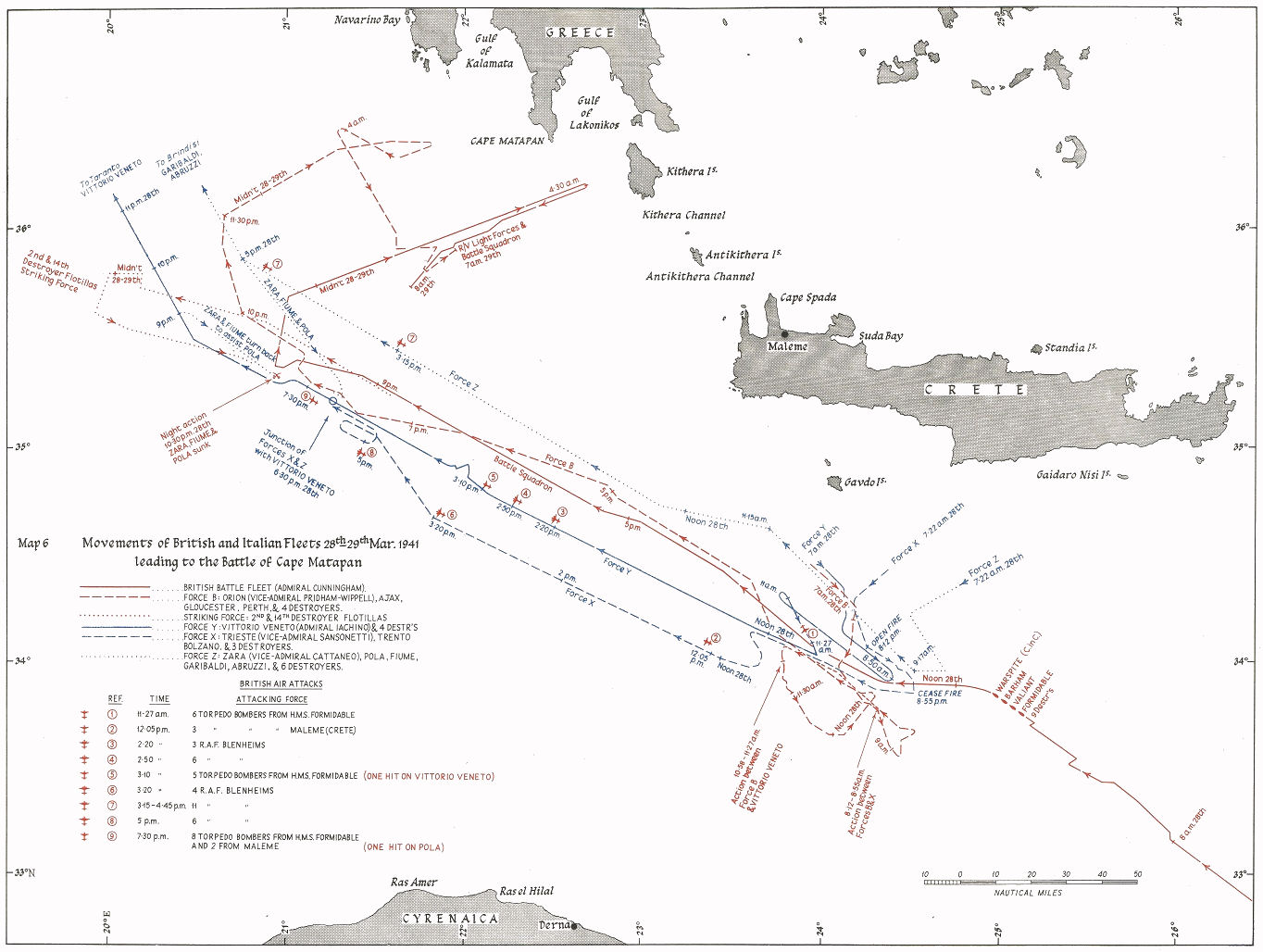
In addition, through the decision to defend Malta, the British played right into the RM’s hands by tasking the RN with having to venture into the central Mediterranean. Had the RM been more robust in following through on their plans (above) the RN could have been heavily defeated.
But it is important to remove hindsight and I think that to malign the RM for not being aggressive in the early months of the war is, on reflection, unfair. After all, Mussolini declared war because he knew it was pretty much over. By declaring war the Italians would therefore reap the benefits without putting themselves at risk. In April 1940 the naval Chief of Staff, Cavagnari, prepared a memorandum to Mussolini that confirmed that in a full-scale naval battle there would be large losses on both sides – but that the British could make good their losses, whereas the Italians couldn’t. As Cavagnari was the CoS in the opening months of war the RM’s cautious mindset – notwithstanding the war plans detailed - is perhaps more understandable.
However, when that assumption regarding the length of the war was pretty quickly seen to be totally false, the RM mindset should have changed. In post 43 it was questioned what events post Spartivento had to do with Mussolini – well the removal of Cavagnari and his deputy confirms exactly what Mussolini thought of the RM’s inability to beat the RN, even when at an advantage. Mussolini expected more from his fleet where circumstances allowed.
Per the plans above, these did not mean the Italian navy could not be aggressive if the right opportunity presented itself. But Campioni’s replacement, Iachino, never took full advantage of his situation and O’Hara makes the point that the Italian rank and file view was perhaps that this Admiral was not up to the job. He confirms that the wrong, overly timid, calls were still being made in 1942 - by Supermarina not just Iachino. The Harpoon and Pedestal convoys could have been finished off by the RM – but the ships were recalled (or never committed)….
The simple truth is that the Italians were heavily reliant upon German assistance and the performance of both the RM and the RA is inflated by the Luftwaffe and U-boat contribution. Until the arrival of the Luftwaffe in January 1941 the number of sinkings of Malta-bound merchant vessels was precisely 4 out of 59 – or less than 7%. One only needs to look at the exposed position of Malta to realise that this is hardly an impressive performance.
Things began to change only with the arrival of the Luftwaffe in January 1941 and they immediately made their presence felt both on Malta and to the RN during the Excess convoy. Malta became untenable as a naval base – certainly for surface warships.
Indeed when the Luftwaffe was withdrawn three months later Malta became effective once more and toward the end of 1941 cruisers were able to base on the island. This Malta Striking Force caused serious losses to Axis supply convoys during this period, whilst Malta was re-supplied.
O’Hara makes the point that the Italian performance rose sharply in 1942 and yes, as was to be expected, years of war and battle experience does lead to improvements. But more than this December 1941 also marked the return of the Luftwaffe.
To be fair to the RM, the one human torpedo attack that succeeded during the war (by removing Queen Elizabeth and Valiant for repairs) was achieved at a vital time and removed the last battleships from the eastern Mediterranean. However, look at the ships sunk by the Germans and then compare this to those sunk by the Italians – of particular importance is the vessel type. The Italian navy (inc. torpedo boats) did not sink anything larger than a cruiser in World War II. Compare that to the much smaller number of German U-boats, and their victims included the carriers Eagle and Ark Royal and the battleship Barham.
The Allied warship losses to all causes are as follows – Germans 56% - Italians 44% and this is made up a follows: German aircraft 30%, Italian surface forces + mines + Shore batteries 28%, German U-boats 21%, Italian aircraft 9%, Italian submarines 7%, Other German 5%. It is clear from this that the RN’s position would have been significantly different without the German armed forces intervention.
So no, I do not entirely agree with O’Hara’s view of the RM/RA performance during World War II. They were most certainly not useless and they did not lack for bravery. However, in terms of what they did achieve and what they should (or could) have achieved, there is too large a gap.
My 2 cents.