

This seems weird, but maybe historcally they weren't on carriers much, but I seem to remember F4u-1's being able to be used by carriers and I can't get them on my carriers.
Also, when I click air squadrons on carriers, I get "out of memory" warning and the screen goes a little screwy and jumbled up. If I click "c" twice I can change the planes and if I click "m" twice I can change mission, but it is kind of hard to read.
Anyone else have this problem? I always had it on later updates of my original game, too.
F4U-1's not able to be on carriers?
RE: F4U-1's not able to be on carriers?
Its a memory issue to do with using DOS programmes in the NT environment.
Go here:
http://members.home.nl/mabus/
and get yourself this:
D-Fend v2 for DOSBox 0.62
Go here:
http://members.home.nl/mabus/
and get yourself this:
D-Fend v2 for DOSBox 0.62
"I am Alfred"
RE: F4U-1's not able to be on carriers?
Or read through this stickied thread: http://www.matrixgames.com/forums/tm.asp?m=261283#
"I am Alfred"
-
Capt. Harlock

- Posts: 5379
- Joined: Sat Sep 15, 2001 8:00 am
- Location: Los Angeles
- Contact:
RE: F4U-1's not able to be on carriers?
ORIGINAL: hgilmer
This seems weird, but maybe historcally they weren't on carriers much, but I seem to remember F4u-1's being able to be used by carriers and I can't get them on my carriers.
I'm afraid you have to wait for the F4U-4 model, which comes on-line in early September 1944. The game considers the F4U-1 not to be carrier qualified.
Civil war? What does that mean? Is there any foreign war? Isn't every war fought between men, between brothers?
--Victor Hugo
--Victor Hugo
RE: F4U-1's not able to be on carriers?
Thanks all! I can play without doing that fix, it just seemed weird. I don't lose anything, it just flubbers up the graphics a tad.

RE: F4U-1's not able to be on carriers?
When the F4Us first came off the production line, pilots found it almost impossible to land these birds on a carrier because they couldn't see the flight deck. This was because the Corsair's long fusalage, which was needed to accomodate the double wasp engine, obstructed their (downward) view. So many early F4Us were used exclusively in a land based role.
However, Brit pilots eventually discovered that if you look thru the space in the inverted gull wing visible from the cockpit, you can land an F4U on a flight deck.
However, Brit pilots eventually discovered that if you look thru the space in the inverted gull wing visible from the cockpit, you can land an F4U on a flight deck.
Stratford, Connecticut, U.S.A.[center]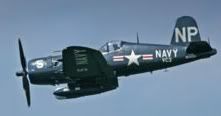 [/center]
[center]"The Angel of Okinawa"[/center]
Home of the Chance-Vought Corsair, F4U
The best fighter-bomber of World War II
[/center][center]"The Angel of Okinawa"[/center]
Home of the Chance-Vought Corsair, F4U
The best fighter-bomber of World War II
-
SMK-at-work
- Posts: 3396
- Joined: Mon Aug 28, 2000 8:00 am
- Location: New Zealand
RE: F4U-1's not able to be on carriers?
British pilots were used to making curved approaches with Seafires (navalised Spitfires) which also had long noses and visibility problems with a straight approach.
Meum est propisitum in taberna mori
RE: F4U-1's not able to be on carriers?
Thanks; I had always wondered how the Brits seemed to solve that F4U problem so easilly.
Stratford, Connecticut, U.S.A.[center][/center]
[center]"The Angel of Okinawa"[/center]
Home of the Chance-Vought Corsair, F4U
The best fighter-bomber of World War II
[/center][center]"The Angel of Okinawa"[/center]
Home of the Chance-Vought Corsair, F4U
The best fighter-bomber of World War II
-
LargeSlowTarget

- Posts: 5085
- Joined: Sat Sep 23, 2000 8:00 am
- Location: Hessen, Germany - now living in France
RE: F4U-1's not able to be on carriers?
I have read that the early F4Us were carrier capable even with their poor visibility, and the reason they were not used on carriers was logistical - providing spare parts for another plane model (which at the time was available in limited numbers only) would have complicated things considerabely for the service squadrons - too much hassle for just a few planes. So it was decided to concentrate logistical support on the Hellcat. Source: Tom Blackburn: The Jolly Rogers (VF-17 - first carrier qualified USN Corsair squadron). [/align]

RE: F4U-1's not able to be on carriers?
All the F4Us were carrier capable, i.e., folding wings, short, stubby legs, tailhook -- the question was how to land them.
I couldn't verify your info on-line, but found this in the Encyclopedia of Aircraft of WW II, which may explain what happened:
The Corsair was perceived to be the backup to the F6F Hellcat, but the Corsair's design began even before the concept of the Hellcat had taken shape. However, early Corsair development was seriously delayed, and it reached service only after engineers had solved some "infuriating flaws."
Here in CT, we were producing a Corsair every 80 minute; I can't imagine what other aircraft part(s) could have cut-back F4U production/deployment.
I couldn't verify your info on-line, but found this in the Encyclopedia of Aircraft of WW II, which may explain what happened:
The Corsair was perceived to be the backup to the F6F Hellcat, but the Corsair's design began even before the concept of the Hellcat had taken shape. However, early Corsair development was seriously delayed, and it reached service only after engineers had solved some "infuriating flaws."
Here in CT, we were producing a Corsair every 80 minute; I can't imagine what other aircraft part(s) could have cut-back F4U production/deployment.
Stratford, Connecticut, U.S.A.[center][/center]
[center]"The Angel of Okinawa"[/center]
Home of the Chance-Vought Corsair, F4U
The best fighter-bomber of World War II
[/center][center]"The Angel of Okinawa"[/center]
Home of the Chance-Vought Corsair, F4U
The best fighter-bomber of World War II
RE: F4U-1's not able to be on carriers?
The Corsair was the 'hotrod', the biggest engine available with the biggest prop in a small airframe. Lots of new aerodynamic ideas. Arguably, with the P51D, Spitfire XXI and TA 152, and maybe the post war Sea Fury, the best of the prop fighters. Two - three years ahead of the rest, and lasted longer in service because its range and load carrying capacity was better than the early shipboard jets.
The Hellcat, whilst not actually a development of the Wildcat, was its lineal successor, relied on the 'tried and true' and whilst built to defeat the A6M (and did) was slower than contemporary land based fighters, and the Corsair.
Admiral Towers' BureauAir reluctantly did not clear it for carrier ops in 1942 because of the visibility problem on landing, and because the port wing stalling speed was higher than the starboard wing speed. The Fleet Air Arm, because they needed it to make do with smaller air groups, developed a curved landing pattern which overcame the visibility problems. The addition of a stall block to the starboard wing improved low speed handling. Two navy squadrons, VF12 andd VF 17, did carrier qualify their F4Us, but operated from shore although they did manage to dos some refueling stops on carriers. Eventually the FAA tactic was adopted by the USMC and then the USN to get some VMF's shipboard, and VMF 124 and 213 were assigned to the Essex in 1944.
The Hellcat, whilst not actually a development of the Wildcat, was its lineal successor, relied on the 'tried and true' and whilst built to defeat the A6M (and did) was slower than contemporary land based fighters, and the Corsair.
Admiral Towers' BureauAir reluctantly did not clear it for carrier ops in 1942 because of the visibility problem on landing, and because the port wing stalling speed was higher than the starboard wing speed. The Fleet Air Arm, because they needed it to make do with smaller air groups, developed a curved landing pattern which overcame the visibility problems. The addition of a stall block to the starboard wing improved low speed handling. Two navy squadrons, VF12 andd VF 17, did carrier qualify their F4Us, but operated from shore although they did manage to dos some refueling stops on carriers. Eventually the FAA tactic was adopted by the USMC and then the USN to get some VMF's shipboard, and VMF 124 and 213 were assigned to the Essex in 1944.
"I am Alfred"
RE: F4U-1's not able to be on carriers?
Though there's still a debate re the best piston fighter, the Corsair was the best fighter-bomber, and being carrier capable meant it could be launched anywhere off the coasts of Korea.
Thanks for your detailed explanation; it basically fleshed-out what SMK-at-work previously posted above re Seafire pilot's "patented" curved approach pattern.
Thanks for your detailed explanation; it basically fleshed-out what SMK-at-work previously posted above re Seafire pilot's "patented" curved approach pattern.
Stratford, Connecticut, U.S.A.[center][/center]
[center]"The Angel of Okinawa"[/center]
Home of the Chance-Vought Corsair, F4U
The best fighter-bomber of World War II
[/center][center]"The Angel of Okinawa"[/center]
Home of the Chance-Vought Corsair, F4U
The best fighter-bomber of World War II

RE: F4U-1's not able to be on carriers?
Hey, guys. I love this game and have lurked on here for ahwile (and found some great in-game tips), but hadn't jumped in and registered, so now seems like good time as any.
What I don't understand about the pro-Corsair argument is:
We all know the Hellcat had a superb combat record. Off the top of my head, about 75% of USN kills, and a 19:1 kill/loss ratio (incidentally, vs. 11:1 for the Corsair), being the plane that made the famous "Turkey shoot" possible, and being flown by more US aces than any other fighter type.
In addition, it was regarded as a very easy aircraft to fly, especially for rookie pilots, wheras the Corsair was nicknamed "the ensign eliminator" due to tricky handling under certain conditions.
The Hellcat also cost the US government 33% less money than the Corsair.
So my point is: The F6F was an excellent naval fighter that did it's job extremely well. Why replace it with something else? Using a cost effectiveness sort of analysis, you'd have to be able to claim the Corsair would somehow do at least 34% more damage to the enemy to justify the extra expense. But looking at the Hellcat's record (once again, 19:1 kill ratio, 75% of USN victories), how do you top that by such a significant margin?
As for the disparity in top speed between the two aircraft, I have a couple of links comparing the F6F-5 to the F4U-1 that are, shall we say, interesting. The F6F-6 would have had even better performance, but Grumman decided to produce the Bearcat instead.
Unfortunately, the Hellcat, for whatever reason, never seems to get the publicity of the Corsair, despite contributing far more to the war effort. Everybody knows about Boyington, but what about Hellcat aces like Eugene Valencia, Alex Vraciu, Cecil Harris, even David McCampbell? Too bad the "Mowing Machine" of VF-9 or "Fabled Fifteen" didn't get their own TV show instead of the Black Sheep...
-Tim/88
What I don't understand about the pro-Corsair argument is:
We all know the Hellcat had a superb combat record. Off the top of my head, about 75% of USN kills, and a 19:1 kill/loss ratio (incidentally, vs. 11:1 for the Corsair), being the plane that made the famous "Turkey shoot" possible, and being flown by more US aces than any other fighter type.
In addition, it was regarded as a very easy aircraft to fly, especially for rookie pilots, wheras the Corsair was nicknamed "the ensign eliminator" due to tricky handling under certain conditions.
The Hellcat also cost the US government 33% less money than the Corsair.
So my point is: The F6F was an excellent naval fighter that did it's job extremely well. Why replace it with something else? Using a cost effectiveness sort of analysis, you'd have to be able to claim the Corsair would somehow do at least 34% more damage to the enemy to justify the extra expense. But looking at the Hellcat's record (once again, 19:1 kill ratio, 75% of USN victories), how do you top that by such a significant margin?
As for the disparity in top speed between the two aircraft, I have a couple of links comparing the F6F-5 to the F4U-1 that are, shall we say, interesting. The F6F-6 would have had even better performance, but Grumman decided to produce the Bearcat instead.
Unfortunately, the Hellcat, for whatever reason, never seems to get the publicity of the Corsair, despite contributing far more to the war effort. Everybody knows about Boyington, but what about Hellcat aces like Eugene Valencia, Alex Vraciu, Cecil Harris, even David McCampbell? Too bad the "Mowing Machine" of VF-9 or "Fabled Fifteen" didn't get their own TV show instead of the Black Sheep...
-Tim/88
RE: F4U-1's not able to be on carriers?
Tim,
"The F6F was an excellent naval fighter that did it's job extremely well. Why replace it with something else?"
I don't think anyone is suggesting the F6F was a bad plane. on the contrary, in the 43-45 time slot it did its special job - defeating the A6M - extremely well. Horses for courses.
F6F-5 v F4U-1 - what was the date of introduction into service of each? The first F4U model had a top speed of just under 400 mph and later models got up to 460 or 470 mph.
The F4U was available in 42, whereas the F6F arrived mid 43 and I IIRC first saw combat in November 1943 (at least off CVs), but carrier ops with the the F4U were problematic until 1944 when mods to the plane and landing procedures were developed to get it shipboard.
The F4U was a more radical design (with Igor Sikorsky one of the co-designers) than the "ironworks'" F6F. It had more "mod potential" and was produced until 1952, but the Hellcat was considered obselescent at the end of the war. The new "battle carriers" (the Midways) had planned airgroups consisting entirely of F4U and SB2C (pending the availability of the AD and the AM) for 1946 - no Hellcats or Avengers.
It is interesting to note that the F8F Bearcat was a smaller plane than the F6F with a great big engine (a bit like the Corsair), small enough that they worked out they could spot 48 F8Fs on an Independence class CVL for Operation Coronet. But it was the Corsairs (as "AU"s) that flew alongside the AD Skyraiders and the early jets such as the F9F and FH-1 during the Korean conflict.
"The F6F was an excellent naval fighter that did it's job extremely well. Why replace it with something else?"
I don't think anyone is suggesting the F6F was a bad plane. on the contrary, in the 43-45 time slot it did its special job - defeating the A6M - extremely well. Horses for courses.
F6F-5 v F4U-1 - what was the date of introduction into service of each? The first F4U model had a top speed of just under 400 mph and later models got up to 460 or 470 mph.
The F4U was available in 42, whereas the F6F arrived mid 43 and I IIRC first saw combat in November 1943 (at least off CVs), but carrier ops with the the F4U were problematic until 1944 when mods to the plane and landing procedures were developed to get it shipboard.
The F4U was a more radical design (with Igor Sikorsky one of the co-designers) than the "ironworks'" F6F. It had more "mod potential" and was produced until 1952, but the Hellcat was considered obselescent at the end of the war. The new "battle carriers" (the Midways) had planned airgroups consisting entirely of F4U and SB2C (pending the availability of the AD and the AM) for 1946 - no Hellcats or Avengers.
It is interesting to note that the F8F Bearcat was a smaller plane than the F6F with a great big engine (a bit like the Corsair), small enough that they worked out they could spot 48 F8Fs on an Independence class CVL for Operation Coronet. But it was the Corsairs (as "AU"s) that flew alongside the AD Skyraiders and the early jets such as the F9F and FH-1 during the Korean conflict.
"I am Alfred"
-
LargeSlowTarget
- Posts: 5085
- Joined: Sat Sep 23, 2000 8:00 am
- Location: Hessen, Germany - now living in France
RE: F4U-1's not able to be on carriers?
ORIGINAL: Joe D.
Here in CT, we were producing a Corsair every 80 minute; I can't imagine what other aircraft part(s) could have cut-back F4U production/deployment.
I was talking about F4U spare part logistics. The fleet train would have been forced to manage, ship and dispense spare parts for the F4U, on top of the parts for the Hellcat and the carrier bombers. This would have added another level of complexity to the logistical process. Since the Hellcat was doing its job well, it was not considered worth the additional trouble to deploy the F4U on carriers. So in order to keep the supply channels of the fleet train simple, the Corsair was relegated to land based duty.
Of course the visibility could have been better, but nonetheless there were two VF squadrons who completed deck landing qualifications with F4Us. When it was decided not to deploy Corsairs on carriers, VF-12 changed to Hellcats and VF-17 decided to to accept land-based duty in order to keep their Corsairs.
RE: F4U-1's not able to be on carriers?
Ian,
About F6F-5 vs F4U-1...
From a performance analysis of US aircraft vs. a captured A6M5 Zero, article here: http://home.att.net/%7Ehistoryworld/TAICzero.pdf
"Top speeds attained were 413 MPH at 20,400 feet for the F4U-1D, and 335 MPH at 18,000 feet for the Zeke 52."
"Top speeds attained were 409 MPH at 21,600 feet for the F6F-5, and 335 MPH at 18,000 feet for the Zeke 52."
Corky Meyer (Grumman test pilot, after Grumman and Chance-Vought had been given one of their competetor's fighters) in Flight Journal Magazine on the F6F vs. F4U: (note, bolded emphasis is mine)
As long as we had the enemy in our hangar, we decided to conduct a witch-hunt into its entrails. In my first flight, I discovered the Corsair did indeed indicate 20 knots faster and did have really smooth and powerful ailerons compared with our Hellcats. But, as we had heard and as was completely obvious, the cockpit was wretched from many standpoints. The most glaring deficiency was the absence of a cockpit floor! Behind the rudder pedals, only two, small heel panels offered any protection against dropping a pencil, a chart, or earphones, etc., into a three-foot-deep, yawning black hole. Consider the havoc this would cause if the pilot's relief tube dropped down there on a very, very long mission!
To simplify the evaluation and reduce data, we decided to test-fly the Hellcat and the Corsair in close formation. Instead of comparing complex calculations, performance could then be compared directly at the critical altitudes of the main stage, high and low blower altitudes of the engine's superchargers, and from cruise to high-speed, level flight with water injection. We also included some formation dives to learn which airplane was the slickest
Performance almost equal
Except for the Corsair being 20 knots faster than the Hellcat in the main, sea-level, supercharger stage, both fighters had almost exactly the same speed at the low and high blower stages from 5,000 feet altitude up to service ceiling! In essence, they had the same performance. Our formation flights showed that both airplanes (with similar power settings) were in closely stabilized formation at all altitudes tested above 5,000 feet Sometimes, the Corsair would slowly gain a lead of 100 to 200 feet after five minutes of stabilized power flight, and sometimes, the Hellcat would do the same. Considering that both airplanes had the same engine, propeller, gross weight, wingspan, etc., they should have had about the same performance. We did notice that during these runs, the Corsair always had about a 20-knot indicated airspeed (IAS) advantage! We didn't realize just how embarrassing it would be to solve that dilemma.
We soon received the Navy's glowing report of the new system; and it went on to say that the Air Test Center had never tested an airplane with such remarkable low-speed performance in its entire history. They found that in a left side slip with the wheels and flaps extended, the Hellcat could fly at zero airspeed. Wonder of wonders! Grumman led the industry again! Upon re-evaluation, we found that the engineers, inexperienced with flush static airspeed systems, had designed ours with only one orifice on the left side of the airplane, and it was very unbalanced with the flaps down. As the senior engineering test pilot, I was in deep doo-doo for not testing the new system in all side-slip conditions. A dualorifice system way behind the lowered flaps (similar to the Corsair's) finally provided a satisfactory means to give the Hellcat a cockpit indicated airspeed reading comparable to the vaunted Corsair's. That was the last we heard of the Hellcat's performance gap with the Corsair. Performance case closed.
The reason the Corsair was faster in the main stage blower was that its engine and carburetor were provided with ram air coming in directly from the forward-facing wing duct, whereas the Hellcat had the carburetor air coming in from the accessory compartment of the fuselage just behind the engine, with no ram air effect Our airplane was getting carburetor air at the same pressure as it would have were it motionless on the ground, and the Corsair was getting carburetor air supercharged by the speed of the airplane giving it more power (speed) in the main stage blower. In both aircraft, however, the designs were similar in that they provided ram air to the low and high blower stages. Our engineering department defended its position because taking the warmer air for the main stage blower would prevent inadvertent carburetor icing engine failures. Many Wildcats that had ram air in the main stage like the Corsair were lost because pilots failed to take precautions in time to avert this type of disaster. The Hellcat design was reviewed and approved by the Navy. I had had a carburetor icing accident during final approach on my first flight in a Wildcat a few months previously; it resulted in my first deadstick landing and a vertical ground loop. I therefore heartily agreed with the Navy's decision.
IAS performance equalized-the hard way
After noting the 20 knots indicated airspeed difference that had caused all the "lower performance" ruckus for our Hellcat, we eagerly decided to change the airspeed system so that it would read evenly with the Corsair when they were in formation. We had taken a lot of flak from all who had flown both airplanes (but not in formation) and, therefore, everybody 'knew' that the Hellcat was inferior in high-speed performance. We liked our simple and less complicated airspeed system with the static and dynamic orifices on the same boom, but we decided to go whole hog and put the static orifice on the fuselage (like the Corsair) to tailor the system to read 20 knots higher. We tried several orifice locations to get the required reading. After I had done a thorough testing of the final system over the entire flight envelope-or so I thought-I proudly flew the airplane to the Naval Air Test Center at Patuxent, Maryland for an evaluation. We soon found out that we had not purloined the Corsair airspeed system design thoroughly enough.
During this time, our flight-control engineers designed all kinds of aileron contours and shapes. We tested them to their limits, but to no avail We just could not get the same delightful low forces and high rolling performance as the Corsair had so ably demonstrated. We eventually realized that the high dihedral angle of the Hellcat's wing produced exceptionally high lateral stability, which was the cause of the low rolling rate of our ailerons. To change the dihedral of the wing meant completely redesigning the complicated wing-fold mechanism where the dihedral angle of the wing was formed. That was a real no-no in wartime production. We even went as far as making an exact set of molded plywood ailerons to the Corsair's contours, but we met with zero success. The very low lateral stability that we measured in the Corsair gave its ailerons great power and produced the fabulous rolling rate. They were simply not fighting as much inherent lateral stability as we were. We finally incorporated the newly invented NACA spring tab for the aileron; it did the trick by lowering the aileron stick forces over 50 percent, thus allowing the pilot to get full aileron deflections at speeds of 100 knots faster than he could before. Navy pilots agreed that the spring tab ailerons did close the rolling performance gap of the two competitors.
To everybody's happiness (except the Japanese's) these ailerons were introduced on the F6F-5 early in 1944. To further increase Japanese joy, we retrofitted many of the 3,000-plus F6F-3s that had been delivered to the Navy without spring tab ailerons with spring tabs.
As for the Midway CV's planning to use Corsairs (no Hellcats, or even Bearcats) I am curious to hear the rationale for this. I've read quite a bit about the Pacific war and I don't recall running into this one.
I've read the Bearcat was intended to be used off CVE's because of its small size (makes sense, as the FM-2 was getting rather old) and likewise the CVL's would make sense ...so does this mean the Bearcat wasn't intended to be used off fleet carriers at all?
Back to Hellcat vs. Corsair:
The Corsair had potential, but the Hellcat was ready to go "out of the box" without long delays, teething problems, etc. IMHO in WWII service it was:
Corsair: Better "on paper" or in mock combat in the States, but fussy and tempramental.
Hellcat: "Pragmatic" design - aka more suitable for "real world wartime conditions," aka "stuff that can't be neatly quantified on a performance chart" - excellent plane for the average Joe pilot, keeps rookies alive long enough to become veterans, easy to maintain, cheap to manufacture. WHile the Corsair was being improved to "mod potential" the Hellcat, a good "out of the box" plane with a minimum of modifications, was busy flying off carriers, shooting down Zeros, and winning important carrier battles. High max speed is not the be-all, end-all unless you're flying an air race.
Or, as I saw once, a quote on another forum, attributed to "an old wag":
"The Corsair was a better plane, three days out of the week."
-Tim
About F6F-5 vs F4U-1...
From a performance analysis of US aircraft vs. a captured A6M5 Zero, article here: http://home.att.net/%7Ehistoryworld/TAICzero.pdf
"Top speeds attained were 413 MPH at 20,400 feet for the F4U-1D, and 335 MPH at 18,000 feet for the Zeke 52."
"Top speeds attained were 409 MPH at 21,600 feet for the F6F-5, and 335 MPH at 18,000 feet for the Zeke 52."
Corky Meyer (Grumman test pilot, after Grumman and Chance-Vought had been given one of their competetor's fighters) in Flight Journal Magazine on the F6F vs. F4U: (note, bolded emphasis is mine)
As long as we had the enemy in our hangar, we decided to conduct a witch-hunt into its entrails. In my first flight, I discovered the Corsair did indeed indicate 20 knots faster and did have really smooth and powerful ailerons compared with our Hellcats. But, as we had heard and as was completely obvious, the cockpit was wretched from many standpoints. The most glaring deficiency was the absence of a cockpit floor! Behind the rudder pedals, only two, small heel panels offered any protection against dropping a pencil, a chart, or earphones, etc., into a three-foot-deep, yawning black hole. Consider the havoc this would cause if the pilot's relief tube dropped down there on a very, very long mission!
To simplify the evaluation and reduce data, we decided to test-fly the Hellcat and the Corsair in close formation. Instead of comparing complex calculations, performance could then be compared directly at the critical altitudes of the main stage, high and low blower altitudes of the engine's superchargers, and from cruise to high-speed, level flight with water injection. We also included some formation dives to learn which airplane was the slickest
Performance almost equal
Except for the Corsair being 20 knots faster than the Hellcat in the main, sea-level, supercharger stage, both fighters had almost exactly the same speed at the low and high blower stages from 5,000 feet altitude up to service ceiling! In essence, they had the same performance. Our formation flights showed that both airplanes (with similar power settings) were in closely stabilized formation at all altitudes tested above 5,000 feet Sometimes, the Corsair would slowly gain a lead of 100 to 200 feet after five minutes of stabilized power flight, and sometimes, the Hellcat would do the same. Considering that both airplanes had the same engine, propeller, gross weight, wingspan, etc., they should have had about the same performance. We did notice that during these runs, the Corsair always had about a 20-knot indicated airspeed (IAS) advantage! We didn't realize just how embarrassing it would be to solve that dilemma.
We soon received the Navy's glowing report of the new system; and it went on to say that the Air Test Center had never tested an airplane with such remarkable low-speed performance in its entire history. They found that in a left side slip with the wheels and flaps extended, the Hellcat could fly at zero airspeed. Wonder of wonders! Grumman led the industry again! Upon re-evaluation, we found that the engineers, inexperienced with flush static airspeed systems, had designed ours with only one orifice on the left side of the airplane, and it was very unbalanced with the flaps down. As the senior engineering test pilot, I was in deep doo-doo for not testing the new system in all side-slip conditions. A dualorifice system way behind the lowered flaps (similar to the Corsair's) finally provided a satisfactory means to give the Hellcat a cockpit indicated airspeed reading comparable to the vaunted Corsair's. That was the last we heard of the Hellcat's performance gap with the Corsair. Performance case closed.
The reason the Corsair was faster in the main stage blower was that its engine and carburetor were provided with ram air coming in directly from the forward-facing wing duct, whereas the Hellcat had the carburetor air coming in from the accessory compartment of the fuselage just behind the engine, with no ram air effect Our airplane was getting carburetor air at the same pressure as it would have were it motionless on the ground, and the Corsair was getting carburetor air supercharged by the speed of the airplane giving it more power (speed) in the main stage blower. In both aircraft, however, the designs were similar in that they provided ram air to the low and high blower stages. Our engineering department defended its position because taking the warmer air for the main stage blower would prevent inadvertent carburetor icing engine failures. Many Wildcats that had ram air in the main stage like the Corsair were lost because pilots failed to take precautions in time to avert this type of disaster. The Hellcat design was reviewed and approved by the Navy. I had had a carburetor icing accident during final approach on my first flight in a Wildcat a few months previously; it resulted in my first deadstick landing and a vertical ground loop. I therefore heartily agreed with the Navy's decision.
IAS performance equalized-the hard way
After noting the 20 knots indicated airspeed difference that had caused all the "lower performance" ruckus for our Hellcat, we eagerly decided to change the airspeed system so that it would read evenly with the Corsair when they were in formation. We had taken a lot of flak from all who had flown both airplanes (but not in formation) and, therefore, everybody 'knew' that the Hellcat was inferior in high-speed performance. We liked our simple and less complicated airspeed system with the static and dynamic orifices on the same boom, but we decided to go whole hog and put the static orifice on the fuselage (like the Corsair) to tailor the system to read 20 knots higher. We tried several orifice locations to get the required reading. After I had done a thorough testing of the final system over the entire flight envelope-or so I thought-I proudly flew the airplane to the Naval Air Test Center at Patuxent, Maryland for an evaluation. We soon found out that we had not purloined the Corsair airspeed system design thoroughly enough.
During this time, our flight-control engineers designed all kinds of aileron contours and shapes. We tested them to their limits, but to no avail We just could not get the same delightful low forces and high rolling performance as the Corsair had so ably demonstrated. We eventually realized that the high dihedral angle of the Hellcat's wing produced exceptionally high lateral stability, which was the cause of the low rolling rate of our ailerons. To change the dihedral of the wing meant completely redesigning the complicated wing-fold mechanism where the dihedral angle of the wing was formed. That was a real no-no in wartime production. We even went as far as making an exact set of molded plywood ailerons to the Corsair's contours, but we met with zero success. The very low lateral stability that we measured in the Corsair gave its ailerons great power and produced the fabulous rolling rate. They were simply not fighting as much inherent lateral stability as we were. We finally incorporated the newly invented NACA spring tab for the aileron; it did the trick by lowering the aileron stick forces over 50 percent, thus allowing the pilot to get full aileron deflections at speeds of 100 knots faster than he could before. Navy pilots agreed that the spring tab ailerons did close the rolling performance gap of the two competitors.
To everybody's happiness (except the Japanese's) these ailerons were introduced on the F6F-5 early in 1944. To further increase Japanese joy, we retrofitted many of the 3,000-plus F6F-3s that had been delivered to the Navy without spring tab ailerons with spring tabs.
As for the Midway CV's planning to use Corsairs (no Hellcats, or even Bearcats) I am curious to hear the rationale for this. I've read quite a bit about the Pacific war and I don't recall running into this one.
I've read the Bearcat was intended to be used off CVE's because of its small size (makes sense, as the FM-2 was getting rather old) and likewise the CVL's would make sense ...so does this mean the Bearcat wasn't intended to be used off fleet carriers at all?
Back to Hellcat vs. Corsair:
The F4U was a more radical design (with Igor Sikorsky one of the co-designers) than the "ironworks'" F6F. It had more "mod potential" and was produced until 1952, but the Hellcat was considered obselescent at the end of the war.
The Corsair had potential, but the Hellcat was ready to go "out of the box" without long delays, teething problems, etc. IMHO in WWII service it was:
Corsair: Better "on paper" or in mock combat in the States, but fussy and tempramental.
Hellcat: "Pragmatic" design - aka more suitable for "real world wartime conditions," aka "stuff that can't be neatly quantified on a performance chart" - excellent plane for the average Joe pilot, keeps rookies alive long enough to become veterans, easy to maintain, cheap to manufacture. WHile the Corsair was being improved to "mod potential" the Hellcat, a good "out of the box" plane with a minimum of modifications, was busy flying off carriers, shooting down Zeros, and winning important carrier battles. High max speed is not the be-all, end-all unless you're flying an air race.
Or, as I saw once, a quote on another forum, attributed to "an old wag":
"The Corsair was a better plane, three days out of the week."
-Tim
RE: F4U-1's not able to be on carriers?
Granted that logistics in the Pacific was a daunting task -- ask anyone who has played UV/WitP -- the US still excelled at it. And even though Corsairs were used as LBA, you still have to ship their spare parts out there anyway.
However, there are space limitations on CVs for large plane parts; I could understand that they just didn't have the space for another model's extra parts on top of those for the Hellcat.
However, there are space limitations on CVs for large plane parts; I could understand that they just didn't have the space for another model's extra parts on top of those for the Hellcat.
Stratford, Connecticut, U.S.A.[center][/center]
[center]"The Angel of Okinawa"[/center]
Home of the Chance-Vought Corsair, F4U
The best fighter-bomber of World War II
[/center][center]"The Angel of Okinawa"[/center]
Home of the Chance-Vought Corsair, F4U
The best fighter-bomber of World War II
RE: F4U-1's not able to be on carriers?
"so does this mean the Bearcat wasn't intended to be used off fleet carriers at all"
No, I think it means they wanted to maximise the capacity of the CVLs, and spot more fighters. If they had enough Bearcats I am sure they would have spotted them on the fast carriers instead of/in addition to Hellcats. As it was, the CV airgroups were reshaped in 44-45 to have more fighters and fighter bombers than before and less strike aircraft. The IJN was dwindling and the kamikazes were the main threat. The Corsairs were shipped in VBF squadrons, instead of strike aircraft.
My source for the Midway airgroup is Reynold's the Fast Carriers. He says 70 plus Corsairs and 60 plus helldivers, another source says there were to be 96 Corsairs, and 46 Helldivers. Even the VT squadrons were to be equipped with Helldivers, which started training to drop torpedos in June and July 1945 at NAAF Hyannis...He also mentions that removing the 9 plane VT unit from the CVLs would save on training, as they had to do extra tactical training to accomodate their lower number of strike aircraft compared to a full size squadron.
Here is CVBG-74:
CVBG-74
07 OCT 45
Navy Day Celebration ~ Hudson River, NY
VF-74 F4U-4
VBF-74 Fighting Cavaliers F4U-4
VB-74 Bomb-a-Toms SBW-3
VT-74 Beasts SBW-3
No, I think it means they wanted to maximise the capacity of the CVLs, and spot more fighters. If they had enough Bearcats I am sure they would have spotted them on the fast carriers instead of/in addition to Hellcats. As it was, the CV airgroups were reshaped in 44-45 to have more fighters and fighter bombers than before and less strike aircraft. The IJN was dwindling and the kamikazes were the main threat. The Corsairs were shipped in VBF squadrons, instead of strike aircraft.
My source for the Midway airgroup is Reynold's the Fast Carriers. He says 70 plus Corsairs and 60 plus helldivers, another source says there were to be 96 Corsairs, and 46 Helldivers. Even the VT squadrons were to be equipped with Helldivers, which started training to drop torpedos in June and July 1945 at NAAF Hyannis...He also mentions that removing the 9 plane VT unit from the CVLs would save on training, as they had to do extra tactical training to accomodate their lower number of strike aircraft compared to a full size squadron.
Here is CVBG-74:
CVBG-74
07 OCT 45
Navy Day Celebration ~ Hudson River, NY
VF-74 F4U-4
VBF-74 Fighting Cavaliers F4U-4
VB-74 Bomb-a-Toms SBW-3
VT-74 Beasts SBW-3
"I am Alfred"
-
The Luddite
- Posts: 2
- Joined: Sat Feb 16, 2008 9:07 pm
RE: F4U-1's not able to be on carriers?
As far as the logistics challenge inherent in supporting two different fighter types in the fleet, it was not just a matter of getting the spare parts into the theater. It was the challenge of getting the supplies for the carrier groups to the right place at the right time. The carrier groups needed to replenish quickly and get back into action, and they needed to resupply at bases as close to their current area of operations as was possible. Supplying them with what they needed, when and where they needed it, was a whole different kind of challenge than getting spare parts to a land-based air group. For the task groups that had the job of following around and supplying the carriers, stocking spare parts for two different types of fighters would have added to their logistical problems, and it was a headache the fleet did not need during the great buildup in 1943.
Another factor I have not seen mentioned in this thread, but that played a part in relegating the Corsair initially to land based operations, is that the maintenance personnel for shipboard aircraft were, at that time, members of the ship's company, rather than being a part of each squadron. So, having only a single fighter type operating off of the carriers greatly simplified the training and assigning of the aircraft maintenance personnel for the carriers.
I too have read Tom Blackburn's book (referenced earlier in this thread), and the reasons he gave for the Corsair squadrons being used as land-based squadrons while the carriers shipped only Hellcats were the logistical problems associated with having two different fighter types in the fleet at the same time. He had to seek out the answer to that question at the time, as the Navy was not volunteering any explanation for his command, VF-17, having been removed from the Bunker Hill and replaced by a Hellcat squadron upon their arrival in Hawaii, and he was eager to know the reason. He learned from someone "in the know" that it was the logistical concerns, rather than any belief that the Corsair was unsuited to carrier operations, that led to the decision. They were instead sent to Onandonga, in the Solomon Islands, where they could rely upon the already-established USMC maintenance and logistical operations supporting the Marine Corsair units.
Now, my own supposition is that the Corsair's early issues during its qualification for carrier operations may well have decided the issue as to which one of the Navy's two excellent fighters was going to be the one that was first used on the fleet carriers. The Hellcat had not had those same problems, and was the natural choice if the Navy was going to limit themselves, for a time, to a single carrier fighter. But once the carrier task forces, and the fleets of supply vessels that supported them, had increased sufficiently in size and capability, the Corsairs were used as carrier fighters alongside the Hellcats.
I have seen it implied elsewhere that it was only with the modifications introduced in the later F4U-4 version that the Corsair became suitable as a carrier fighter. I would have to disagree. The modifications that improved the aircraft's suitability for carrier use, including the blown canopy, the raised pilot's seat, the longer tail wheel strut, the leading edge anti-stall spoiler, etc., were all present in the F4U-1A version that was in service in 1943. That is the version that VF-17 was equipped with by the time they sailed from Norfolk on the Bunker Hill to join the Pacific Fleet. They carried out flight operations continuously during the journey from Virginia to Hawaii, and they did not have a single accident during the entire trip.
As far as which was the better fighter, Hellcat or Corsair, that seems like a debate that will never be resolved. Both were excellent fighters, and both had impressive kill ratios over the Japanese. The Hellcat did get more total kills, but that is more a function of opportunity than capability. When the Corsair units got a lot of air-to-air action, they also racked up impressive tallies. In fact, by the time Tom Blackburn's VF-17 completed their combat tour in March 1944, they were the top-scoring fighter squadron in the Navy, and VF-17's Ira Kepford was the Navy's leading ace.
The performance comparison between the F4U-1D and the F6F-5 that is cited above gives the Corsair only a 20-knot speed advantage over the Hellcat, and only below 5,000 feet. But the F4U-4 Corsair, which entered sevice in 1944, was another 20 knots faster than the F4U-1D, giving it that much more of a speed advantage over the Hellcat. The F4U-4 Corsair could also outclimb the F6F-5 Hellcat. Another distinction between the two types, which became more important as the war continued on through 1944 and into 1945, is that the Corsair had twice the bomb load of the Hellcat when used as a strike aircraft.
Another factor I have not seen mentioned in this thread, but that played a part in relegating the Corsair initially to land based operations, is that the maintenance personnel for shipboard aircraft were, at that time, members of the ship's company, rather than being a part of each squadron. So, having only a single fighter type operating off of the carriers greatly simplified the training and assigning of the aircraft maintenance personnel for the carriers.
I too have read Tom Blackburn's book (referenced earlier in this thread), and the reasons he gave for the Corsair squadrons being used as land-based squadrons while the carriers shipped only Hellcats were the logistical problems associated with having two different fighter types in the fleet at the same time. He had to seek out the answer to that question at the time, as the Navy was not volunteering any explanation for his command, VF-17, having been removed from the Bunker Hill and replaced by a Hellcat squadron upon their arrival in Hawaii, and he was eager to know the reason. He learned from someone "in the know" that it was the logistical concerns, rather than any belief that the Corsair was unsuited to carrier operations, that led to the decision. They were instead sent to Onandonga, in the Solomon Islands, where they could rely upon the already-established USMC maintenance and logistical operations supporting the Marine Corsair units.
Now, my own supposition is that the Corsair's early issues during its qualification for carrier operations may well have decided the issue as to which one of the Navy's two excellent fighters was going to be the one that was first used on the fleet carriers. The Hellcat had not had those same problems, and was the natural choice if the Navy was going to limit themselves, for a time, to a single carrier fighter. But once the carrier task forces, and the fleets of supply vessels that supported them, had increased sufficiently in size and capability, the Corsairs were used as carrier fighters alongside the Hellcats.
I have seen it implied elsewhere that it was only with the modifications introduced in the later F4U-4 version that the Corsair became suitable as a carrier fighter. I would have to disagree. The modifications that improved the aircraft's suitability for carrier use, including the blown canopy, the raised pilot's seat, the longer tail wheel strut, the leading edge anti-stall spoiler, etc., were all present in the F4U-1A version that was in service in 1943. That is the version that VF-17 was equipped with by the time they sailed from Norfolk on the Bunker Hill to join the Pacific Fleet. They carried out flight operations continuously during the journey from Virginia to Hawaii, and they did not have a single accident during the entire trip.
As far as which was the better fighter, Hellcat or Corsair, that seems like a debate that will never be resolved. Both were excellent fighters, and both had impressive kill ratios over the Japanese. The Hellcat did get more total kills, but that is more a function of opportunity than capability. When the Corsair units got a lot of air-to-air action, they also racked up impressive tallies. In fact, by the time Tom Blackburn's VF-17 completed their combat tour in March 1944, they were the top-scoring fighter squadron in the Navy, and VF-17's Ira Kepford was the Navy's leading ace.
The performance comparison between the F4U-1D and the F6F-5 that is cited above gives the Corsair only a 20-knot speed advantage over the Hellcat, and only below 5,000 feet. But the F4U-4 Corsair, which entered sevice in 1944, was another 20 knots faster than the F4U-1D, giving it that much more of a speed advantage over the Hellcat. The F4U-4 Corsair could also outclimb the F6F-5 Hellcat. Another distinction between the two types, which became more important as the war continued on through 1944 and into 1945, is that the Corsair had twice the bomb load of the Hellcat when used as a strike aircraft.
RE: F4U-1's not able to be on carriers?
Wow, I feel pretty good that a seemingly small question of mine produced such interesting discussion. This is the place to go if anyone ever needs information on WW2 capabilities of Pacific Theater war machines.
I've always like both airplanes without ever having extensive knowledge of the realities of what actually went on during WW2 regarding the planes. As someone mentioned, there probably should have been a TV show or something based on the experiences of some of the Hellcat aces on the carriers. It makes you wonder what other stories we have never heard because no one ever thought to sit down and write a book or create a show based on those events.
They won the war for us. That's enough for me.
I've always like both airplanes without ever having extensive knowledge of the realities of what actually went on during WW2 regarding the planes. As someone mentioned, there probably should have been a TV show or something based on the experiences of some of the Hellcat aces on the carriers. It makes you wonder what other stories we have never heard because no one ever thought to sit down and write a book or create a show based on those events.
They won the war for us. That's enough for me.