

I'm going to make an attempt to clarify the supply rules. If anyone has situations they find supply confusing please describe the issue and add a screenshot showing supply (S key).
Your input is greatly appreciated.
Thanks.
Understanding Supply
Moderators: MOD_Strategic_Command_3, Fury Software
-
Hubert Cater

- Posts: 6098
- Joined: Mon Jul 22, 2013 11:42 am
- Contact:
RE: Understanding Supply
Great idea PvtBenjamin, and here is the latest summary on HQ supply rules and the HQ boosting and linking rules etc., which might be helpful towards the overall supply system picture.
1) HQ units, after amphibiously unloading, start at 10 supply and maintain supply for up to 5 turns with a drop of 2 supply points per turn. This is similar to Special Forces, and allows the HQ to act as a Mulberry for an initial landing until further supply sources are achieved.
2) HQ distribution supply:
a) HQ supply = 0 will have a distribution supply value of 3 (previously it was 5).
b) HQ supply 1 or 2 will have a distribution supply value of 5.
c) HQ supply 3 or 4 will have a distribution supply value of 6 (previously it was 8).
d) HQ supply 5 will have a distribution supply value of 8.
e) HQ supply > 5 will have a distribution supply value of 10.
3) HQ distribution value when an HQ is not at full strength is the following formula:
New Supply Distribution Value = Old Supply Distribution Supply Value * HQ Strength / 10
For example, a 10 strength HQ receiving supply > 5 would have a distribution supply value of 10, as outlined from 2e) above. But if the HQ is now at strength 5, then its distribution value would now be 5, e.g 10 * 5 / 10 = 5
4) Logistics research benefits for HQ distribution supply - if after distribution supply for an HQ is calculated, the distribution value is less than the current logistics value, then the logistics value is applied as the distribution supply value for this HQ.
5) HQ boosting can only be achieved if the first HQ has a supply value >= 3 (previously it was > 0).
a) the HQ to be boosted must have a supply value < 5 and is now automatically increased to a supply value of 5 which caps its distribution supply at 8.
b) this will improve distribution supply for boosted HQs that were at 3 or 4 supply (from 6 to 8), and more importantly, will allow them to 'operate' and 'upgrade' now that they are at 5 supply.
c) between two HQs, the higher rated HQ receives the boost, the lower rated HQ is the parent provider of the boost.
d) source HQs of a supply boost to another HQ are now highlighted with a yellow hex outline, indicating they are the source of the supply boost, when clicking on the recipient HQ.
e) source HQ boost range is dependent on the distribution supply of the source HQ. For example, if it has a distribution supply of 8, then the linked HQ needs to be within a movement distance of 8, e.g. hexes as well as any terrain costs that may be applied
6) LOW SUPPLY HQ boosting can only be achieved if the source HQ has a supply value >= 1 and < 3.
a) the HQ to be boosted must have a supply value < 3 and is now automatically increased to a supply value of 5 which caps its distribution supply at 6.
7) Air units do not receive supply from an HQ unless they are attached.
a) under supplied Air units, due to not being attached to an HQ, will be indicated by a red hatch beneath the applicable Air unit.
b) under supplied Air units, attached to an HQ but not to the most optimal supply giving HQ, will be indicated by a purple hatch beneath the applicable Air unit.
8) Unit attrition losses due to low supply:
a) units at 0 supply, HQs excluded, not adjacent to a friendly supply hex will suffer desertion losses, 1 strength point. If they are reduced to 0 strength then the unit is considered lost.
b) units at 0 supply may suffer desertion losses if they are adjacent to at least 2 front line ZoC enemy units that have a minimum strength and supply >= 5. They will then have a 50% chance of 1 strength point loss per adjacent unit, up to 2 strength points. If they are reduced to 0 strength then the unit surrenders.
c) units at 1 supply may suffer desertion losses if they are adjacent to at least 2 front line ZoC enemy units that have a minimum strength and supply >= 5. They will then have a 20% chance of 1 strength point loss per adjacent unit, up to 2 strength points. If they are reduced to 0 strength then the unit surrenders.
9) Unit morale losses due to low supply:
a) units at 0 supply will have their morale, after recalculation, further reduced by 50%.
b) units at 1 supply will have their morale, after recalculation, further reduced by 25%.
Hubert
1) HQ units, after amphibiously unloading, start at 10 supply and maintain supply for up to 5 turns with a drop of 2 supply points per turn. This is similar to Special Forces, and allows the HQ to act as a Mulberry for an initial landing until further supply sources are achieved.
2) HQ distribution supply:
a) HQ supply = 0 will have a distribution supply value of 3 (previously it was 5).
b) HQ supply 1 or 2 will have a distribution supply value of 5.
c) HQ supply 3 or 4 will have a distribution supply value of 6 (previously it was 8).
d) HQ supply 5 will have a distribution supply value of 8.
e) HQ supply > 5 will have a distribution supply value of 10.
3) HQ distribution value when an HQ is not at full strength is the following formula:
New Supply Distribution Value = Old Supply Distribution Supply Value * HQ Strength / 10
For example, a 10 strength HQ receiving supply > 5 would have a distribution supply value of 10, as outlined from 2e) above. But if the HQ is now at strength 5, then its distribution value would now be 5, e.g 10 * 5 / 10 = 5
4) Logistics research benefits for HQ distribution supply - if after distribution supply for an HQ is calculated, the distribution value is less than the current logistics value, then the logistics value is applied as the distribution supply value for this HQ.
5) HQ boosting can only be achieved if the first HQ has a supply value >= 3 (previously it was > 0).
a) the HQ to be boosted must have a supply value < 5 and is now automatically increased to a supply value of 5 which caps its distribution supply at 8.
b) this will improve distribution supply for boosted HQs that were at 3 or 4 supply (from 6 to 8), and more importantly, will allow them to 'operate' and 'upgrade' now that they are at 5 supply.
c) between two HQs, the higher rated HQ receives the boost, the lower rated HQ is the parent provider of the boost.
d) source HQs of a supply boost to another HQ are now highlighted with a yellow hex outline, indicating they are the source of the supply boost, when clicking on the recipient HQ.
e) source HQ boost range is dependent on the distribution supply of the source HQ. For example, if it has a distribution supply of 8, then the linked HQ needs to be within a movement distance of 8, e.g. hexes as well as any terrain costs that may be applied
6) LOW SUPPLY HQ boosting can only be achieved if the source HQ has a supply value >= 1 and < 3.
a) the HQ to be boosted must have a supply value < 3 and is now automatically increased to a supply value of 5 which caps its distribution supply at 6.
7) Air units do not receive supply from an HQ unless they are attached.
a) under supplied Air units, due to not being attached to an HQ, will be indicated by a red hatch beneath the applicable Air unit.
b) under supplied Air units, attached to an HQ but not to the most optimal supply giving HQ, will be indicated by a purple hatch beneath the applicable Air unit.
8) Unit attrition losses due to low supply:
a) units at 0 supply, HQs excluded, not adjacent to a friendly supply hex will suffer desertion losses, 1 strength point. If they are reduced to 0 strength then the unit is considered lost.
b) units at 0 supply may suffer desertion losses if they are adjacent to at least 2 front line ZoC enemy units that have a minimum strength and supply >= 5. They will then have a 50% chance of 1 strength point loss per adjacent unit, up to 2 strength points. If they are reduced to 0 strength then the unit surrenders.
c) units at 1 supply may suffer desertion losses if they are adjacent to at least 2 front line ZoC enemy units that have a minimum strength and supply >= 5. They will then have a 20% chance of 1 strength point loss per adjacent unit, up to 2 strength points. If they are reduced to 0 strength then the unit surrenders.
9) Unit morale losses due to low supply:
a) units at 0 supply will have their morale, after recalculation, further reduced by 50%.
b) units at 1 supply will have their morale, after recalculation, further reduced by 25%.
Hubert
Follow us on Twitter: https://twitter.com/FurySoftware
We're also on Facebook! https://www.facebook.com/FurySoftware/
Join our Steam Community:
http://steamcommunity.com/groups/strategiccommand3
We're also on Facebook! https://www.facebook.com/FurySoftware/
Join our Steam Community:
http://steamcommunity.com/groups/strategiccommand3
-
canuckgamer
- Posts: 1153
- Joined: Wed Jun 23, 2004 3:20 am
RE: Understanding Supply
I'm still a little foggy on HQ boosting. Let's say the 1st HQ has a supply value of 3. Reading 3(a) it indicates that the boosted HQ is increased to a supply value of 5 which is higher than the first HQ. This doesn't make sense to me or am I misunderstanding what happens?
RE: Understanding Supply
The sense is within the sentence: your combat units will receive more supply than without chaining. Be thankfull and praise the Lord.
RE: Understanding Supply
Hi- it is great that you are taking this on. I have tried writing out the supply connection rules in a table format as a contribution to this effort. But before I post that, let me ask a couple of niggling questions that still puzzle me.
- I think the town of Valetta on Malta retaisn a supply value of 5, even after its two ports are blockaded by Axis naval units. Valetta is a Secondary Supply Center. How is it that it is not considered cutoff from a friendly Capital, Industrial Center or Primary Supply source, and thus should only have a supply value of 3?
- Section 7.13.3 in the Manual says that occupied Industrial Centers that "aren't connected to a friendly Major Capital, Industrial Center or Primary Supply center will have a maximum strength of 3". Does connection mean connected by rail (as specified in the previous bullet in this section)? Or does it mean connected over any friendly controlled land hexes? If it is the latter, why is there a need for this very specific rule, since all resources (except ports) that are cutoff by enemy controlled land hexes have a maximum supply strength of 3?
Grateful for advice.
- I think the town of Valetta on Malta retaisn a supply value of 5, even after its two ports are blockaded by Axis naval units. Valetta is a Secondary Supply Center. How is it that it is not considered cutoff from a friendly Capital, Industrial Center or Primary Supply source, and thus should only have a supply value of 3?
- Section 7.13.3 in the Manual says that occupied Industrial Centers that "aren't connected to a friendly Major Capital, Industrial Center or Primary Supply center will have a maximum strength of 3". Does connection mean connected by rail (as specified in the previous bullet in this section)? Or does it mean connected over any friendly controlled land hexes? If it is the latter, why is there a need for this very specific rule, since all resources (except ports) that are cutoff by enemy controlled land hexes have a maximum supply strength of 3?
Grateful for advice.
-
BillRunacre

- Posts: 6890
- Joined: Mon Jul 22, 2013 2:57 pm
- Contact:
RE: Understanding Supply
It's existence as a Secondary Supply Center means it has supply up to 5 when cut off, as per section 5.13.1. General Notes on Supply.
Though the paragraph above the one you've quoted from 7.13.3 also covers this:
"Occupied Capitals, Primary or Secondary Supply Centers that aren’t connected by rail to a friendly Major’s Capital, Industrial Center or Primary Supply Center will have a maximum strength of 5".
Though the paragraph above the one you've quoted from 7.13.3 also covers this:
"Occupied Capitals, Primary or Secondary Supply Centers that aren’t connected by rail to a friendly Major’s Capital, Industrial Center or Primary Supply Center will have a maximum strength of 5".
Follow us on Twitter: https://twitter.com/FurySoftware
We're also on Facebook! https://www.facebook.com/FurySoftware/
We're also on Facebook! https://www.facebook.com/FurySoftware/
RE: Understanding Supply
Bill - OK, got that re Secondary Supply sources. Can you answer my second question about how to interpret the meaning of "connection" as it applies to occupied Industrial Centers? My guess is that this bullet should be read to mean "connected by rail", like the bullet above it in section 7.13.3. If so, what is the reason for treating occupied Industrial Centers differently from occupied Capitals, Primary and Secondary Supply Centers?
Separately, does anyone know if it is possible to past a table into this Forum software? I tried to paste a simple table made in Word to a draft post and found all the table formating was stripped out, defeating the purpose of laying out the information this way.
Cheers,
Michael
Separately, does anyone know if it is possible to past a table into this Forum software? I tried to paste a simple table made in Word to a draft post and found all the table formating was stripped out, defeating the purpose of laying out the information this way.
Cheers,
Michael
-
BillRunacre
- Posts: 6890
- Joined: Mon Jul 22, 2013 2:57 pm
- Contact:
RE: Understanding Supply
I think it might be that 7.13.3 should have included Industrial Centers in the first paragraph, and just been referring to any other resource type in the second paragraph (i.e. not listed in the first paragraph).
As to tables, I don't know if it's possible, but perhaps adding an image will be the way to do it?
As to tables, I don't know if it's possible, but perhaps adding an image will be the way to do it?
Follow us on Twitter: https://twitter.com/FurySoftware
We're also on Facebook! https://www.facebook.com/FurySoftware/
We're also on Facebook! https://www.facebook.com/FurySoftware/
RE: Understanding Supply
Hi Bill - that makes sense. I assume then that the game engine is not going to treat occupied Industrial Centers differently than occupied Major Capitals or Primary Supply centers, if they are not connected by rail back to friendly supply of supply.
I have a couple of further supply questions, which I will post separately in this thread.
I have a couple of further supply questions, which I will post separately in this thread.
RE: Understanding Supply
Re French supply sources
I notice that Paris is not a Major Capital, whereas Rome is. In fact, France has no Major Cities at all, whereas Italy has two - both Rome and Milan. This means that France is on a par with Poland as the only Major Power to have no Major City, Major Capital or Major Port. Why is that? Surely, the population size, political significance and industrial importance of Paris in 1939 would justify it being designated a Major Capital.
I notice that Paris is not a Major Capital, whereas Rome is. In fact, France has no Major Cities at all, whereas Italy has two - both Rome and Milan. This means that France is on a par with Poland as the only Major Power to have no Major City, Major Capital or Major Port. Why is that? Surely, the population size, political significance and industrial importance of Paris in 1939 would justify it being designated a Major Capital.
RE: Understanding Supply
Re supply from Settlements
The Manual seems to be contradictory on whether Settlements are a source of supply.
Section 5.13.1 says "Oil, Mine and Settlement resource types do not provide supply to any units".
Section 7.13.1 says that Settlements will have a supply value of 5 if they are connected by rail to a friendly Major's Capital, Industrial Center or Primary Supply Center.
Which is correct?
The Manual seems to be contradictory on whether Settlements are a source of supply.
Section 5.13.1 says "Oil, Mine and Settlement resource types do not provide supply to any units".
Section 7.13.1 says that Settlements will have a supply value of 5 if they are connected by rail to a friendly Major's Capital, Industrial Center or Primary Supply Center.
Which is correct?
-
Hubert Cater
- Posts: 6098
- Joined: Mon Jul 22, 2013 11:42 am
- Contact:
RE: Understanding Supply
Hi mdsmall,
Settlements do provide supply to units, probably an update that was just missed from correction/amendment in the Manual for Section 5.13.1
Hubert
Settlements do provide supply to units, probably an update that was just missed from correction/amendment in the Manual for Section 5.13.1
Hubert
Follow us on Twitter: https://twitter.com/FurySoftware
We're also on Facebook! https://www.facebook.com/FurySoftware/
Join our Steam Community:
http://steamcommunity.com/groups/strategiccommand3
We're also on Facebook! https://www.facebook.com/FurySoftware/
Join our Steam Community:
http://steamcommunity.com/groups/strategiccommand3
-
BillRunacre
- Posts: 6890
- Joined: Mon Jul 22, 2013 2:57 pm
- Contact:
RE: Understanding Supply
ORIGINAL: mdsmall
Re French supply sources
I notice that Paris is not a Major Capital, whereas Rome is. In fact, France has no Major Cities at all, whereas Italy has two - both Rome and Milan. This means that France is on a par with Poland as the only Major Power to have no Major City, Major Capital or Major Port. Why is that? Surely, the population size, political significance and industrial importance of Paris in 1939 would justify it being designated a Major Capital.
Italy's cities are thus to represent the economic importance of the north, it wasn't my policy when designing this game to give every Major a Major Capital or other Major resource types, it was on an "as needed" basis.
That isn't my policy any more (this game was designed 4-6 years ago) but changing it now would require further re-balancing so it would only be done if France needs beefing up.
Follow us on Twitter: https://twitter.com/FurySoftware
We're also on Facebook! https://www.facebook.com/FurySoftware/
We're also on Facebook! https://www.facebook.com/FurySoftware/
RE: Understanding Supply
Hi - I have been reviewing this thread and have a few more questions of clarification to ask
1) The rules governing the Occupational Efficiency of occupied resources are not spelled out in the Manual. In most cases, it looks like the maximum supply value of occupied urban resources drops by 2. Thus, occupied Major Capitals or Major Cities are reduced to 10, Cities and Fortified Towns to 8 and Towns and Settlements to 6, provided they have a rail connection back to a friendly Major Capital, Industrial Center or Primary Supply Center.
However, in the USSR, its seems there is a greater penalty: Axis occupied cities and fortified towns have a maximum supply of 6 and towns and settlements have a maximum of 5.
Is there a different rule that applies to the USSR? If so, what is it and does it apply to other places on the board?
2) Do the same reductions in Occupational Efficiency apply to occupied ports? It looks that way: ports that would normally have a level of 10 have a level of 8 when occupied, except in the USSR where they seem to have a port level of 6. However, occupied 5 level ports (e.g in North Africa) keep their level at 5. Is this correct?
3) It seems that if the friendly city or town adjacent to a 10 level port can not trace a rail line to a friendly Major Capital, Industrial Center or Primary Supply Source, the port level drops to 5, in tandem with the supply level of the city or town. However, once a rail connection is established, the ports go back to level 10. Is this correct? (This seems to be the case for the Canadian ports until the USA enters the war, or for the ports in Leningrad when they are cut-off from a rail connection to the rest of the USSR). What exactly is the rule governing this drop in port level?
Michael
1) The rules governing the Occupational Efficiency of occupied resources are not spelled out in the Manual. In most cases, it looks like the maximum supply value of occupied urban resources drops by 2. Thus, occupied Major Capitals or Major Cities are reduced to 10, Cities and Fortified Towns to 8 and Towns and Settlements to 6, provided they have a rail connection back to a friendly Major Capital, Industrial Center or Primary Supply Center.
However, in the USSR, its seems there is a greater penalty: Axis occupied cities and fortified towns have a maximum supply of 6 and towns and settlements have a maximum of 5.
Is there a different rule that applies to the USSR? If so, what is it and does it apply to other places on the board?
2) Do the same reductions in Occupational Efficiency apply to occupied ports? It looks that way: ports that would normally have a level of 10 have a level of 8 when occupied, except in the USSR where they seem to have a port level of 6. However, occupied 5 level ports (e.g in North Africa) keep their level at 5. Is this correct?
3) It seems that if the friendly city or town adjacent to a 10 level port can not trace a rail line to a friendly Major Capital, Industrial Center or Primary Supply Source, the port level drops to 5, in tandem with the supply level of the city or town. However, once a rail connection is established, the ports go back to level 10. Is this correct? (This seems to be the case for the Canadian ports until the USA enters the war, or for the ports in Leningrad when they are cut-off from a rail connection to the rest of the USSR). What exactly is the rule governing this drop in port level?
Michael
-
BillRunacre
- Posts: 6890
- Joined: Mon Jul 22, 2013 2:57 pm
- Contact:
RE: Understanding Supply
Hi Michael
1) Occupational Efficiency is a setting in the Editor that can vary from country to country, and represents the % efficiency of their resources when they are under enemy occupation. So if this is set to 80% then all resources' maximum strength will be 80% of what they would have been when connected by rail to a friendly Major's Capital/Industrial Center/Primary Supply Center.
2) Yes they do.
3) That's right, and it's the rule requiring full strength (e.g. 10 for a city) connected by rail to a friendly Major's Capital/Industrial Center/Primary Supply Center.
1) Occupational Efficiency is a setting in the Editor that can vary from country to country, and represents the % efficiency of their resources when they are under enemy occupation. So if this is set to 80% then all resources' maximum strength will be 80% of what they would have been when connected by rail to a friendly Major's Capital/Industrial Center/Primary Supply Center.
2) Yes they do.
3) That's right, and it's the rule requiring full strength (e.g. 10 for a city) connected by rail to a friendly Major's Capital/Industrial Center/Primary Supply Center.
Follow us on Twitter: https://twitter.com/FurySoftware
We're also on Facebook! https://www.facebook.com/FurySoftware/
We're also on Facebook! https://www.facebook.com/FurySoftware/
RE: Understanding Supply
Hi Bill - I am almost finished producing my own redraft of the current supply rules which I will post on this Forum shortly for others to comment. But I would like to check a couple more things with you first.
1) Scorched Earth: can you spell out what the rules are for determining Scorched Earth? I have read the patch note for V. 18 covering Scorched Earth and to be frank, I don't understand what it means. There seems to be a random variable within a set range in determining what the Scorched Earth impact will be. Is this true? Also, does the Scorched Earth factor apply to ports as well as to urban resources?
2) Industrial Centers and Primary Supply Centers: Rule 7.12.2 says that Industrial Centers "act as a primary supply source". I take this to mean that if an urban resource can trace a supply line by rail line to an Industrial Center that it will be at maximum strength (as per section 7.14)? Is that correct? If so, then why are the town and port of St. John's, Newfoundland, both only at level of 5 throughout the game, given that St. John's is designated as an Industrial Center?
3) Attrition: I was just testing out game mechanics using a hotseat scenario and encountered the following situation. There were two adjacent Soviet units, both at zero supply, just north of Leningrad which had been occupied by the Axis. One unit, sitting on an open hex, suffered from attrition losses every turn. The other, sitting on a woods and fortification hex, never suffered from any attrition over six turns of play. Both units were adjacent to three Axis units, each of which had supply levels of 5 or higher. Any idea why one of these Soviet units would have suffered attrition and not the other one?
Many thanks in advance,
Michael
1) Scorched Earth: can you spell out what the rules are for determining Scorched Earth? I have read the patch note for V. 18 covering Scorched Earth and to be frank, I don't understand what it means. There seems to be a random variable within a set range in determining what the Scorched Earth impact will be. Is this true? Also, does the Scorched Earth factor apply to ports as well as to urban resources?
2) Industrial Centers and Primary Supply Centers: Rule 7.12.2 says that Industrial Centers "act as a primary supply source". I take this to mean that if an urban resource can trace a supply line by rail line to an Industrial Center that it will be at maximum strength (as per section 7.14)? Is that correct? If so, then why are the town and port of St. John's, Newfoundland, both only at level of 5 throughout the game, given that St. John's is designated as an Industrial Center?
3) Attrition: I was just testing out game mechanics using a hotseat scenario and encountered the following situation. There were two adjacent Soviet units, both at zero supply, just north of Leningrad which had been occupied by the Axis. One unit, sitting on an open hex, suffered from attrition losses every turn. The other, sitting on a woods and fortification hex, never suffered from any attrition over six turns of play. Both units were adjacent to three Axis units, each of which had supply levels of 5 or higher. Any idea why one of these Soviet units would have suffered attrition and not the other one?
Many thanks in advance,
Michael
-
BillRunacre
- Posts: 6890
- Joined: Mon Jul 22, 2013 2:57 pm
- Contact:
RE: Understanding Supply
Hi Michael
1) Yes, it does affect ports too, all resources in fact, and you're understanding is correct as the resource will have a % of its strength reduced when it changes hands, within the parameters set in the Editor.
2) Only resources that can trace a route via rail to a friendly Major's Capital/Industrial/Primary can be at full strength. St. John's cannot, and therefore its maximum strength is 5. But it being an Industrial Center allows new Canadian units to be deployed there, should you wish to.
3) That is an interesting question as from what you've described I would have expected both to have suffered.
1) Yes, it does affect ports too, all resources in fact, and you're understanding is correct as the resource will have a % of its strength reduced when it changes hands, within the parameters set in the Editor.
2) Only resources that can trace a route via rail to a friendly Major's Capital/Industrial/Primary can be at full strength. St. John's cannot, and therefore its maximum strength is 5. But it being an Industrial Center allows new Canadian units to be deployed there, should you wish to.
3) That is an interesting question as from what you've described I would have expected both to have suffered.
Follow us on Twitter: https://twitter.com/FurySoftware
We're also on Facebook! https://www.facebook.com/FurySoftware/
We're also on Facebook! https://www.facebook.com/FurySoftware/
-
Hubert Cater
- Posts: 6098
- Joined: Mon Jul 22, 2013 11:42 am
- Contact:
RE: Understanding Supply
Hi Mdsmall,
For #3 I quickly tried to re-create the situation you described, one Soviet in an open hex, the other on a forest with a fortification, both surrounded by 3 Axis units, and both units suffered attrition on my end from my test, see below:
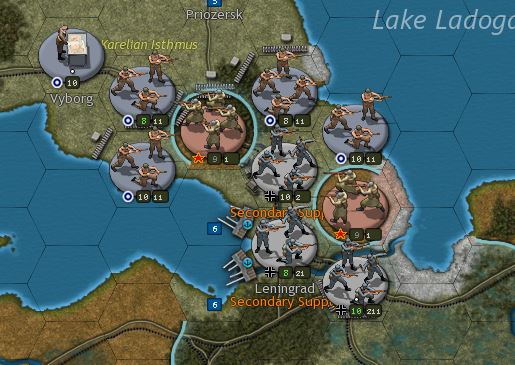
Now I don't know if this matches your example exactly as I just went off of the description, and it could be something else I'm missing without seeing your exact setup, but I did confirm that this worked on the current release version as well as the latest development version I have on my end.
For #3 I quickly tried to re-create the situation you described, one Soviet in an open hex, the other on a forest with a fortification, both surrounded by 3 Axis units, and both units suffered attrition on my end from my test, see below:
Now I don't know if this matches your example exactly as I just went off of the description, and it could be something else I'm missing without seeing your exact setup, but I did confirm that this worked on the current release version as well as the latest development version I have on my end.
Follow us on Twitter: https://twitter.com/FurySoftware
We're also on Facebook! https://www.facebook.com/FurySoftware/
Join our Steam Community:
http://steamcommunity.com/groups/strategiccommand3
We're also on Facebook! https://www.facebook.com/FurySoftware/
Join our Steam Community:
http://steamcommunity.com/groups/strategiccommand3
RE: Understanding Supply
Hubert - thanks for testing this. I repeated my HotSeat experiment a second time and after a few turns I found that the Soviet unit at zero supply on hex 205, 50 started to suffer from attrition. So, assumed the result I reported earlier was the result an odd run of chance.
However, after doing more HotSeat tests to study other supply effects, it seems that attrition kicks in if a unit is at zero supply regardless of whether is adjacent to two enemy units or not, or if those units are at supply level 5 or not. Also, once attrition starts, units seem to suffer from attrition loss every turn until the unit is lost, even when adjacent enemy units move away. This is not what I expected based on the explanation in Section 7.28.2 in the Game Manual. Have the attrition settings been changed in a patch since the Manual was published?
Michael
However, after doing more HotSeat tests to study other supply effects, it seems that attrition kicks in if a unit is at zero supply regardless of whether is adjacent to two enemy units or not, or if those units are at supply level 5 or not. Also, once attrition starts, units seem to suffer from attrition loss every turn until the unit is lost, even when adjacent enemy units move away. This is not what I expected based on the explanation in Section 7.28.2 in the Game Manual. Have the attrition settings been changed in a patch since the Manual was published?
Michael
RE: Understanding Supply
ORIGINAL: BillRunacre
2) Only resources that can trace a route via rail to a friendly Major's Capital/Industrial/Primary can be at full strength. St. John's cannot, and therefore its maximum strength is 5. But it being an Industrial Center allows new Canadian units to be deployed there, should you wish to.
Hi Bill - I have been thinking through the implications of your reply above in terms of the mechanics of the overall game. It does not exactly square with section 7.12.2 in the Manual on Industrial Centers which says "These act as a primary supply source providing supply up to their maximum strength value according their Resource type (usually 10) even if they are cutoff from the Capital". St. John's, since it is located on an island, is always cut-off from both its (minor) Capital in Ottawa or the nearest Major Capitals in London or Washington. Yet it is obviously is not serving as a primary source of supply. I wondered if this was because St. John's is an Industrial Center that belongs to a Minor power.
So, using Hotseat with the Case Blue campaign, I tested out cutting off from supply the only other Industrial Center belonging to a Minor that I could find on the map - Kalamata in southern Greece. In this campaign, Kalamata is an Axis occupied town connected by rail to Athens (its minor Capital) and back to Berlin and has a supply level of 6. I found that if I landed British units on the isthmus of Corinth (hex 191, 108) and cut the rail line this had no effect on its supply, which remained at 6 (and did not drop to 5 as I expected). This is not what happens when other Axis occupied towns are cut-off from a rail connection back to Berlin. So, I guessed this was due to it being an Industrial Center which was serving as its own primary source of supply. However, I was surprised to see that if British units also occupied all the land hexes on the mainland of Greece north of Kalamata, cutting off all overland routes back to Berlin, it drops to supply level 3 (consistent with the last bullet under the supply connection rules under 7.14).
Also, playing around with this scenario, I found that if I cut-off Athens (a city which is a minor Capital) both by rail and by land from the rest of the Axis, it still maintained its supply level of 8. Unlike Kalamata, its supply does not drop to 3 when cut-off by land. Even placing a naval unit against its port has no effect on its supply level. To double-check this result, I then used amphibious invasion to land a British unit in Denmark on hex 167, 68 cutting off the only land connection from occupied Copenhagen back to the rest of the Axis. Same thing - its supply level remained at 8 and did not change, even though it has no land connection at all to a friendly Major's Capital, Industrial Center or Primary Supply Source.
So, can you explain in terms of the rules why Kalamata retains a supply level of 6, even when its rail line is cut back to Berlin, while St. John's stays at 5. And can you explain why these two minor Capitals, even though both were completely cut-off by land, remain at their original supply levels for an occupied city, namely 8? The reason why I am keen to understand these specific cases is to fully understand how the supply connection rules work in practice.
Michael