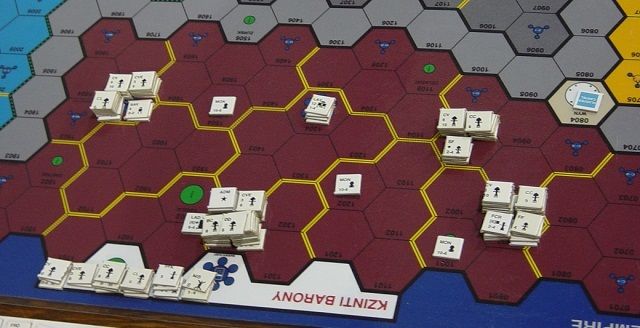
ORIGINAL: Alfred
Before addressing Bullwinkle's suggested options one should look at the overall purpose of fighting in Lower Burma and the present assets (both enemy and Allied) available to meet the preferred outcome.
1. At Rangoon deployed forces are:
Japanese 73k troops (unadjusted AV 3200)
Allied 90k troops (unadjusted AV 3200)
The Japanese have four category 1 divs + 4 category 3 divs (Thai) plus sundry infantry/tank small units that add up to about a single category 2 div. A lot of artillery and engineers are also present.
Allied units are mainly category 1 and 2 divs with only a few category 3 divs.
2. At Pegu deployed forces are:
Japanese 65k troops (unadjusted AV 2000)
Allied 159k troops (unadjusted AV 5550)
The Japanese have 5 category 1 divs.
Almost all of the Allied units are category 3 divs with little supporting units necessary to reduce a fortified position.
3. At Moulmein deployed forces are:
Japanese 24k troops (unadjusted AV 600).
A single category 1 div + a good infantry bde are deployed.
4. All up Japan has 10 category 1 divs, plus about the equivalent of 2-3 category 2 divs, plus 4 category 3 divs in Lower Burma. This means there is no local theatre reserve. No substantial land reinforcements will become available until Java or Chungking fall. By the time that occurs British Empire forces should be on the verge of upgrading to much higher firepower devices which will negate the arrival of "fresh" enemy units.
5. Japan has local air superiority. Three good airbases (Rangoon, Moulmein and Tavoy) provide interlocking air support for Japanese operations. Allied air infrastructure is less developed. There is also a shortage of Allied airframes.
6. Local Japanese naval assets, whilst still potent, are inferior to available Allied naval resources because most of the heavy units are occupied dealing with the situation way over in the Marshall Islands. However, combined with it's control of the air, the Allied naval superiority cannot be successfully brought to play.
7. Local supply sources are insufficient to maintain the large Japanese army (162k troops) and air force deployed to hold the line. It has been a while since I have seen map displaying hexside controls but I doubt that Japan is importing most of its supply from the Chiang Mai railhead. Much more likely is that supply, under the cover of it's air force, is being shipped in to Rangoon.
8. The basic Allied strategy since 8 Dec 1941 has been to bleed enemy fuel stocks dry by early 1943. Operation FUDD was a great strategic success because it ensured denial of the substantial Magwe oil and fuel assets to Japan. It was also a tactical success as evidenced by the fact that the current supply shipments to Rangoon are economically not profitable to Japan because there is no fuel to either replenish the ship bunkers locally or to ship back to the industrial centres on the return leg. There is a steady bleeding of the pre war Japanese fuel stockpile, compounded by not yet having the large Palembang and Java oil fields/refineries.
Bullwinkle has posited the following options:
(A) withdraw both investing forces at Rangoon and Pegu to the nearest Allied bases
(B) as either force at Rangoon and Pegu is currently inadequate to achieve it's objective, concentrate forces at Rangoon with a view to capturing that base
(C) remain in situ with an eye towards maintaining the logistics and airframe drain on Japan
(D) launch one attack and then retreat
(E) move most of the Pegu army to capture the Moulmein air field which is the key to enemy air operations
(F) move most of the Pegu army to capture the Chiang Mai railhead
Some of these options are consistent with the basic Allied strategy employed to date; some are not.
Option (D) is by far the worst. It is not consistent with the fundamental Allied strategy, will not achieve any tactical benefits and will just gut the Allied armies.
Option (A) removes the pressure on Japan. It is the second worst option whose only merit is if Bullwinkle is finding it impossible to feed his two advanced armies. Even then the retreat would have a faint ring of the retreat from Moscow as the enemy air force pounds the units both on the retreat and once they reach Bassein/Prome and Toungoo.
Option (B), which is Bullwinkle's preferred option, suffers from 3 key elements:
(i) the shifting of category 3 divs to Rangoon is unlikely to overcome the Japanese fortification and terrain benefits (plus any matching shifting from Pegu by Japan too)
(ii) time will be wasted as the reinforcing Chinese change their objective and it climbs towards the 100 mark
(iii) does nothing to neutralise the key Japanese asset which is holding the position together (viz the air force) or bring into play additional Allied assets (viz the navy)
Essentially this option is merely trying a bigger hammer to knockdown the front door. The odds for success are poor.
Option (C) is OK but does represent a lost opportunity. The Allied flak will continue to exact it's pound of flesh wherever the army is, be it at Pegu or en route to another destination.
Option (F) would be good if, if, if Rangoon is importing it's supplies from there. I don't think it is. Chiang Mai would still be a good move if it was part of a general move into Thailand, but that is not the case here whilst the key port for such an invasion, Rangoon, remains enemy controlled. Chiang Mai is therefore a side show. Which brings us to Option (E)...
Striking at Moulmein is good. The Tavoy airfield is not a sufficiently good airfield, both in terms of size and location, to fully compensate for the loss of Moulmein. Capture Moulmein and the short range Allied fighters can be brought into play to both confront the current enemy CAS and open up the possibility of deploying Allied naval assets to interdict supply or bombard the Rangoon located enemy air force/army. It opens a port to resupply the Allied army which can move on Tavoy whilst threatening an invasion of Thailand. It outflanks the main enemy forces and exposes the lack of an enemy theatre reserve.
Just don't rely solely on releasing units from the Pegu investment forces if you move on Moulmein. Thin out the Rangoon forces too which can take advantage of the terrain there to have fewer troops present than the enemy. Plus if you thin out the Pegu forces you encourage the enemy to attack the Chinese who are best used holding a defensive position.
Alfred
This is the kind of structured analysis I strive for, but don't achieve.
Alfred is quite correct that it is the air forces which are stopping the Allies from making progress. Although this effort is costing him hundreds of planes, much HI, and many pilots it is also costing me British and Indian devices which I can't replace. Overall though the battle is eating up calendar and stopping Japan from accessing the petroleum in Burma, which is the whole idea really.
My concern about Chiang Mai is mostly the RR being used to get LCUs north from Bangkok, not so much supply. However, I have only seen the LCUs which were already there move west to Moulmein. There may be more down south, but probably not much more given the size of the stacks at Rangoon/Pegu as well as Chungking.
Supply is not good, as shown in the Tracker screens. I hope to improve it in the next week to ten days. It's not low, but it's not at a level I can attack on many days in a row.
Moulmein will be next effort. That air field is the linchpin. I need to carefully allocate Chinese forces to move there while not making Pegu so weak the remainders there can be routed and retreated. Even if I get Moulmein I don't have fighters enough to bring the RN in close to stop supply convoys to Rangoon. Not yet. I can snipe at them from Port Blair as they pass, but not much else. Subs too of course. Colombo is a major sub base now, with a lot of USN fleet boats as well as Dutch/RN.
Per Alfred's point about moving some of the Rangoon stack to help at Moulmein, I will do that, but the Rangoon stack is brittle. I have some theater reserves heading there from Prome, but after that the cupboard is pretty bare. The Mandalay area is mostly being held by base forces.
If I could take Moulmein then the possibilities are much wider, as Alfred says. If he thins Rangoon at all I will pounce. The central Burma, northern Thailand bases are not defended. Bangkok reserves, if any, would probably have to be moved north. I need to be careful about the Indo-China border for four more months until the militia division activation rule fades. But there is plenty to do outside Indo-China.
To answer Alfred's other question in the follow-on post: I have used Reserve a fair bit in both stacks. So far as I know Reserve does not protect from air attack, which is what's killing me. It does seem to lower disruption quickly and protects from ground bombardment.