T59: 30 July – 5 August 1942: “The Thunders Gossiped Low”
If the end of July saw the first slackening of the main German offensive, it also saw fighting along the great arc around Moscow from Kalinin to the lower reaches of the Khoper river. For the first time each German push was met by a Soviet response as Stavka committed fresh reserves in an attempt to slow their offensive.
North of Moscow, the German 42 Infantry corps briefly retook Klin, leaving the small town in flames.

(Klin after it had changed hands yet again)
However, after the suspension of the last Soviet attack towards the Larna, they had pulled away their Panzer reserves. Taking advantage, 4 Shock Army struck the unwary 206 Infantry division near Bultschewo. After several major air raids, 150,000 men backed by over 2000 guns adeptly broke through the multiple German trench lines. Lacking any reserves, the Germans fell back.

South of Tula, the German 13 Infantry Corps forced the line of the Don creating a dangerous bridgehead in the heart of Leningrad Front's defensive lines. At the same time their 59 Infantry Corps pushed back elements of the Bryansk Front between the Voronezh and Don rivers.

Of concern, Soviet reconnaissance indicated a substantial armoured build up on the Mecha, indicating that these attacks were probably the preliminary stage of a new major offensive.
However, for the first time their infantry moved beyond their entrenchments and were exposed to a surprise attack. Leningrad Front struck with ferocity. 1 and 2 Shock Armies were drawn from reserve, reinforced by the tanks of 41 Army, hit the German bridgeheads. By the time Stavka called off the offensive, the east bank of the Don was back in Soviet hands and elements of 7, 13 and 20 Infantry Corps had been badly mauled.

Supporting attacks by Western Front to the north and Bryansk Front to the south also drove in over-confident German infantry.
Finally, at Tambov, the Germans attacked again and 14, 46 and 48 Panzer re-established the pocket and encircled fresh Soviet units.

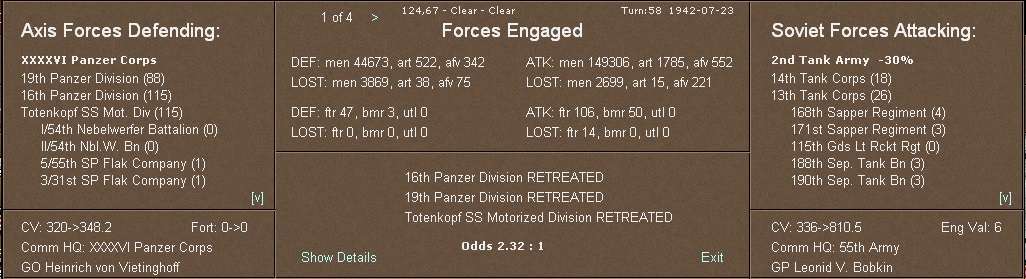
This time the Voronezh Front shifted tactics. Unable to break the pocket directly, the counter-attack fell on German units around Rshaksa. The opening attack was launched by 9 Army to the south and had the effect of drawing off the only German reserves.
With that 1 and 3 Tank and the infantry of 46 Army first overran 46 Panzer Corps and then the now exposed infantry of 29 and 44 Corps.


(T-34s in action near Rtshaksa)
Having delivered a substantial blow, the bulk of the Soviet forces disengaged and fell back behind the Vorona.
However, Stavka did not believe that one week of successful localised counter-attacks meant the Germans had been stalled. Orders were sent to Leningrad, Stalingrad and Bryansk Fronts to fall back as there was a fear that the German armour to the west of Leningrad Front and around Tambov would try to pull off a major pocket.
Beyond mere tactical adjustments, Stavka started to send out orders for a major redeployment as the Summer battles reached crisis point. Held back, for the moment, was any reintroduction of the no retreat orders. Equally, a plan was slowly being developed that might catch the Germans badly off balance as all their armour was increasingly committed to the depths of Central Russia.
OOB

In terms of quantity my army is holding up despite the losses since this offensive started. The problem of course is partly that the quality is declining and that I am having to use my small number of elite formations if I want to attack (as in this turn). So they are picking up fatigue and slowly falling into pockets in turn as the Germans press on.
In terms of Gds formations, after those battles I have 6 infantry corps but have lost 2 of my Gds Cavalry Corps (and a rifle corp) around Tambov. I have Il-2 squadrons reaching Gds status on a regular basis now.