The Great Patriotic War (loki100 vs SigUp) ... SigUp welcome to read

Post descriptions of your brilliant victories and unfortunate defeats here.

Moderators: Joel Billings, Sabre21

User avatar
loki100
Posts: 11708
Joined: Sat Oct 20, 2012 12:38 pm
Location: Utlima Thule

RE: T47-T50 (7 May - 3 June 1942)

Post by loki100 »

ORIGINAL: Pelton

ORIGINAL: M60A3TTS

The Luftwaffe lost air superiority on all fronts by the end of the war.

Yes, but not in 42 or 43.

Which we know can easly happen without house rules.

unhistorical.

all in all sounds a lot better, at this stage in the war all the VVS could do was not to lose air superiority unless the Germans really put in a sustained effort. The Voronezh battles at the start of Blau are informative in that the VVS just could manage even a semblance of resistance due to the concentration of German airpower.

It wasn't till Kursk that they could actually stand toe to toe with the Luftwaffe ... at the cost of horrendous losses but the Germans never gained air control - either offensive or defensive - in 1943, if the Soviets were prepared to match them.

Be interesting to see the impact of more AA generated attrition. SigUp seems to have spent a lot of time making sure each of his Pzr divisions has attached AA and that is already causing me rather painful losses.
User avatar
loki100
Posts: 11708
Joined: Sat Oct 20, 2012 12:38 pm
Location: Utlima Thule

T54: 25 June – 1 July 1942

Post by loki100 »

T54: 25 June – 1 July 1942: “I like a look of Agony”

The final week of June saw the return of sweeping mobile warfare. No longer were gains or losses counted in kilometres as both sides struggled for small advantage on a narrow front. This time the German spearheads struck 150 km deep into Southern Russia breaching the middle section of the Don.

Image
(this is before my recon and response)

Stavka had been misled by the apparent build up at Tula as it became clear, that at least 6 Pzr Corps and 4 Infantry Corps had been rapidly deployed behind the Aidar. The resulting Derkul pocket trapped 9, 18 and 54 armies and portions of 61 Army.

Image
Soviet troops in the Derkul pocket await their fate

While their opening blow may have fallen on an unexpected sector, Stavka had the reserves to recover. Southern Front's 16 and 38 Armies fell back behind the Don and South West Fronts 12 Army deployed to guard the Don crossings at Svoboda. Soviet positions to the north of the main spearhead were rapidly filled out by reinforcements from Stavka Reserve including armour and units of the newly raised Voronezh Front.

Image
Tank crews digging in to their new positions

The Khoper was covered by a hastily organised operational group drawn from the reserves at Saratov. To the south, the Trans-Caucasus Front's 60 and 40 Armies took up a defence line along the Chir and Tsymla rivers while 61 Army held the old positions protecting the Donets crossings. Further reserves, released from the Caucasus were added to the formations in the Stalingrad sector.

Image

Although the Germans had spotted and exploited one of the weak links in the Soviet defences, they had also committed the bulk of their armour to a sector with poor communications and supply lines. Reconnaissance indicated that one Panzer army was embroiled in the Larna battles and another still in reserve around Orel.

To Stavka, it was clear that gaining control of the Don crossings at Svoboda and the rail from Bobrov to Talovaya were critical if they were to be able to sustain their offensive.

Image

Given the gap between the armour and their infantry support, it was estimated that it would take 3-4 weeks for the Germans to eliminate the Derkul pocket and be able to support the German armour. This presented a vital chance for the Soviets to regain their balance and to make the German Panzers pay a high price for their gains. Even as fresh formations moved into the Bobrov-Borisoglebsk defence line the VVS struck the first counterblow.

Given the importance of preventing the Germans reinforcing their offensive, it was decided to maintain the Yaroslavl offensive. 52 Army quickly occupied positions the Germans had abandoned on the south side of the Volga reservoir and 4 Shock pushed towards the Lama even as fresh reinforcements were moved up. The VVS continued to pound the German front line and identified reserve formations.

Image

The possibility of an offensive in the Tula sector was discussed, but for the moment, Stavka wanted to keep those reserve formations available in case they were needed in the South.

Both sides suffered heavy losses. The Germans lost nearly 5,000 men, 35 tanks and 110 planes. Soviet losses were just under 45,000 men, 100 tanks and 270 planes.
jwolf
Posts: 2493
Joined: Tue Dec 03, 2013 4:02 pm

RE: T54: 25 June – 1 July 1942

Post by jwolf »

No more boring mud turns now, that's for sure. [:)]

I'm very interested to see how this offensive will play out.  I think you're right that the RR crossing at Svoboda is key (assuming the Germans don't just capture Voronezh itself outright).  The German units across the Don are indeed in a supply dead zone as you said.  But I assume they were well topped off with fuel for at least one more turn.  They'll need infantry support pretty soon and the question is how fast SigUp can get some infantry over the river.  I think he can clean out all or nearly all of the pocket in one turn, but that would commit all his infantry in the area.  In any case, your title "I like a look of agony" is certainly appropriate.
User avatar
loki100
Posts: 11708
Joined: Sat Oct 20, 2012 12:38 pm
Location: Utlima Thule

RE: T54: 25 June – 1 July 1942

Post by loki100 »

ORIGINAL: jwolf

No more boring mud turns now, that's for sure. [:)]

I'm very interested to see how this offensive will play out.  I think you're right that the RR crossing at Svoboda is key (assuming the Germans don't just capture Voronezh itself outright).  The German units across the Don are indeed in a supply dead zone as you said.  But I assume they were well topped off with fuel for at least one more turn.  They'll need infantry support pretty soon and the question is how fast SigUp can get some infantry over the river.  I think he can clean out all or nearly all of the pocket in one turn, but that would commit all his infantry in the area. 

In an odd way its nice not to be looking at the same area of the map all the time. I'm really not sure how effective this choice was, the conservative version would have been to take out my forces west of the Don and then stop and reassess. I think that SigUp really needs to get that rail junction or will have problems, but then I've been surprised before at his very methodical planning for big operations.

My logic for the infantry is it'll take one turn (maybe a bit more) to clear out the pocket, one turn up to the Don, one to cross it, thats quite a long time for the Pzrs to operate in an exposed position with dodgy supply lines - I must confess I'm drawing some hope from 821Bobo's current battles in a similar sector - realise that is happening a bit later in the year.

I think he potentially has one Pzr army/3 mot/pzr corps uncommitted. I'm assuming one Pzr Army, presumably the one that starts with AGN (4 Panzer?) is tied up in my activities on the Lama. I'm not sure what a single Pzr Army can do, guess it could try to force the Don around Voronezh, but there are some nasty surprises lurking around there.

Equally, while I'd rather sit back, if he weakens the Moscow - Orel defense I'm in a position to take some advantage. I'm not keen on spending too many APs on Inf Corps this early, but I have formations like and 1 and 3 Shock there that would give me very strong line rifle corps and with component divisions that would convert to Gds after a couple of victories.
ORIGINAL: jwolf
In any case, your title "I like a look of agony" is certainly appropriate.

ah, the Empress of gloom, Emily Dickinson. If you ever need a depressing line you can find it somewhere in her works. She wrote the classic line of regret for something you have done (and know there is no way to make up for it) ... "good morning midnight, I'm coming home" ... the rest of that poem being equally grim.
jwolf
Posts: 2493
Joined: Tue Dec 03, 2013 4:02 pm

RE: T54: 25 June – 1 July 1942

Post by jwolf »

I think you're counting on too many turns for his infantry before they'll join their armored brothers along or across the Don.  But it should make for an exciting period in the war for us armchair generals on the sidelines.  [:)]  My only regret is that SigUp is still in early spring in his AAR so I can't get his take on this critical part of the war or at least not at the same time.
User avatar
loki100
Posts: 11708
Joined: Sat Oct 20, 2012 12:38 pm
Location: Utlima Thule

RE: T54: 25 June – 1 July 1942

Post by loki100 »

ORIGINAL: jwolf

I think you're counting on too many turns for his infantry before they'll join their armored brothers along or across the Don.  ....

My logic is that to get across behind Boguchar, they need one turn to reduce the pocket, its about 10 hexes then to the Don so that is another and the turn they cross the Don they won't get much further?

I'm expecting some pressure between Svoboda and Voronezh next turn, he is close enough for infantry to move up and attack?
User avatar
Peltonx
Posts: 5814
Joined: Sun Apr 09, 2006 2:24 am
Contact:

RE: T54: 25 June – 1 July 1942

Post by Peltonx »

Infantry will get close to 16 Mp's withen 10 hexes of railheads.

As long as GHC is withen 20 hexes of a rail head they will have 30-35 MP's.

Fuel drops will keep MoT units about 20 past 20 hexes and if he was smart
he would have hold one PZ Corp withen HQBU range so he could follow up his
first thrust with a 2nd.

Skilled GHC players generally will have 3 PZ Corp ( 1 all MoT) punch a hole, with several high morale inf Corp push through
and 1 PZ Corp in reserve that does a HQBU the turn of break though.

Turn 1 3 PZ Corp punch hole, one pz Corp does HQBU and fuel drops to MoT Corp.
Turn 2 MoT and reserve Corp at full MP's, the 2 low MP Corp widen flanks and push some, high morale infantry move up supporting flanks and finally the 2 high MP pz Corp push deeper east.

Not sure if he was set up right but if he was you be toast at this pt.
Beta Tester WitW & WitE
User avatar
loki100
Posts: 11708
Joined: Sat Oct 20, 2012 12:38 pm
Location: Utlima Thule

RE: T54: 25 June – 1 July 1942

Post by loki100 »

ORIGINAL: Pelton

Infantry will get close to 16 Mp's withen 10 hexes of railheads.

As long as GHC is withen 20 hexes of a rail head they will have 30-35 MP's.

Fuel drops will keep MoT units about 20 past 20 hexes and if he was smart
he would have hold one PZ Corp withen HQBU range so he could follow up his
first thrust with a 2nd.

Skilled GHC players generally will have 3 PZ Corp ( 1 all MoT) punch a hole, with several high morale inf Corp push through
and 1 PZ Corp in reserve that does a HQBU the turn of break though.

Turn 1 3 PZ Corp punch hole, one pz Corp does HQBU and fuel drops to MoT Corp.
Turn 2 MoT and reserve Corp at full MP's, the 2 low MP Corp widen flanks and push some, high morale infantry move up supporting flanks and finally the 2 high MP pz Corp push deeper east.

Not sure if he was set up right but if he was you be toast at this pt.

yep, that is a pretty accurate summary, add to which 10% of my front line strength evaporated and we get the next update ...
User avatar
loki100
Posts: 11708
Joined: Sat Oct 20, 2012 12:38 pm
Location: Utlima Thule

T55-56: 2 - 15 July

Post by loki100 »

T55-56: 2 - 15 July: "Midsummer ... in the Mind"

The start of July saw political and military disasters that rivalled the losses of 1941. The bulk of 4 armies were destroyed in the Derkul pocket and this was followed by the loss of most of 16 Army that had fallen back across the Don. In 2 short weeks, 3 armies of the Southern Front had been destroyed and 2 from the Trans-Caucasus Front badly damaged.

Worse was the political damage and the resulting implications. The Derkul region had been the last corner of the Ukraine held by Soviet forces, so the Soviet state was reduced to holding the centre of Russia itself with the long line of the Volga now threatened by the Germans [1].

Image
(read as: We must defend the Mother Volga – historically one of the Stalingrad posters but it seems to fit this situation)

Losses in the two encirclements, plus massive desertions saw the Red Army lose almost 10% of its effective forces, as Stavka struggled to find a new defensive line [2].

Image

This gives some idea of how much I've just had to give up to try and recover manpower. As below, SigUp suspended his offensive for one turn which is quite a loss to him given the relatively short period he has in the Summer of 1942 to inflict real damage.


[1] – in reality the loss of direct control over the Ukraine was one of a number of reasons why Soviet morale fell apart in the Summer of 1942, it also offers a way to rationalise the consequences of the new patch.
[2] – SigUp agreed not to attack on T56 as I had to pull back radically in an attempt to recover the strength of my units that had been in contact. Of importance, I've had to stop trying to contest the rail line at Bobrov, which I think was my last chance to ensure his crossing of the Don was hampered by poor supply.

Comments;

The new patch is great but be careful about applying it to an active phase of the war. The key problem is that it vastly improves the swapping routine, removing a lot of stuff and updating with better versions, but at the moment units in contact can only grow to 60% of TOE. Even with a turn of no fighting, my front line strength has dropped from 8,000,000 to 7,300,000 and then back to 7,500,000. Of these, roughly 430,000 are combat losses, but I recruit 100,000 men a turn so my numbers should be around 7,750k-8,000k. There is a post in the 1.08 discussion thread that shows this in more detail.

The good thing is that it has removed some older stuff from my TOEs to replace them by more modern weapons sitting in my production pools, such as

Image

Image
(this shows a T-70 undergoing field repairs, I like it that almost everyone is carrying out a highly technical repair task, apart from the bloke with the big hammer – especially given how light the armour was on the T-70).

Attachments
mainmap.jpg
mainmap.jpg (1.41 MiB) Viewed 515 times
User avatar
M60A3TTS
Posts: 4866
Joined: Fri May 13, 2011 1:20 am

RE: T55-56: 2 - 15 July

Post by M60A3TTS »

If there is a way to do it, and SigUp would agree, I'd look to restore your NM setting from 95 to 100. A 38 base morale is just brutal now.
User avatar
loki100
Posts: 11708
Joined: Sat Oct 20, 2012 12:38 pm
Location: Utlima Thule

RE: T55-56: 2 - 15 July

Post by loki100 »

ORIGINAL: M60A3TTS

If there is a way to do it, and SigUp would agree, I'd look to restore your NM setting from 95 to 100. A 38 base morale is just brutal now.

I'm not sure you can change the settings in a MP game? Its a pity as that 95% proved to be a good choice in the first phase of the game - I think it mitigated the worst impact of the +1 rule and kept the game mobile when its common to see things bog down. Problem is since, its one reason for my too limited winter offensive but the impact now is horrible. Also between October and now, I've not won a single defensive battle (so for some time the +1 was masking the very worst effect on the offense)

Most of my rifle divs were already around 42-43, they are starting to reduce towards 40-41 and already if they pick up any fatigue it is harming their cv. My only solution is to raise all new units as rifle brigades, but that means it take 4-5 turns longer before they represent a fully formed up division rather than if I was raising new divisions directly (roughly 4-5 turns to fill out as a brigade plus 2-3 to then take on the additional equipment and men to make a division), and of course they start losing morale quickly.

I fear that losing the ability to fight south of Voronezh is going to be fatal. Its not that I expected to win that phase but it should have left him with marginal supply well into August. Also I'm fully aware that there are walls of level 3 forts behind every river if, by some chance, I do survive. So must confess at this stage my own morale too has dropped.

Wuffer
Posts: 402
Joined: Thu Jun 16, 2011 7:08 pm

RE: T55-56: 2 - 15 July

Post by Wuffer »

"So must confess at this stage my own morale too has dropped."
Not really surprising, 95 morale = 100 % mortal

At least, you found the automatically 'I loose'-button :-)

sry, Loki, I hope you understand: don't take it too serious, just a game with crazy settings
User avatar
loki100
Posts: 11708
Joined: Sat Oct 20, 2012 12:38 pm
Location: Utlima Thule

RE: T55-56: 2 - 15 July

Post by loki100 »

ORIGINAL: Wuffer

"So must confess at this stage my own morale too has dropped."
Not really surprising, 95 morale = 100 % mortal

At least, you found the automatically 'I loose'-button :-)

sry, Loki, I hope you understand: don't take it too serious, just a game with crazy settings

well our goal was to dampen down what we felt were the two worst flaws in the game, the +1 for the Soviets and the permissive logistics (for both sides, but the Germans in 1941).

I think that Soviet morale should, as it did, nosedive in the summer of 1942. Not only realistic but it may stop some of the more obsessive axis play based around a perceived need to win in 1941 ... 1942 should be the critical phase.

Problem is the shifts in the patch have hit our game at a bad phase, but SigUp still has to solve the logistics problem before he can move onto a knock out blow.
User avatar
loki100
Posts: 11708
Joined: Sat Oct 20, 2012 12:38 pm
Location: Utlima Thule

T57: 16-22 July

Post by loki100 »

T57 16-22 July "Red – Is the fire's common tint"

The fourth week of the German offensive on the Don saw substantial elements of 47 and 5 Armies trapped around Voronezh. After the heavy losses inflicted on Southern Front in previous weeks, this time the blow had fallen on the Stalingrad Front.

Image

Image
(hasty Soviet ambush near Voronezh)

However, Stavka had not been idle in the previous weeks. Abandoning Tula and pulling back the front by 30 kms had been painful but had freed up substantial mobile reserves. Equally, almost every operable VVS squadron was pulled from reserve or training and thrown into the battle [1]. Given the nature of the German victories it was essential that they were prevented from driving either towards the Volga or to try to cross the Oka to the east of the Moscow defences.

The first step was to see the VVS try to wrest control of the airspace from the Luftwaffe. The result was intense air combat as both sides committed the bulk of their fighters to try and stop ground attacks. By the end of the week, the Germans had lost 130 aircraft and the VVS 410. However, critically, Soviet bombers managed to hit all their targets including the German front line formations and their logistics network [2].

In reward, the 19 BAD of 8 Air Army was awarded Guards status [3]

Image

An ad-hoc force of the fresh tank corps and cavalry corps hit their positions around Dobrinka.

Image

After 4 days of exceptionally heavy fighting elements of 3 German Panzer Corps had been driven back 10-20 kms. Three of their Panzer divisions had borne the brunt of the offensive, 3rd Panzer had lost 81 tanks, 18 Panzer had lost 21 and 14 Panzer 43.

Image
(Soviet cavalry trying to cut off the retreat of 3 Panzer)

For the first time since the Dniepr battles in 1941, Soviet armour had been committed to an offensive in its right rather than as a support arm. However, Soviet tankers had paid a terrible price for this baptism of fire with 580 tanks knocked out. Of these 80% were either T-60s or T-70s.

Image
(T-34 from 41 Army moving past a shattered German AT position)

To place the Germans under even more pressure, the hastily rebuilt Southern Front attacked along the line of the Khoper assisted by Trans Caucasus Front's 60 Army. For the survivors who had escaped the Derkul cauldron, even such limited gains raised morale even as fresh forces filled in to hold the vital Volga valley.

Image

OOB and comments

My only realistic goal from now to the end of September is to survive, the regular infantry divisions are going to become increasingly useless (most are around 40-41 as of now). But I think with the Gds, Tank and Cavalry Corps I can do some damage and keep SigUp from pushing too carelessly. If I lose a significant chunk of those in a pocket then I am in real trouble. My basic plan as of now is to produce the equivalent of 5 rifle divisions (10 brigades = 50 admin pts) per turn. That is less than my current losses but if I can keep above an army of 7 million then I think I can pull off some attacks on quiet sectors. Building as brigades takes longer, but has the advantage that the division starts at 50 morale when fully formed.

For the OOB, after two turns with the patch, I'm at 7.76m (so down from just over 8m 3 turns back) and have a manpower reserve of 250,000. I add about 90,000 a turn but lose about 15,000 a turn to attrition. I have lost 370,000 surrendered since 25 June.

One other patch related observation, net German losses are dropping as it looks like his disabled pool reduces by around 2,000 per turn.

Image

Image


[1] In consequence, my truck demand is hugely above my supply for the first time.
[2] I've been going for the FBD formations, not sure if killing them off slows their ability to repair rails or not, but there is something satisfying at seeing such direct losses for the effort.
[3] Learnt this trick from Oshawatt, previously I've spread the tactical bombers out but it is more efficient if they operate from a few bases. The bulk of the damage was done by the Il-2s but the relentless U2 campaign is also paying off.

User avatar
loki100
Posts: 11708
Joined: Sat Oct 20, 2012 12:38 pm
Location: Utlima Thule

T58 23-29 July 1942

Post by loki100 »

T58 23-29 July "With hammer, and with blaze"

The fifth week of the German summer offensive saw the loss of Tula, Lipetsk and the destruction of the forces trapped around Voronezh.

Image
More Soviet POWs taken at Voronezh

With their hold on the Don consolidated, they struck towards Tambov, encircling some elements of 34 and 41 Armies that had advanced around Dobrinka.

Image

In desperation, Stavka assembled an offensive force based around 55 Army but including elements of the new Tank Armies under the operational control of the Voronezh Front.

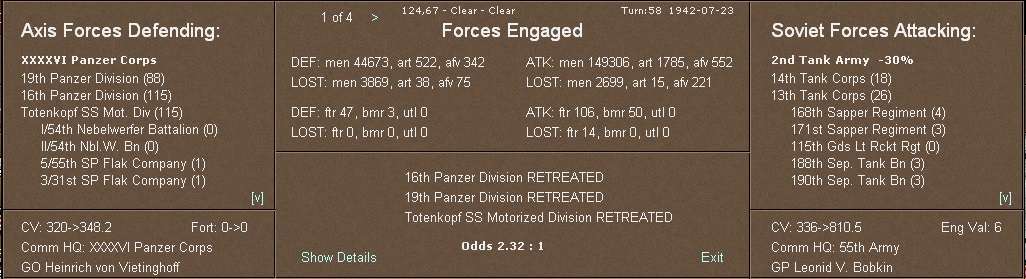
In combination almost 150,000 men hit the advanced formations of 46 Panzer Corps opening the pocket.

Image

As the Germans retreated, Voronezh Front's 58 and 2 Tank Armies tried to cut them off inflicting further damage [1]

Image

However, these limited gains did little to stabilise the front or to bring the Germans to a halt. 6 Panzer Corps formed the north and east side of the German bulge. Reconnaissance flights suggested that some German armour remained in the Don bend and in support of the German lines facing Moscow and advancing past Tula.

Image
KV1 destroyed in the Dobrinka battles

However, it seemed possible that 2 additional Panzer formations were unaccounted for.

Image

In response, Stavka pulled Stalingrad and Bryansk Fronts back to a line along the upper Voronezh to Tambov, Voronezh Front held the gap between the Tsna and Vorona rivers while Southern Front screened the Vorona, upper Khoper and the rail junction at Borisoglebsk. None of these defensive lines was expected to hold and increasingly the few elite and mobile formations were being drawn into the battle leaving Stavka with no effective reserves.

OOB and Discussion

Image

I've not been able to sustain the commitment of the VVS due to lack of supply. Actually I've never before seen what amounts to a global supply shortage on these terms so wonder if its patch related?

Anyway, in response almost all the level bombers and transports are back in the national reserve and I've removed most of the LaGG-3 squadrons. The latter are starting to take heavy losses so if I need to conserve supply they are not the most effective use of resources.

This should, hopefully, improve the supply and truck constraints even if the ability to bomb more or less at will has been useful in the recent turns.

Compared to last turn, my manpower is down 20,000, guns are down 500 and tanks up by 200. For the Germans, their manpower is down 10,000, guns are down by 100 and tanks much the same.

In terms of resources, my manpower is down 30,000 (so a net loss of 50,000 as some move from the pool to on map units), trucks are up by 2,000 (so problem is demand not supply) and armaments down by 17,000.

Critically the Germans are now only 26 VP from an automatic victory.

In the German combat phase I lost 30/30 combats, in mine I won the two I made (but I used mostly Guards, Tank and Cavalry Corps). All this of course adds to the fast worsening morale differential as many of my rifle divisions are in the range 38-41. The few over 45 are recent converts from rifle brigades. I hate to think what the German morale range is with so many relatively easy victories.


[1] one of those weird retreats you sometimes see, they ended up on my side of the river Karachan and formed a much too tempting target to miss out on.
jwolf
Posts: 2493
Joined: Tue Dec 03, 2013 4:02 pm

RE: T58 23-29 July 1942

Post by jwolf »

That's starting to look a little desperate. If SigUp can take the Moscow area during the rest of the summer he would be right on the brink of victory. I have to wonder if converting to 1.08 in the midst of the game was a mistake.

BTW I just about fell out of my chair at the pic of the German "POW" near Voronezh. Between that and the pic of the partisan milkmaid I'm not sure which is my favorite now.
User avatar
loki100
Posts: 11708
Joined: Sat Oct 20, 2012 12:38 pm
Location: Utlima Thule

RE: T58 23-29 July 1942

Post by loki100 »

ORIGINAL: jwolf

That's starting to look a little desperate. If SigUp can take the Moscow area during the rest of the summer he would be right on the brink of victory. I have to wonder if converting to 1.08 in the midst of the game was a mistake.

BTW I just about fell out of my chair at the pic of the German "POW" near Voronezh. Between that and the pic of the partisan milkmaid I'm not sure which is my favorite now.

I think the unknown balancing issue is whether logistics at 90% means he has to be too cautious/constrained to take full advantage.

With hindsight it wasn't the brightest idea to switch but if we waited for the late 42 mud season then I would have been the main beneficiary of the shift (well ok the axis would have gained a little from the improved swap rules) so this seemed to be the last chance to share advantages and disadvantages. The real problem was it wrecked my chance to make him fight for a couple of turns in the supply blackspot behind Bolguchar. That was part of the reason why I hadn't bothered to cover the Don crossings in that sector. But really as in the comment above, I'm in a pretty huge hole, but it may just be that SigUp lacks the logistics to take full advantage (remember we are both at 90% in that respect).

The camel pictures came out of some research I was doing into an unsubtantiated claim that the 120 Gds Rifle Division adopted a camel at Stalingrad and it went with the division all the way to Berlin. It apparently (and I assume the poor beast was utterly traumatised) knew to take shelter under artillery fire or air attack. Vasily Grossman makes some reference to it in his newspaper articles covering the Bagration offensive.
User avatar
loki100
Posts: 11708
Joined: Sat Oct 20, 2012 12:38 pm
Location: Utlima Thule

T59: 30 July – 5 August 1942

Post by loki100 »

T59: 30 July – 5 August 1942: “The Thunders Gossiped Low”

If the end of July saw the first slackening of the main German offensive, it also saw fighting along the great arc around Moscow from Kalinin to the lower reaches of the Khoper river. For the first time each German push was met by a Soviet response as Stavka committed fresh reserves in an attempt to slow their offensive.

North of Moscow, the German 42 Infantry corps briefly retook Klin, leaving the small town in flames.

Image
(Klin after it had changed hands yet again)

However, after the suspension of the last Soviet attack towards the Larna, they had pulled away their Panzer reserves. Taking advantage, 4 Shock Army struck the unwary 206 Infantry division near Bultschewo. After several major air raids, 150,000 men backed by over 2000 guns adeptly broke through the multiple German trench lines. Lacking any reserves, the Germans fell back.

Image

South of Tula, the German 13 Infantry Corps forced the line of the Don creating a dangerous bridgehead in the heart of Leningrad Front's defensive lines. At the same time their 59 Infantry Corps pushed back elements of the Bryansk Front between the Voronezh and Don rivers.

Image

Of concern, Soviet reconnaissance indicated a substantial armoured build up on the Mecha, indicating that these attacks were probably the preliminary stage of a new major offensive.

However, for the first time their infantry moved beyond their entrenchments and were exposed to a surprise attack. Leningrad Front struck with ferocity. 1 and 2 Shock Armies were drawn from reserve, reinforced by the tanks of 41 Army, hit the German bridgeheads. By the time Stavka called off the offensive, the east bank of the Don was back in Soviet hands and elements of 7, 13 and 20 Infantry Corps had been badly mauled.

Image

Supporting attacks by Western Front to the north and Bryansk Front to the south also drove in over-confident German infantry.

Finally, at Tambov, the Germans attacked again and 14, 46 and 48 Panzer re-established the pocket and encircled fresh Soviet units.

Image

This time the Voronezh Front shifted tactics. Unable to break the pocket directly, the counter-attack fell on German units around Rshaksa. The opening attack was launched by 9 Army to the south and had the effect of drawing off the only German reserves.

With that 1 and 3 Tank and the infantry of 46 Army first overran 46 Panzer Corps and then the now exposed infantry of 29 and 44 Corps.

Image

Image
(T-34s in action near Rtshaksa)

Having delivered a substantial blow, the bulk of the Soviet forces disengaged and fell back behind the Vorona.

However, Stavka did not believe that one week of successful localised counter-attacks meant the Germans had been stalled. Orders were sent to Leningrad, Stalingrad and Bryansk Fronts to fall back as there was a fear that the German armour to the west of Leningrad Front and around Tambov would try to pull off a major pocket.

Beyond mere tactical adjustments, Stavka started to send out orders for a major redeployment as the Summer battles reached crisis point. Held back, for the moment, was any reintroduction of the no retreat orders. Equally, a plan was slowly being developed that might catch the Germans badly off balance as all their armour was increasingly committed to the depths of Central Russia.

OOB

Image

In terms of quantity my army is holding up despite the losses since this offensive started. The problem of course is partly that the quality is declining and that I am having to use my small number of elite formations if I want to attack (as in this turn). So they are picking up fatigue and slowly falling into pockets in turn as the Germans press on.

In terms of Gds formations, after those battles I have 6 infantry corps but have lost 2 of my Gds Cavalry Corps (and a rifle corp) around Tambov. I have Il-2 squadrons reaching Gds status on a regular basis now.
jwolf
Posts: 2493
Joined: Tue Dec 03, 2013 4:02 pm

RE: T59: 30 July – 5 August 1942

Post by jwolf »

I have to admit I'm more optimistic about your situation after that move. Those attacks hurt the Germans a lot. The key is if you can prevent them from forming a really significant pocket, and on that count I just don't know. Great writeup as usual.

Judging from the picture of Klin, it really wasn't worth anyone's bother trying to take it.
swkuh
Posts: 1034
Joined: Sun Oct 04, 2009 9:10 pm

RE: T55-56: 2 - 15 July

Post by swkuh »

As said to SigUp, great AAR... you guys might write a book!

Thanks your efforts.
Post Reply

Return to “After Action Reports”