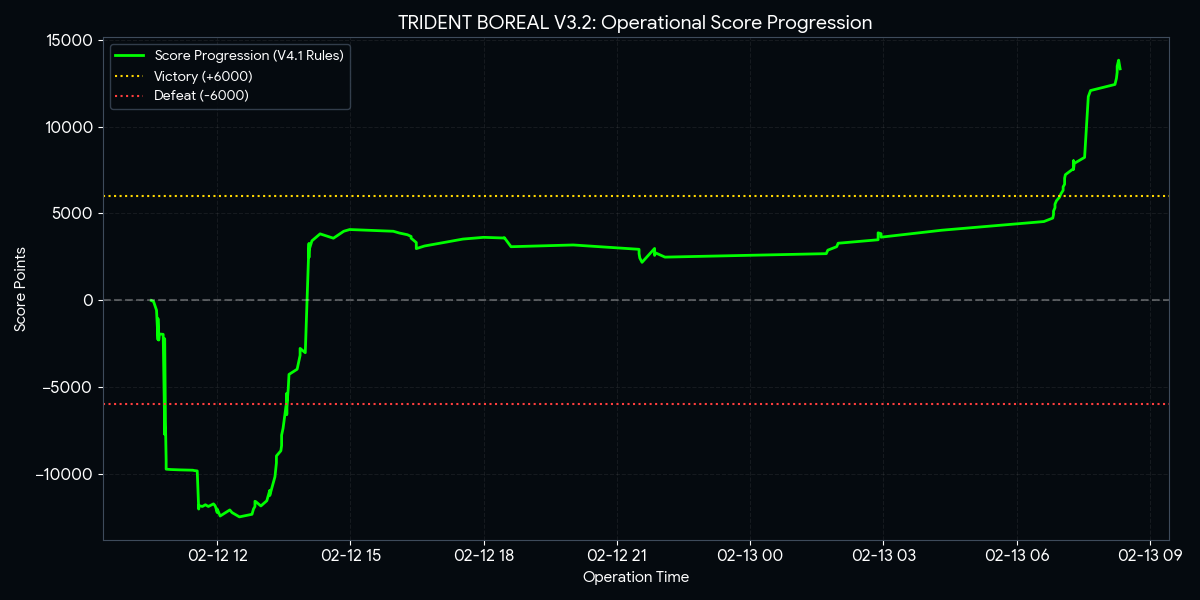
With Perplexity analysis

Yes, the scoring model clearly favors protecting NATO assets over killing Russian ones, which in practice “favours” the Russian side if you trade losses symmetrically.[1]
### How the scoring is weighted
- Typical Russian units you destroy give you small to medium gains: fighters and bombers are usually +100, shipborne helicopters +100, most surface combatants +300 to +800, with a few capital ships like Slava at +1500 and Oscar/Yasen subs at +1000 to +2000.[1]
- Your own high‑value assets are heavily penalized: NATO frigates and destroyers are −1500 to −3000, major auxiliaries around −1500, fighters like F‑16/F‑18/F‑22 are −500, AWACS/AEW and key support aircraft are −500, plus many −100 hits for radars, SAM/SSM batteries, and bunkers.[1]
- ROE violations against civilian shipping cost −1000 each, which is as bad as losing a capital ship or failing to protect a high‑value target.[1]
### Practical effect
- You can wipe out a large part of the Russian surface fleet and long‑range air assets and still remain deeply negative if you lose a handful of NATO major surface units, a dozen high‑end fighters, and some support aircraft.[1]
- The scenario design is telling you: the primary objective is *not* to slaughter Russians at any cost, but to preserve Western forces and avoid civilian casualties while neutralizing a few key Russian assets (Nakhimov, Yasen, Oscars, Mainstay, OTH radars, etc.).[1]
So, in pure points-per-unit terms, the exchange ratio is asymmetric: each NATO loss and each civilian hit hurts far more than most Russian kills help, which is why your score stays very low even with strong offensive results.[1]
[1] Scoring-log-Trident-Boreal-v3.1.txt