Inspired by Road to Moscow – what could a future wargame look like?
Moderator: Joel Billings
-
Peiper1944
- Posts: 160
- Joined: Tue Aug 26, 2014 1:41 pm
- Location: Germany
Inspired by Road to Moscow – what could a future wargame look like?
Hello everyone,
Does anyone remember Road to Moscow by Battlefield Design Group, which was announced back in the day but sadly never released? Its maps and the idea of conducting a campaign from the perspective of a military headquarters have fascinated me ever since.
For those unfamiliar with the project, Road to Moscow was an ambitious undertaking in the 1990s. It was intended to simulate the entire Eastern Front from 1941 to 1945, putting the player in the role of either the German or Soviet high command.
Its distinctive approach involved planning operations on a map without a fixed hex grid: drawing axes of advance, setting primary and secondary objectives, and assigning the formations involved. Subordinate, computer-controlled commanders would then carry out these plans independently. The action was intended to unfold in continuous, pausable time.
Situation reports covering troop strength, combat readiness, supply, and the air situation would inform further decisions. The focus was therefore on conducting a campaign: setting objectives, allocating forces, holding reserves, and responding as operations developed.
After repeated delays and changes of publisher, the game was ultimately never released. Its proposed features remained a fascinating promise.
Inspired by those ideas, I have been using AI to create concept images exploring a possible map style. Alongside the original Road to Moscow images, I am sharing two AI-generated concept images of the Warsaw–Białystok area. The new images are visual concepts, not screenshots from a finished game. They are intended to spark a discussion about what a future historical wargame could look like—in terms of both graphics and gameplay.
Which aspect of such a game would appeal to you most?
Staff work: Assessing situation reports, drawing up orders, and leaving their execution to subordinate commanders?
Strategy: Directing entire theaters of war, managing production and supply, and setting overall objectives?
Operations: Commanding armies and divisions, preparing breakthroughs, committing reserves, and planning encirclements?
Tactics: Directly commanding regiments and battalions and influencing individual engagements in detail?
Should a game like this explore one of these levels in depth—or connect several of them? Which decisions would you want to make yourself, and what would you delegate to your staff and subordinate commanders?
I would be interested to hear your ideas and whether these images spark similar thoughts for you. Perhaps some of you also remember what you were hoping for from Road to Moscow back then.
Re: Inspired by Road to Moscow – what could a future wargame look like?
I remember looking for the Road to Moscow which was for me the early days of the internet. I remember my joy at finding so many hits only to discover nearly all of them were the best places to stop for female company on the road to Moscow.
Anyway...
After WiTE2, which at times I find over whelming due to the detail, probably Staff Work and Strategy would be my interest. Not sure how extensive the original scope was but perhaps to concentrate on one Army, Group or Front and the others to be commanded by the computer.
Anyway...
After WiTE2, which at times I find over whelming due to the detail, probably Staff Work and Strategy would be my interest. Not sure how extensive the original scope was but perhaps to concentrate on one Army, Group or Front and the others to be commanded by the computer.
Molotov : This we did not deserve.
Foch : This is not peace. This is a 20 year armistice.
C'est la guerre aérienne
Foch : This is not peace. This is a 20 year armistice.
C'est la guerre aérienne
Re: Inspired by Road to Moscow – what could a future wargame look like?
nice map.
I envision an even more detailed game, with an even smaller scale than *WitE 2*—though *WitE 2* is already very well executed.
It would be as historically accurate as possible, offering more control over production and logistics, and allowing for the command of individual regiments.
Who knows how AI might assist—both in the programming phase and by taking over specific tasks during gameplay?
Perhaps, at some point, it might even be possible to blow up or repair individual bridges.
A full-scale campaign would likely take two years to complete.
...but it would be incredibly detailed.
-
Peiper1944
- Posts: 160
- Joined: Tue Aug 26, 2014 1:41 pm
- Location: Germany
Re: Inspired by Road to Moscow – what could a future wargame look like?
Hello 56ajax,56ajax wrote: Fri Oct 23, 2026 4:15 am I remember looking for the Road to Moscow which was for me the early days of the internet. I remember my joy at finding so many hits only to discover nearly all of them were the best places to stop for female company on the road to Moscow.
Anyway...
After WiTE2, which at times I find over whelming due to the detail, probably Staff Work and Strategy would be my interest. Not sure how extensive the original scope was but perhaps to concentrate on one Army, Group or Front and the others to be commanded by the computer.
Your suggestion of focusing on a single army, army group, or front fits very well with my game idea: You could play at four command levels—either control all of them yourself or delegate individual levels to your AI-controlled staffs and subordinate commanders.
The following four map views illustrate these different perspectives. The scales mentioned are preliminary suggestions for the level of map detail.
1. Staff and High Command – directing the campaign
Here, the focus is on headquarters work: assessing situation reports, issuing long-term directives and daily orders, setting priorities, and evaluating proposals from the general staff.
The overview map helps you understand the overall situation and the relationships between different sectors of the front. Suggested reference scale: 1:3,000,000. This zoomed-out view shows the wider geographical context. Summarised situation reports and updates from subordinate headquarters would be particularly important for this command role.
The tension comes from making decisions under uncertainty: Does a reported enemy movement indicate a counterattack? Should a reserve be released? Is an operational objective still achievable?
2. Strategy – allocating forces and resources
At this level, you decide which theatres take priority, where new formations are assigned, and how production, training, replacements, and supplies are allocated.
Suggested reference scale: 1:1,000,000. This view connects larger operational areas. It provides the geographical framework for coordinating army groups and armies and assessing the importance of cities, transport links, and supply routes.
The challenge would be to use limited resources effectively: Which main effort receives fuel and reinforcements, and where must you temporarily make do with less?
3. Operations – commanding armies, corps, and divisions
At this level, you plan breakthroughs, envelopments, river crossings, and withdrawals. Operational arrows are linked to formations, intermediate objectives, schedules, and reserves.
Suggested reference scale: 1:300,000—one centimetre represents three kilometres when the map is displayed at that scale. The Warsaw–Białystok–Brest-Litovsk area becomes visible in greater detail. The hex grid, transport network, and waterways provide the framework for marching movements, assembly areas, and coordination between neighbouring formations.
An order might read: “Secure the river crossing, advance to the intermediate objective, and wait there for the neighbouring formation.” Subordinate commanders handle the execution if you choose to delegate it.
4. Tactics – influencing individual engagements
Here, you command regiments, battalions, and equivalent units. You choose local avenues of approach, employ engineers and fire support, and decide when to commit reserves within the battle area.
Suggested reference scale: 1:50,000. The closer view around Brest-Litovsk allows a more detailed examination of settlements, woodland, transport routes, and river crossings. The terrain would need to be represented accurately enough to support the intended tactical depth.
A single crossing could become the decisive objective in a battle. Losing it would, in turn, affect the operational timetable.
One game world – you decide what to control yourself
The four maps show the same world at different distances. As you zoom in, more detail becomes visible. Cities, rivers, and roads stay in the same places.
You decide which tasks you want to handle yourself. For example, you could command an entire army group and set its objectives. Your computer-controlled commanders would then handle troop movements and individual battles. They would report on their progress and tell you where they need help.
You could also command just one army or take control of everything, right down to individual battles. The computer handles whatever you choose to delegate.
I imagine planning would be straightforward: draw an attack arrow on the map, select the troops involved, and decide which places they should reach and by when. Your staff would estimate whether there is enough time, fuel, and supplies to carry out the plan.
The tension comes when things go differently than expected: a bridge is destroyed, a unit arrives late, or the enemy launches a surprise attack. You then decide whether to stick to the plan, send help, or set a different objective.
The four images above were created using AI. They show what the maps could look like. The gameplay features described here are ideas for further development.
Would you be interested in a game like this, where you make the big decisions and can leave it to your commanders to work out how to carry out your orders?
Re: Inspired by Road to Moscow – what could a future wargame look like?
Ideally historical, with every level both controllable and playable. 
- bairdlander2
- Posts: 2398
- Joined: Sat Mar 28, 2009 9:25 am
- Location: Toronto Ontario but living in Edmonton,Alberta
Re: Inspired by Road to Moscow – what could a future wargame look like?
This is the original "Road to Moscow", never understood why the top of screen was east.
- Attachments
-
- road-to-moscow_5.png (3.39 KiB) Viewed 542 times
-
Peiper1944
- Posts: 160
- Joined: Tue Aug 26, 2014 1:41 pm
- Location: Germany
Re: Inspired by Road to Moscow – what could a future wargame look like?
Hello jawi,jawi wrote: Fri Oct 23, 2026 12:40 pm nice map.
I envision an even more detailed game, with an even smaller scale than *WitE 2*—though *WitE 2* is already very well executed.
It would be as historically accurate as possible, offering more control over production and logistics, and allowing for the command of individual regiments.
Who knows how AI might assist—both in the programming phase and by taking over specific tasks during gameplay?
Perhaps, at some point, it might even be possible to blow up or repair individual bridges.
A full-scale campaign would likely take two years to complete.
...but it would be incredibly detailed.![]()
Thank you! Your description comes very close to what I have in mind. Commanding individual regiments, historical orders of battle, production, and logistics are among the central ideas of my concept.
I want to connect four views: Staff and High Command, Strategy, Operations, and Tactics. They all share the same geographical foundation. Towns, rivers, and bridges remain in the same locations; zooming in reveals more detail.
Players could choose their own level of responsibility. For example, you could command just one army or army group while AI commanders take charge of the other formations. You could also command individual regiments and battalions directly. Orders travel down the chain of command, while reports and requests come back up.
The two images show an example from my current work in progress:
The first image shows the selection of subunits within the 291st Infantry Division, in this case within Infantry Regiment 504. This selection system is intended to let players combine elements of a formation into a separate Kampfgruppe, or battlegroup. The second image shows a detached battlegroup with its own unit counter on the map. Its connection to its parent formation remains visible in the unit panel. That panel also includes an option to order it to march back to its parent formation. This would allow you, for example, to assign a smaller battlegroup to secure a bridge while the rest of the formation continues its mission. The images show the current work in progress; the displayed figures and historical details have not yet been fully verified.
I also want to connect this with operational planning: for example, you plot an advance towards Riga, assign formations, and set a target arrival date. Your staff estimates the time required, along with fuel and supply needs. Subordinate commanders carry out the mission and report difficulties. You decide when to intervene.
For production, the entire path to the troops should be traceable: raw materials, factories, equipment, training, depots, rail transport, and finally delivery to the front. After all, a newly produced tank also needs a trained crew and has to reach its unit. To me, historical accuracy also means taking the actual limitations of industry and transport into account.
Individual bridges fit perfectly into this approach. Capturing a bridge intact, demolishing it, repairing it, or replacing it with a temporary crossing could change the course of an entire operation. Suddenly, a single regiment holding a bridge could become crucial to the advance of an entire corps.
AI is already helping me develop the concept and work on the programming. Historical research and checking the results remain necessary. Within the game, AI could act as your staff and as subordinate commanders, using the information and resources actually available to them.
And yes, a campaign lasting two years sounds quite conceivable!
That is why I am working on a concept book for future strategy games of this kind: “The Thinking Map Table” (Der denkende Kartentisch). In it, I want to explain the game concept, how its systems connect, the controls, and the different views as clearly as possible, supported by images.
The aim is to save programmers a great deal of groundwork and time: the more clearly the concept is developed, the fewer fundamental questions remain unanswered, and the more they can focus on the technical implementation.
I think of it as something like a screenplay for a director: it describes what should happen and how everything fits together. Building on that foundation, the development team can concentrate on programming and visual presentation. Of course, technical questions and necessary adjustments will still arise.
These are ideas I am developing step by step; not all the features described have been implemented yet. Would you prefer to command a single army at this level of detail, or oversee the entire front and delegate more responsibility to the AI?
-
Peiper1944
- Posts: 160
- Joined: Tue Aug 26, 2014 1:41 pm
- Location: Germany
Re: Inspired by Road to Moscow – what could a future wargame look like?
**From “Road to Moscow” to the Thinking Map Table – An Idea Across Four Decades**bairdlander2 wrote: Sun Oct 25, 2026 1:58 pm This is the original "Road to Moscow", never understood why the top of screen was east.road-to-moscow_7.pngroad-to-moscow_3.pngroad-to-moscow_1.png
For me, these three images illustrate a fascinating progression: from an early strategy game on the Commodore 64, through the ambitious but ultimately cancelled “Road to Moscow” project of the late 1990s, to a present-day concept illustration. What changes along the way goes far beyond graphics. The question is how a strategy game can give the player the feeling of actually commanding a military formation—with planning, subordinate commanders, incomplete reports, and limited resources.
**Image 1: The Early “Road to Moscow” – A Vast Front with Simple Tools** The first image shows the C64 version of “Road to Moscow.” The original game was released in 1984, followed by an updated version 2.0 in 1987. The “1986” in my image filename should therefore not be taken as a confirmed release year. The original game was developed by Philip Gardocki and Bob Best. It covered the war on the Eastern Front, combining the movement of formations with factors such as terrain, weather, and supply.
By today’s standards, its presentation looks very simple: a small number of colours, tiny unit symbols, and heavily simplified landscapes. Nevertheless, the essential elements of this kind of game are already recognisable. Rivers shape the battlefield, terrain affects movement, and individual units form part of a larger situation.
I find the message at the bottom of the screen particularly fitting: “Checking German Supply.” Behind those symbols lies the question of whether the troops can actually be supplied. For me, that is a major part of the appeal of these games: an advance involves more than moving across a map. It must also be supported and sustained.
**Image 2: The Announced “Road to Moscow” – The Player as High Command** The second image belongs to the later project whose announcements I remember from around 2000. Developed by Battlefield Design Group, it was intended to expand the idea considerably. There was a real connection to the earlier game: Phil Gardocki was also involved in this project. It had already been announced in 1996, was postponed several times, and was ultimately never released.
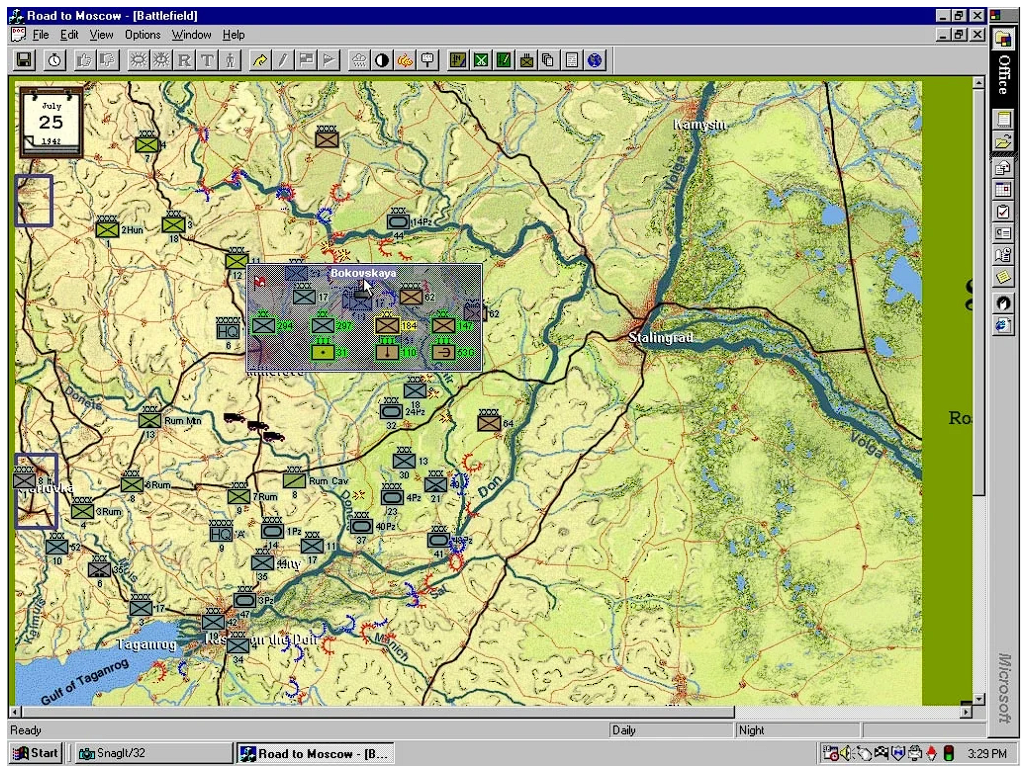
The difference is immediately visible in the image. A much more detailed topographic map shows the region around the Don and Volga, including Stalingrad. Military formation symbols are placed across the landscape, while an open window displays several units around a particular location.
However, the most significant change was the intended approach to command. Playing as the German or Soviet high command, the player would devise operations, set objectives, and allocate forces. Subordinate AI commanders would then carry out those orders. The plans included a map without a fixed hex grid and a continuous flow of time that could be interrupted.
That is precisely the idea that captured my imagination: I draw a plan on the map, explain my intentions, and watch an operation take shape. Reports then come back. One formation reaches its objective, another is held up, and somewhere else I need to commit reserves.
According to a later retrospective on the project, getting the AI to execute such plans reliably was one of its major difficulties. A convincing plan on a map requires commanders who understand their tasks and coordinate effectively.
**Image 3: My Present-Day Vision – A Shared Geographic Foundation** The third image is an AI-generated concept illustration from 2026. It conveys the kind of landscape presentation I can imagine for a modern strategy map: forests, river systems, settlements, and transport routes forming one continuous environment.
The image is a visual study. It demonstrates neither a finished game feature nor verified geographic accuracy. Town locations, labels, and historical transport networks would need to be checked against reliable maps. The duplicate Kursk label, for example, shows that the illustration still needs refinement.
In my concept, a fixed geographic foundation should sit beneath the visible map. The actual locations of places and the distances between them provide the framework. Landscape, settlement, and infrastructure information appropriate to the chosen period would then be layered over it. Historical changes, such as shifts in river courses or coastlines, would also need to be accounted for.
Zooming in should allow the player to examine the same area in greater detail. A town stays in its position, while additional roads, bridges, and terrain features become visible.
**Four Views – Freedom to Choose Your Responsibility**
On this foundation, I want to connect four views: **staff work and high command, strategy, operations, and tactics.**
Players should be able to choose the responsibility they take on. Someone who wants to command an army group sets objectives and priorities, leaving subordinate commanders to carry them out. Someone who wants to be closer to the action takes command of a division, regiment, or battalion.
For example, I might order an army to secure a river crossing. Its subordinate commanders plan how to employ their formations. Engineers prepare the crossing, artillery provides support, and supplies must be able to follow. Reports tell me whether the mission is succeeding or whether further decisions are needed.
The tension comes from developments that make sense within the situation: a bridge becomes unusable, a formation is exhausted, the enemy attacks a flank, or an opportunity appears earlier than expected. Successes and difficulties should arise from the shared game world.
**“The Thinking Map Table” is my concept book for this vision.** In it, I want to describe how maps, command, historical orders of battle, production, training, and supply should work together. FRONTENWERK serves as my working prototype, allowing me to test individual ideas and make them visible.
For me, the three images therefore represent three stages: an early implementation within strict technical limits, a later project with ambitious ideas about command, and my present-day vision of how those ideas could be developed further.
Re: Inspired by Road to Moscow – what could a future wargame look like?
Hello peiper1944,
This all sounds very interesting.
A game like this would be a great follow-up to WiTE2—and it would be wonderful to have it in German, too.
Do you play WiTE2 (or similar games) yourself, or do you prefer the development side of things?
Perhaps you could reach out to Gary Grigsby’s team, or look for some like-minded people—I’m sure there are plenty here on the forum.
You’ve definitely piqued my interest!
-
Peiper1944
- Posts: 160
- Joined: Tue Aug 26, 2014 1:41 pm
- Location: Germany
Re: Inspired by Road to Moscow – what could a future wargame look like?
Hello jawi,jawi wrote: Sun Oct 25, 2026 6:48 pm Hello peiper1944,
This all sounds very interesting.
A game like this would be a great follow-up to WiTE2—and it would be wonderful to have it in German, too.
Do you play WiTE2 (or similar games) yourself, or do you prefer the development side of things?
Perhaps you could reach out to Gary Grigsby’s team, or look for some like-minded people—I’m sure there are plenty here on the forum.
You’ve definitely piqued my interest!
Thank you! I play WiTE2 and WitP AE myself and have been interested in historical strategy games since my youth.
My idea is to let players choose whether to command an entire campaign, an army, or individual battalions. **AI commanders would handle the remaining tasks.** The starting situation would be historical; from there, players could shape events through their own decisions, reorganisations, and new plans. Larger maps and additional languages are also among my ideas.
For now, I would like to develop the concept further together here on the forum. **Anyone who would like to contribute ideas, historical knowledge, or experience in game development is very welcome.** Suggestions about what you feel is missing from these games, or what you find too cumbersome, would also be helpful.
-
Sammy5IsAlive
- Posts: 677
- Joined: Sun Aug 03, 2014 11:01 pm
Re: Inspired by Road to Moscow – what could a future wargame look like?
One big hurdle seems to be the huge numbers of tactical maps you'd need. Having an individual 'hand drawn' map for every hex seems unfeasible. The only way I could see it being manageable would be for the tactical maps to be procedurally generated based on the hex attributes from the strategic map?
Trying to integrate the different levels seems difficult also? Are the 'AI controlled' areas of responsibility keeping track of and resolving activities down to battalion level? Or are those lower levels of command abstracted unless the player chooses to get involved?
How would you see turns working? Does a one week turn make sense for battalion level combat? Or would you break down into 'sub-turns' in areas where the player is controlling at a lower level?
I think the success of the game likely lives or dies with the quality of the game AI, particularly in terms of its ability to meaningfully interpret plans given to it by the player. It's particularly important as to me it seems very difficult to have a game design like this running PvP and so you'd need the AI to be able to provide a good opponent at all the different levels of combat. So you are looking at programming four separate AI layers.
-
Peiper1944
- Posts: 160
- Joined: Tue Aug 26, 2014 1:41 pm
- Location: Germany
Re: Inspired by Road to Moscow – what could a future wargame look like?
Thank you for your detailed thoughts. Your points about the maps, command levels, and AI address exactly the key challenges. I would like to explain my idea using the Eastern Front as an example. This is a concept, rather than a presentation of a finished game.Sammy5IsAlive wrote: Wed Oct 28, 2026 10:21 am One big hurdle seems to be the huge numbers of tactical maps you'd need. Having an individual 'hand drawn' map for every hex seems unfeasible. The only way I could see it being manageable would be for the tactical maps to be procedurally generated based on the hex attributes from the strategic map?
Trying to integrate the different levels seems difficult also? Are the 'AI controlled' areas of responsibility keeping track of and resolving activities down to battalion level? Or are those lower levels of command abstracted unless the player chooses to get involved?
How would you see turns working? Does a one week turn make sense for battalion level combat? Or would you break down into 'sub-turns' in areas where the player is controlling at a lower level?
I think the success of the game likely lives or dies with the quality of the game AI, particularly in terms of its ability to meaningfully interpret plans given to it by the player. It's particularly important as to me it seems very difficult to have a game design like this running PvP and so you'd need the AI to be able to provide a good opponent at all the different levels of combat. So you are looking at programming four separate AI layers.
**The map: the “carpet principle”**
My idea is to stitch historical map sheets together into one continuous map, like a large carpet. Underneath is a geographical base map on which locations are aligned to kilometre accuracy using the straight-line distances between them. This provides the framework for positioning the historical maps.
The technical map tiles are simply the image sections that make up this carpet. They do not represent individual battlefields. This means there would be no need to hand-draw a separate battle map for every hex.
A hex grid overlays the map, with approximately 5.7 km between adjacent hex centres. When zooming in, you remain at the same geographical location and see additional details wherever the source maps contain them. Enlarging the image alone does not, of course, create new terrain data.
The map should also influence movement. In the first image, bodies of water are already treated as obstacles to land units. The displayed numbers show the movement costs of reachable neighbouring hexes. A land unit therefore cannot simply move across the sea or the lagoon.
*An example of water obstacles being taken into account and movement costs being displayed.*
The challenge with the carpet principle is matching the edges. The original maps were drawn in different styles, resulting in differences in water colours, forests, and terrain depiction. These differences are visible in the second image. Colours and drawing styles would need to be harmonised, while roads, rivers, and coastlines must connect properly across map boundaries.
*The different drawing styles of the source maps are still visible at the joins.*
Whether this can be achieved everywhere to the desired standard remains to be seen. However, the potential extends beyond this one scenario: **the carpet principle could provide a blueprint for other historical periods.** A different historical map carpet could be laid over the same geographical foundation—for example, for the Napoleonic era or the First World War. This would avoid rebuilding the geographical base each time. Changes specific to each period, along with units and game rules, would naturally need to be accommodated.
One further question remains for particularly detailed combat: what additional terrain information would be needed? A hex of this size does not provide an accurate depiction of every house or defensive position. The carpet principle provides the shared map foundation; the necessary tactical detail must be developed around it.
**Command levels and the passage of time**
The player should not necessarily have to move every battalion individually. My idea is that they might, for example, order an army to secure a river crossing. Subordinate headquarters would then translate that order into tasks for their formations.
How far individual battalions would be simulated, and which activities would be abstracted, still needs to be worked out. If the player intervenes at a lower command level, positions, losses, and supply must nevertheless remain consistent with the overall situation.
I have therefore not committed to weekly turns. I have also considered three-day turns, within which movement and combat could be resolved in shorter time steps. Put simply, the turn is the calendar, with a clock running underneath it. The same amount of time must pass across every sector of the front.
**The AI opponent**
I agree with you about the importance of the AI. It must translate an order into sensible actions while taking terrain, reconnaissance, reserves, and supply into account. Whether this requires four separate AI systems or a shared architecture with different responsibilities remains an open question.
For the Soviet opponent, my idea is to model development from 1941 to 1945: organisation, training, leadership, and coordination between formations should improve. I do not think a blanket bonus such as “all units gain more combat power from 1942 onward” would be sufficient on its own.
Over time, the AI should become better at building reserves, preparing attacks, and coordinating larger operations. However, its capabilities must depend on the actual situation in the game. Lost factories, heavy casualties, or disrupted supply must not be rendered meaningless by automatic reinforcements.
All of this would first need to prove itself in a limited Eastern Front scenario. That would provide a way to test whether the shared map, the different command levels, and the AI work together effectively.
- bairdlander2
- Posts: 2398
- Joined: Sat Mar 28, 2009 9:25 am
- Location: Toronto Ontario but living in Edmonton,Alberta
Re: Inspired by Road to Moscow – what could a future wargame look like?
Everything you are describing is available in Command Ops and HOI3. But if you want to create a new game, go for it.
-
Sammy5IsAlive
- Posts: 677
- Joined: Sun Aug 03, 2014 11:01 pm
Re: Inspired by Road to Moscow – what could a future wargame look like?
But both of those games look at one 'layer' to the exclusion of others.bairdlander2 wrote: Wed Oct 28, 2026 4:35 pm Everything you are describing is available in Command Ops and HOI3. But if you want to create a new game, go for it.
HOI has divisional and below combat abstracted and outside of the control of the player.
Command Ops has no persistent campaign, with each scenario existing in isolation to the others.
Plus both are pausable real time rather than turn based.
Re: Inspired by Road to Moscow – what could a future wargame look like?
Hi!
Very, very interesting.
A concept with developed maps, historical data and above all a sort of we-go system.
I guess the latest will be very problematic. Perhaps partly we-go.
Interesting with the battlefield project and Stalingrad.
I was following The road to Moscow closely.
Goran W
Here some pictures.
-
Sammy5IsAlive
- Posts: 677
- Joined: Sun Aug 03, 2014 11:01 pm
Re: Inspired by Road to Moscow – what could a future wargame look like?
One possible gameplay design off the top of my head.
The basic turn unit is 3 days.
Gameplay is then split into different blocks - the largest of which is 24 days (8 turns), then 12 days(4turns), then 6 days (2turns) and finally 3 days (1 turn). These blocks would correspond to AG/Army/Corps/Division. At each level you would pick HQs/units to manually control, leaving the rest to AI control. Importantly once a unit is selected you are committed to it for the whole of its block and give orders for the entirity of that block.
So T1 you can pick an army group to control (giving orders to armies for the next 8 turns), an army to control(giving orders to Corps for the next 4 turns), a corps to control(giving orders to divisions for the next 2 turns) and a division to control (controlling a battle at tactical level).
T2 you can pick a division to fight its battle. Each turn you will be able to do this (although limited to picking a division within your corps)
T3 you can (if desired) pick a new corps to control (within your army) and give divisional orders for the next 2 turns (and fight a tactical battle)
T4 is a tactical battle only.
T5 you can pick a new army to control (or continue controlling the current one) and give its corps orders for the next 4 turns, pick a new corps within that army and give orders to its divisions for the next 2 turns and fight a tactical battle
T6-8 proceed as above
T9 You can choose which AG to control for the next 8 turns and give the other AGs their orders for the next 8 turns. Within that AG you have the same set of options as at T5 (i.e. pick an army, a corps and a battle to control individually).
One other possibility is to add some kind of fog of war in terms of your own troops. So for example on T9 the overall map would be showing the situation as it was at T5. You have to estimate where your forces (and the enemy) are likely to now be and give orders accordingly. Subordinate HQs under player control would have an area of influence in which they provide more up to date information. So sticking with that T9 example - in the area of influence of your controlled AG you would see the situation from T7, in the area for your controlled army you would see the situation for T8 and in the area for your corps you would see the actual situation for the current turn. This would result in the kind of gameplay you see with Campaigns on the Danube, where you are always acting on imperfect information of where the enemy is (and if you choose to do so you can play with uncertain information of where even your own troops are).