1.Is the red "circle" around the target the area of uncertainty?
2. What do the minutes and seconds mean below the target?
Thanks so much.

Moderator: MOD_Command
Post by Scorpion86 »

Post by michaelm75au »
Post by Rory Noonan »

ORIGINAL: apache85
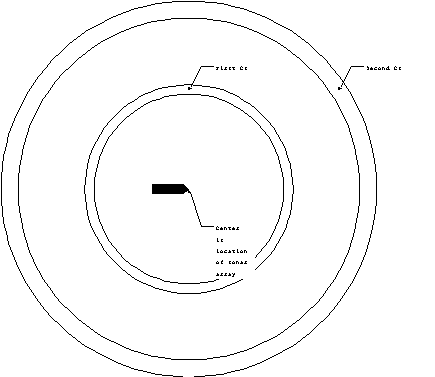
The green ring-shaped annuli are convergence zones. They’re a visual representation of the area where you might pick up really distant contacts.
Post by guanotwozero »
Another special type of propagation occurs when the water is so deep that no sound can reach the bottom without being deflected upwards by the normal positive gradient found in the deep isothermal layer. This situation requires a minimum of 200 m of depth excess which is defined as
depth excess: the distance from the lower boundary of the sound channel to the bottom.
When all of the sound rays are returned to near the surface, they tend to converge into a small region. Therefore the sound pressure level is increased dramatically in this region known as a convergence zones (CZ).
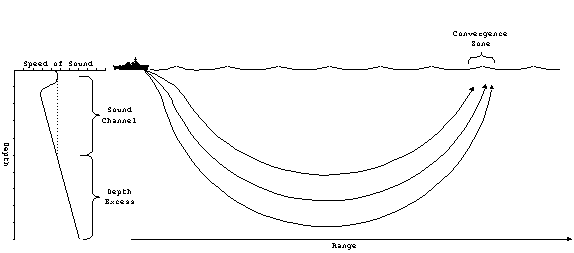

The convergence zone tends to be at large distances, typically 20-30 nm from the source. It is possible to have multiple convergence zones, which will occur at regular intervals. For example, if the first CZ is at 30 nm, the second CZ would be at 60 nm. The CZ is only a few miles wide, and therefore, contacts which are acquired through convergence zones tend to appear and disappear quickly.
It may be possible for a ship to have a rather limited sonar range due to regular transmission losses but multiple convergence zones. These zones form protective rings about the ship. A hostile submarine closing in on the ship would be detected as it passes through the various convergence zones, thereby alerting the ship to its presence. The ship could then deploy mobile ASW assets like a helicopter to handle the submarine.
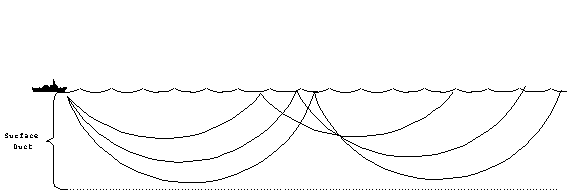
All of the rays will be deflected upwards. When the rays reach the surface, the will be reflected back downwards and the same process begins again. Naturally, some of the energy is lost and the reflection, but the overall effect is to trap the sound in a relatively small layer below the surface. The sound does not reach the deeper regions, so the transmission less than you would expect for cylindrical spreading. This effect is called a surface duct.
Return to “Command: Modern Operations series”