Westfront 1914

Post descriptions of your brilliant successes and unfortunate demises.

Moderator: Vic

User avatar
Metatron
Posts: 49
Joined: Thu Jun 19, 2014 9:50 am

Westfront 1914

Post by Metatron »

Greetings if anyone is left in these parts :D

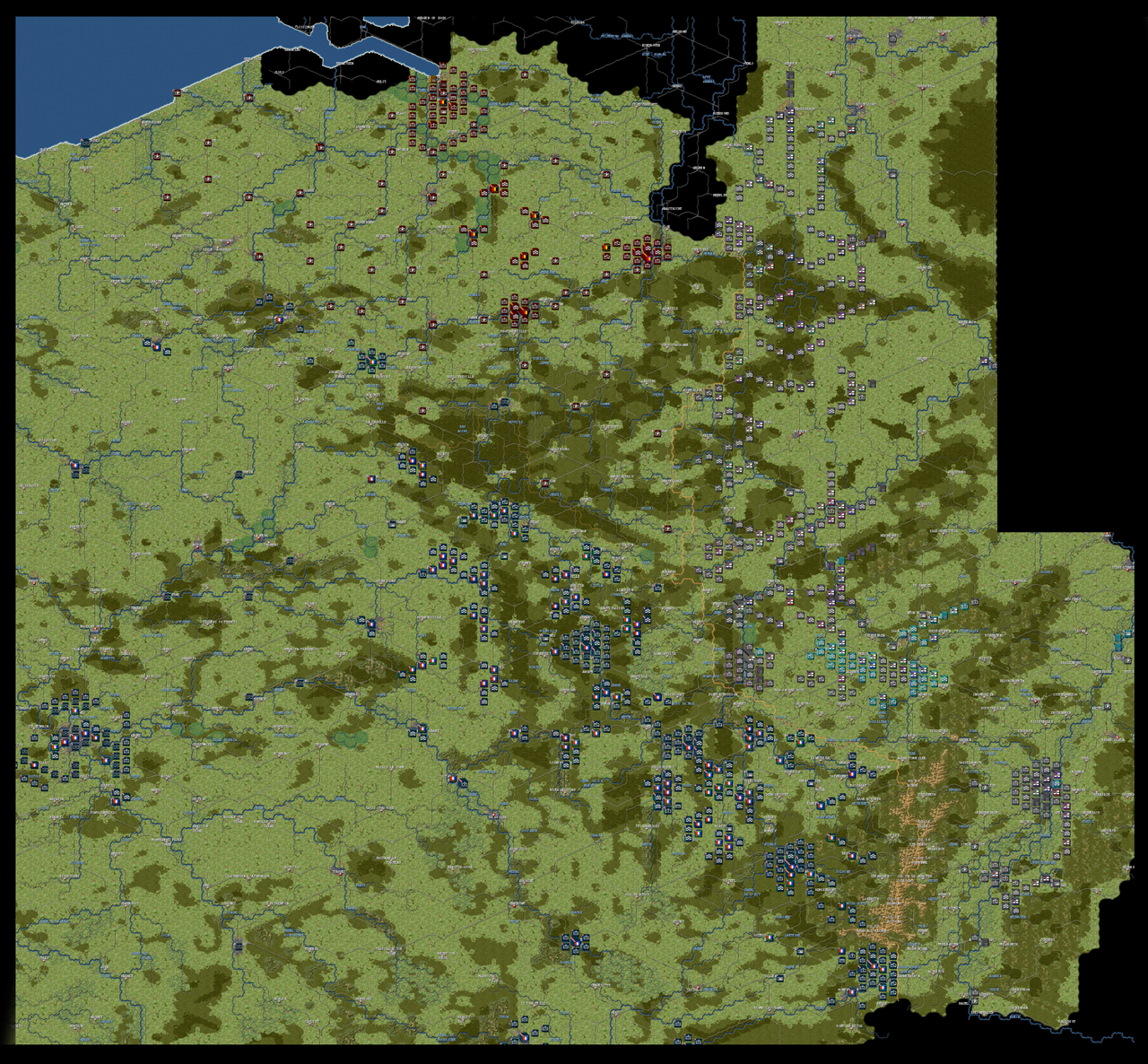
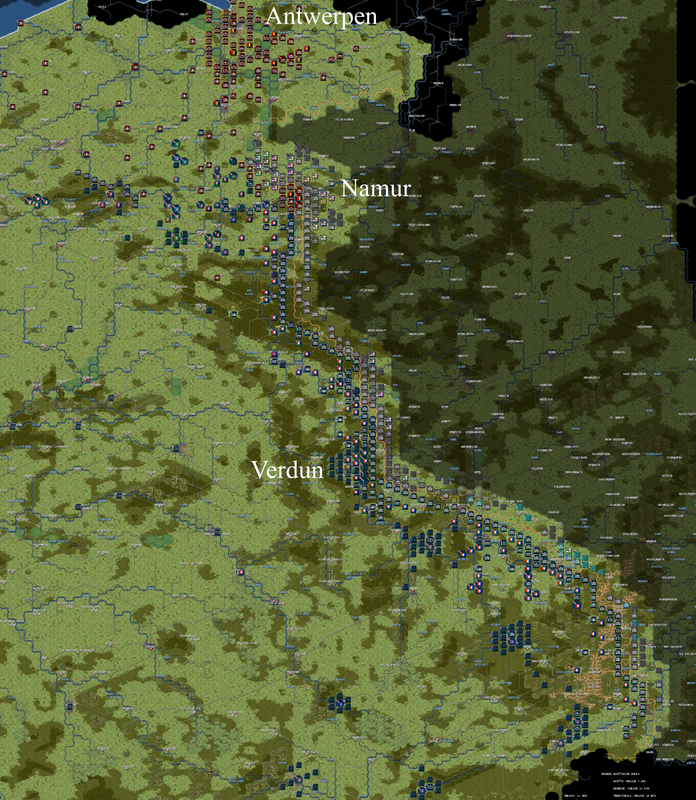
Maybe someone remembers that I was working on a WW1 mod for this game 12 years ago before giving up while transferring the project to the DC Community engine. I found the mod a few weeks ago and decided to finish it to a playable state, and after 200 hours of work I'm quite close. I did not do any scripting so all reinforcements are on the map and unlock through game rules (they are attached down below). It is a big game as you can see below with HQ's at divisional level and up.

Image
hqs.png
hqs.png (1.59 MiB) Viewed 1630 times
So I'm starting my first test match against myself to test the balance past August and I thought I'd give a preview of it here in a AAR format before putting the files up for anyone who wants to play it if the balance is ok.

The AAR will be from the French perspective starting 5th August 1914 all the way to (maybe) 30th November 1914. I hope you enjoy the carnage.

Game Rules Westfront 14.pdf
(139.32 KiB) Downloaded 16 times
Last edited by Metatron on Wed Jul 15, 2026 9:57 pm, edited 1 time in total.
-There is safety in numbers.
-Well there is also death in numbers. It's called a massacre.
User avatar
Metatron
Posts: 49
Joined: Thu Jun 19, 2014 9:50 am

Re: Westfront 1914

Post by Metatron »

5aout.png
5aout.png (2.98 MiB) Viewed 1620 times
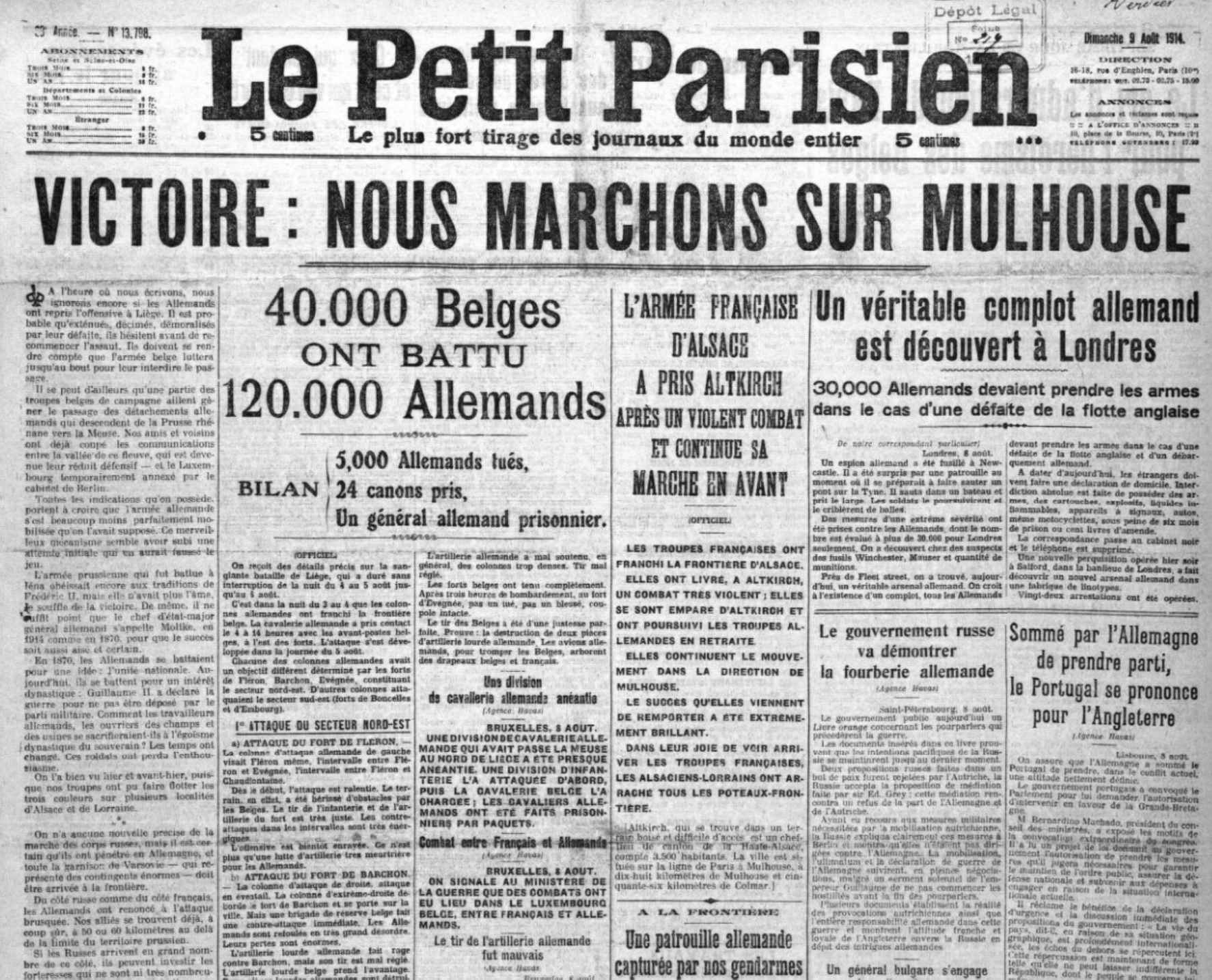
Source of the journals: https://gallica.bnf.fr/accueil/fr/html/accueil-fr

5 August 1914

War it is. The German troops enter Belgium all along the front and even French territory at Briey and Jerny. We await news from Belgium but généralissime Joffre doesn’t think the German push into Belgium to be of consequence. French mobilization according to Plan XVII is under way with the active divisions starting finishing their concentration and moving into position for the first French attacks. So far no direct combat occurred but planes of both side have been spotted reconnoitering the terrain in front of them.

Left Flank:
Image

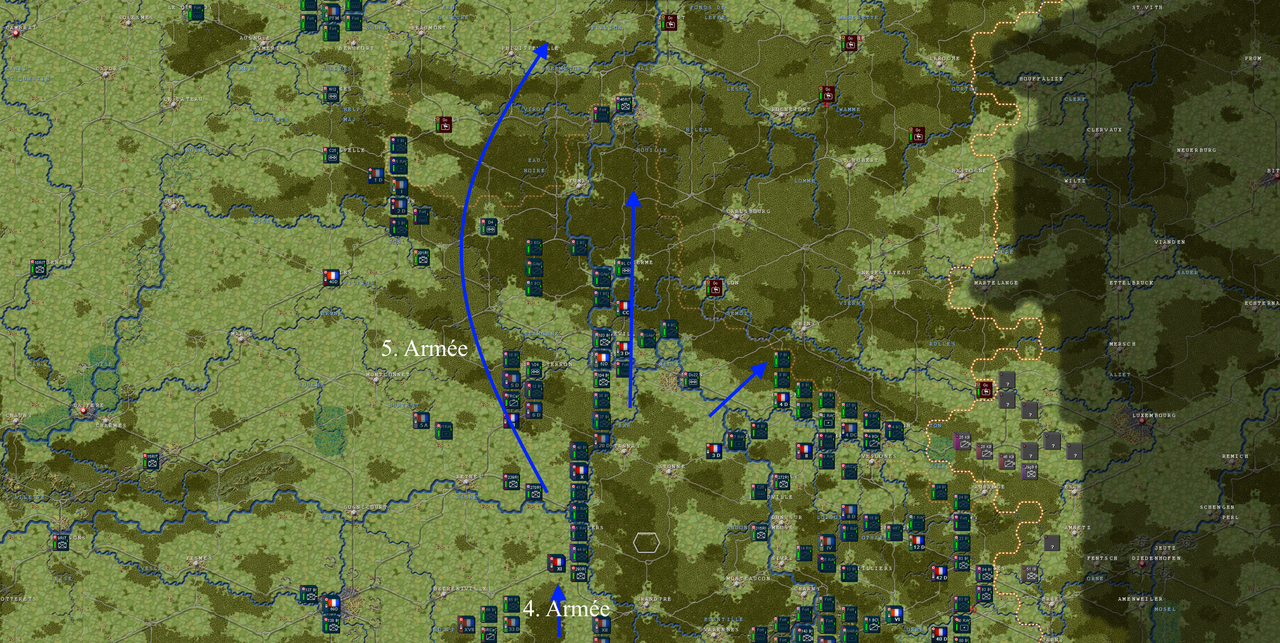
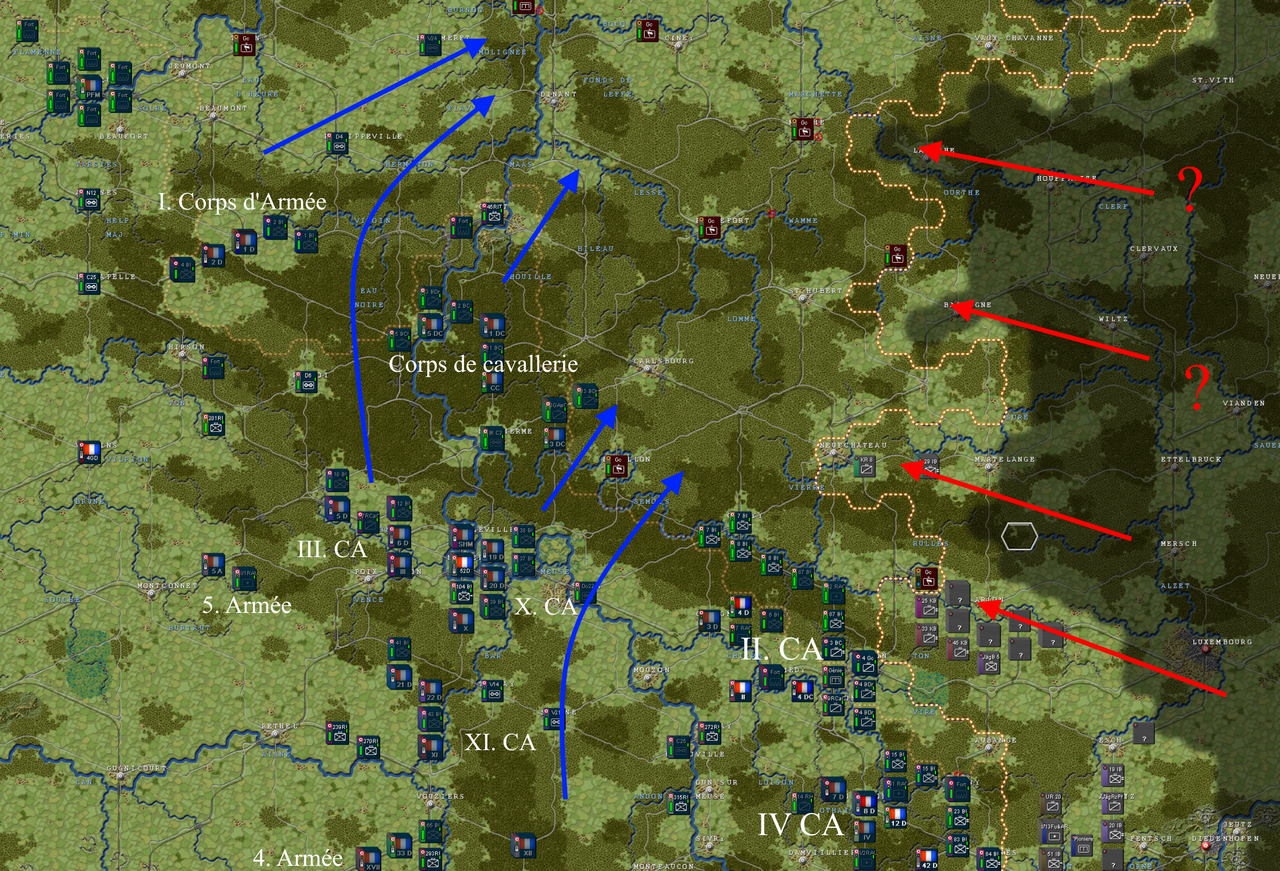
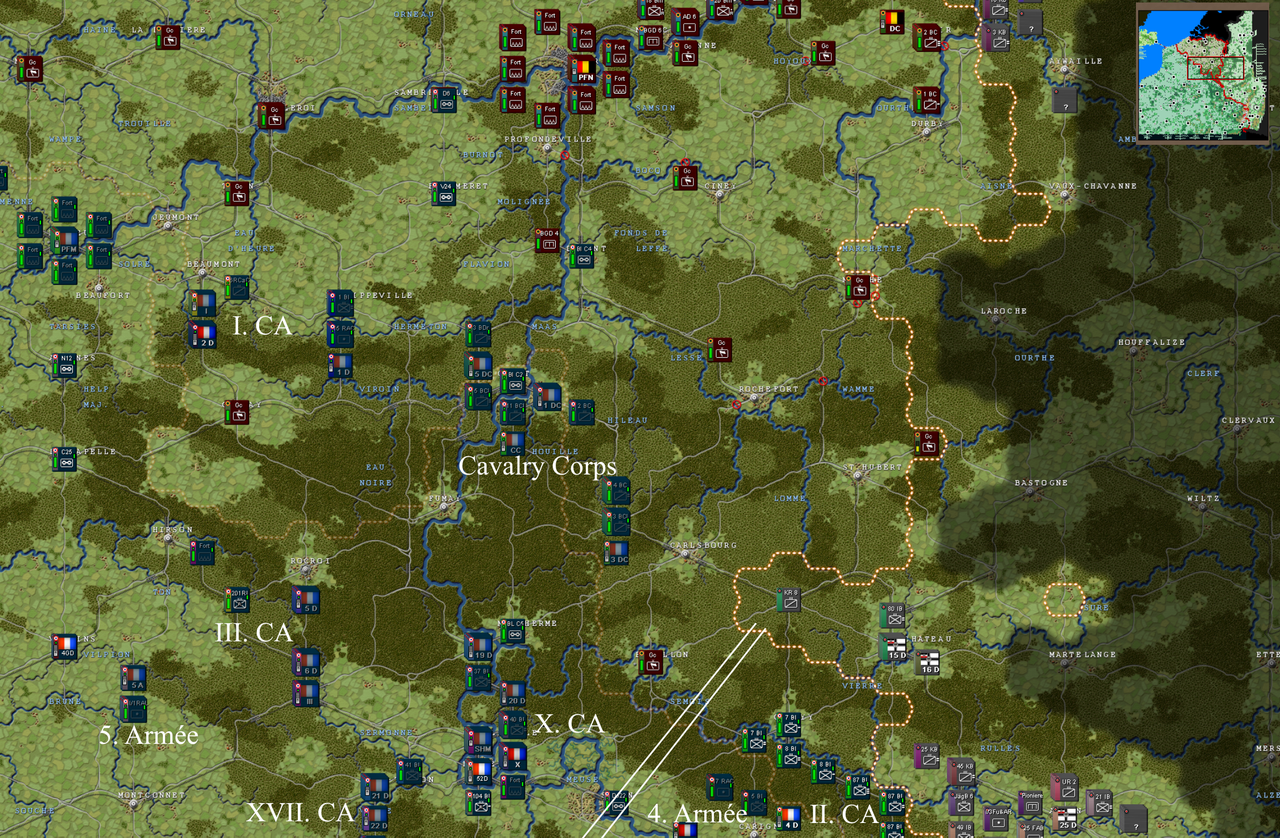
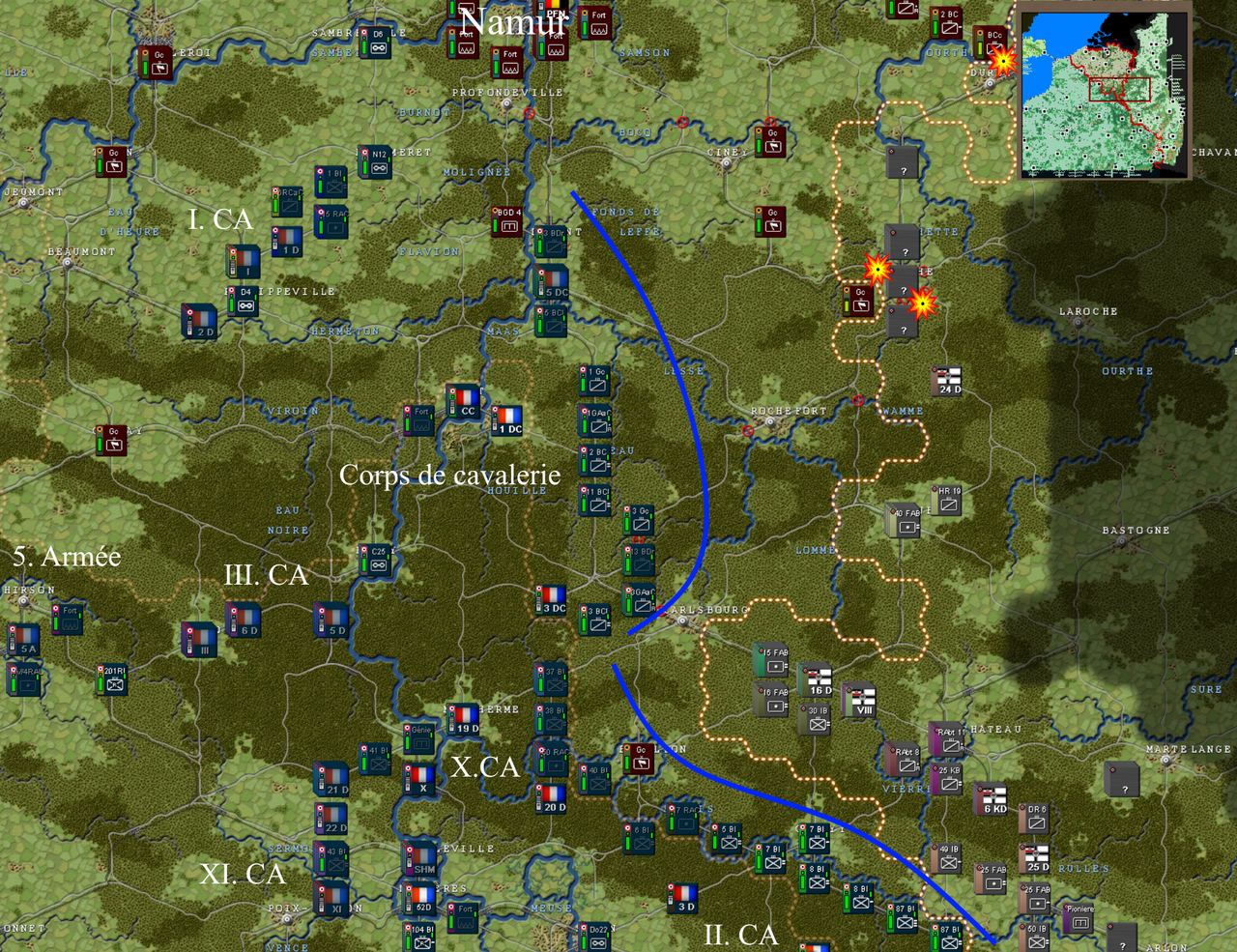
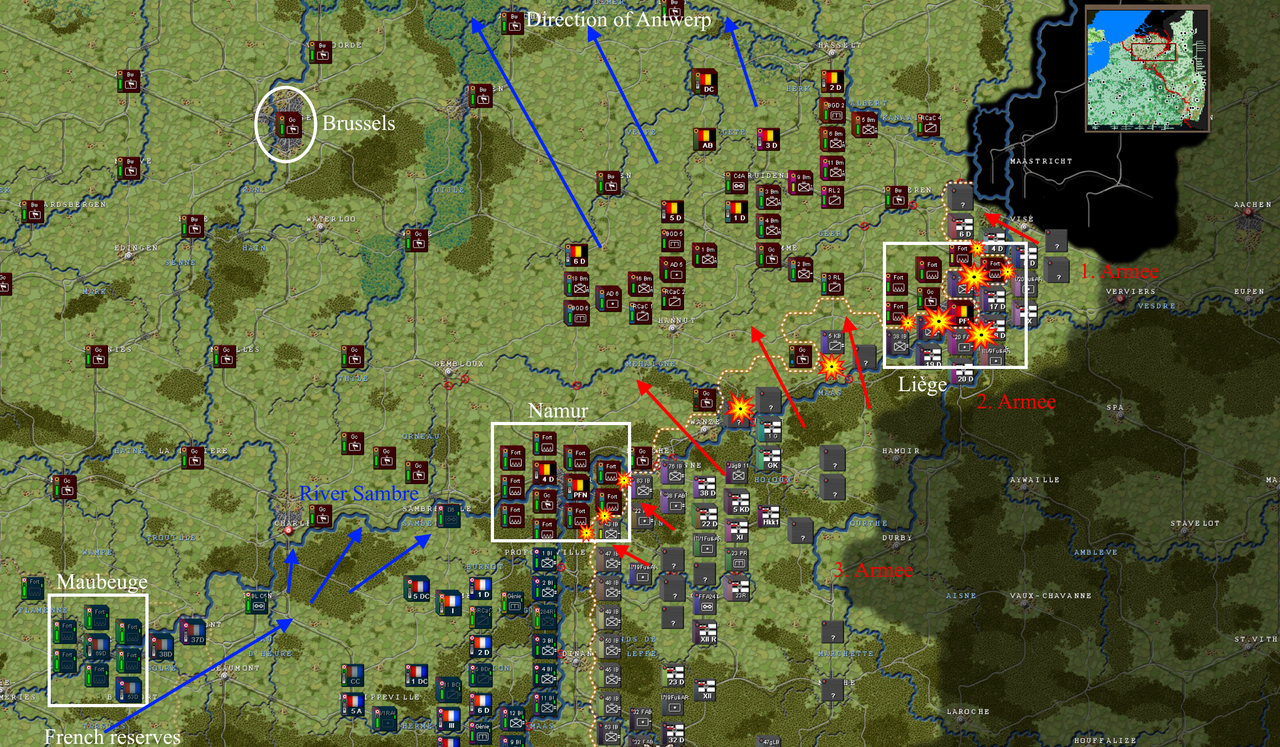
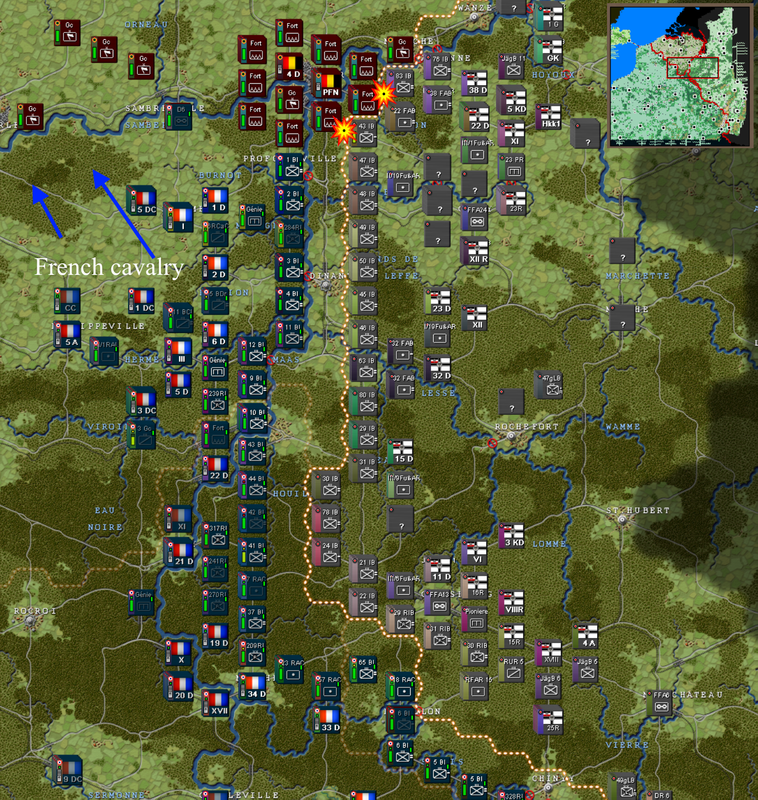
5. Armée of Charles Lanzerac is moving north along the Semois and Meuse river to make a junction with Namur and the Belgian army. Behind it 4. Armée is moving up to slide in between 5. and 3. Armée.

Center left:
Image

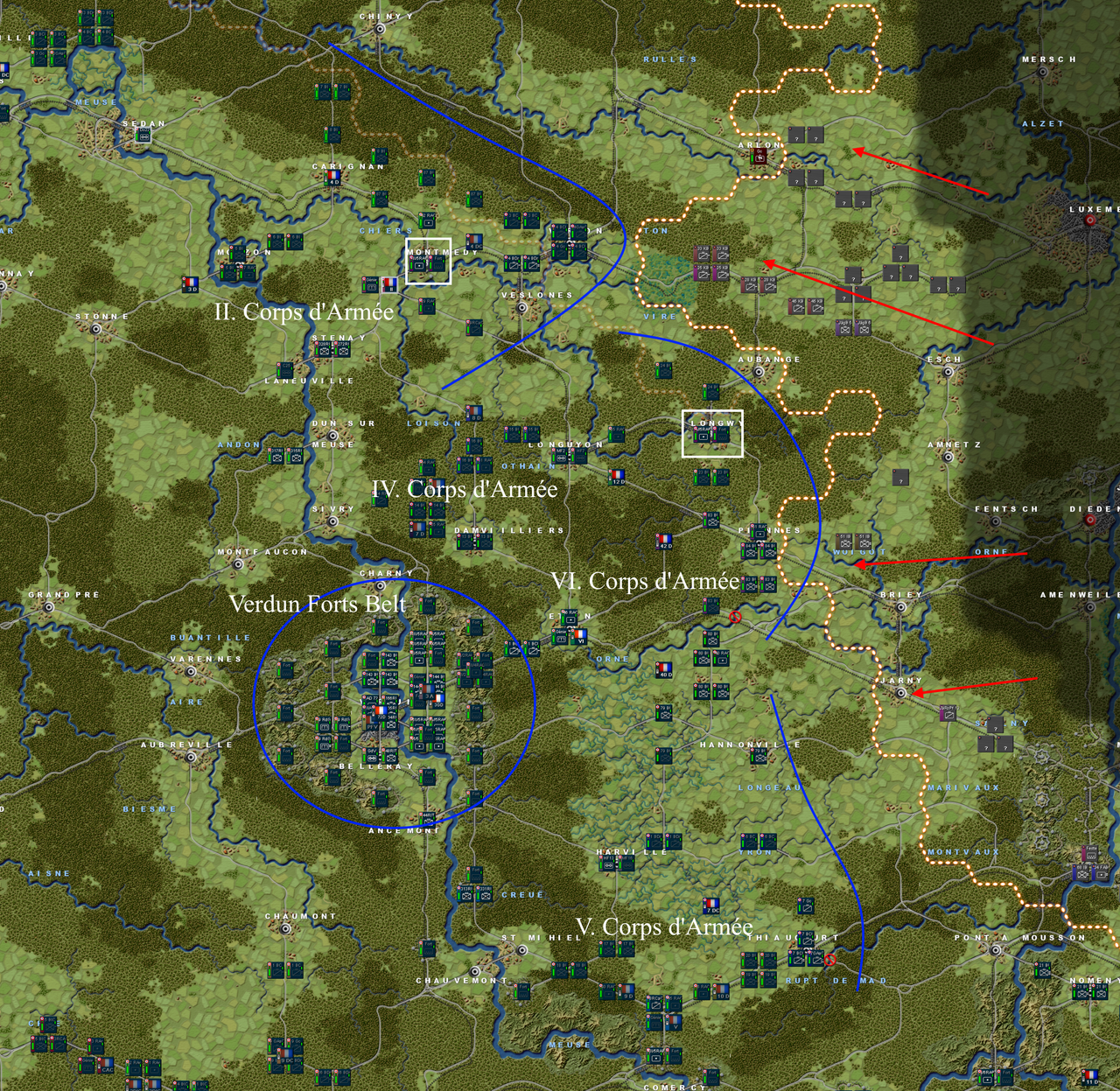
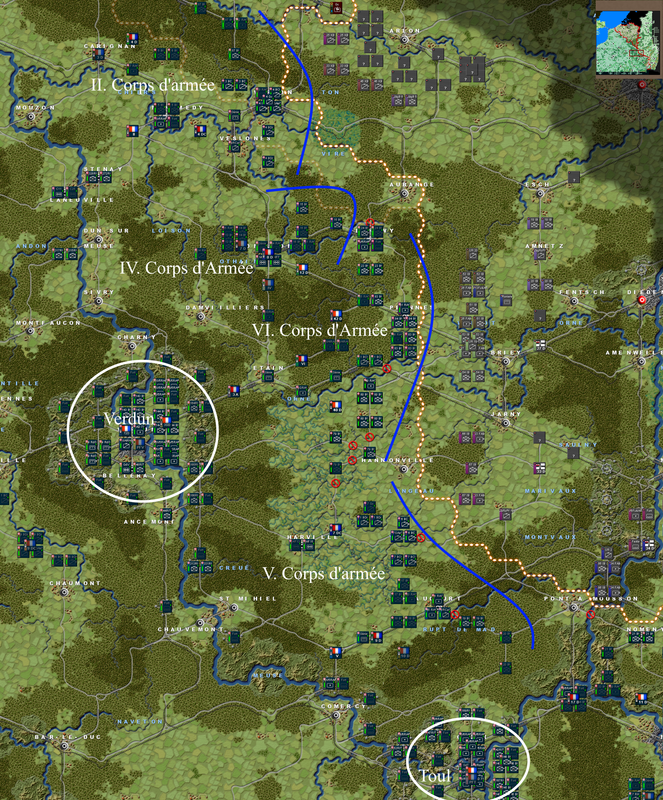
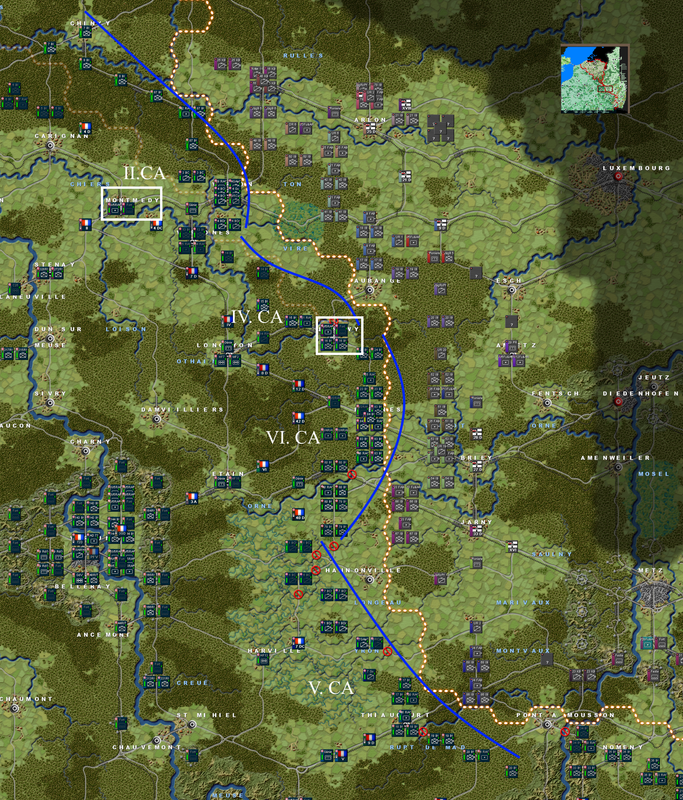
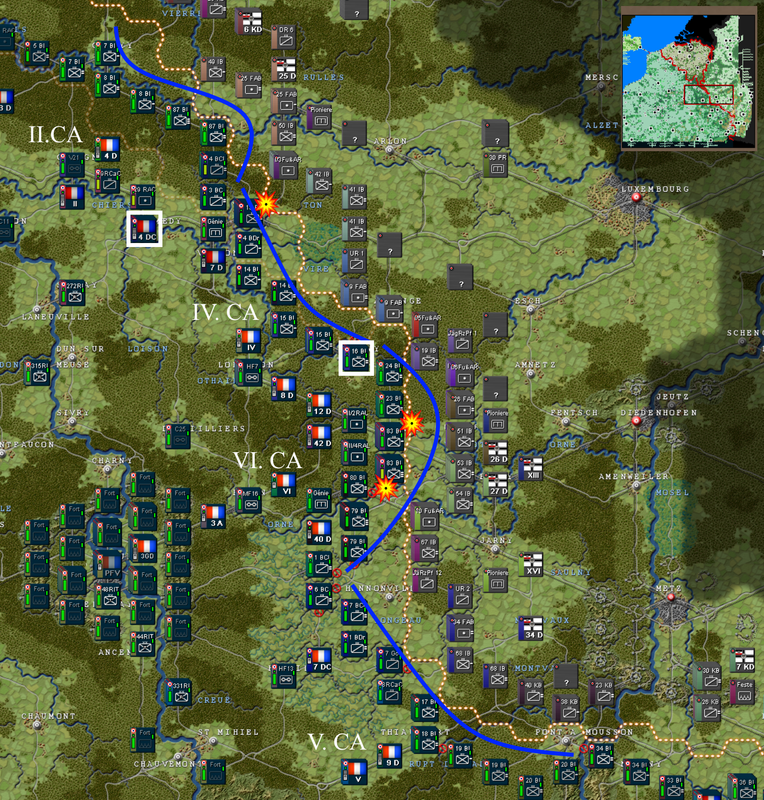
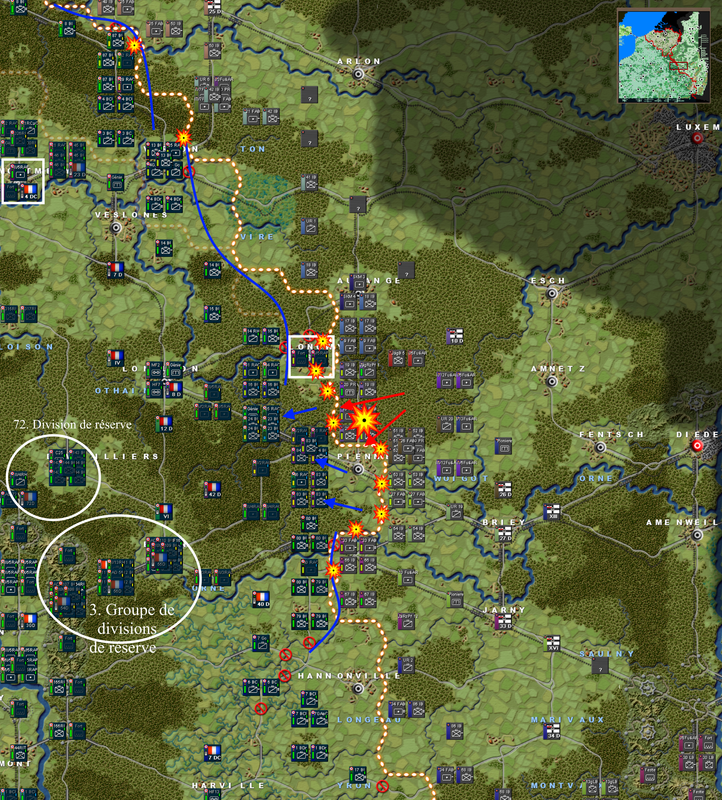
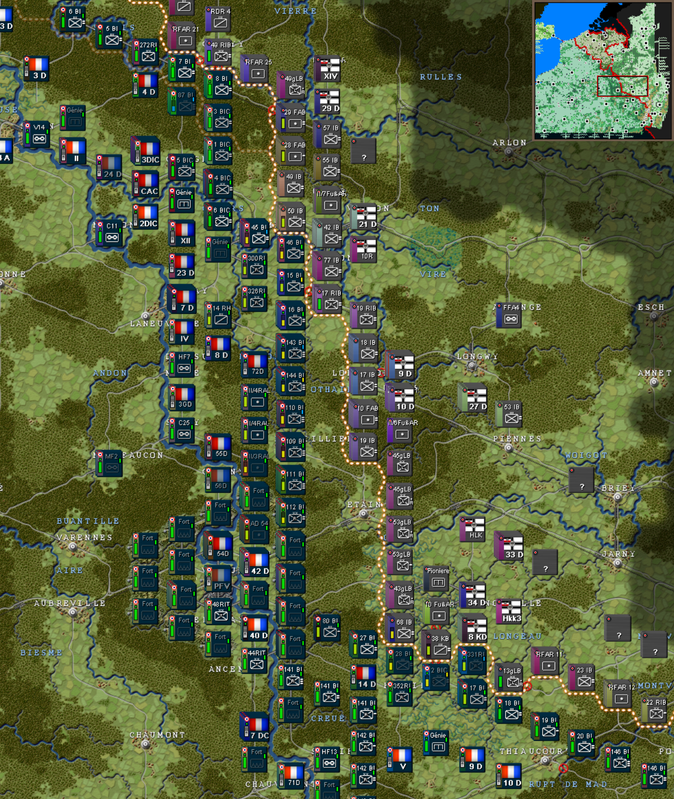
3. Armée is anchoring it's position in front of the Fortified region of Verdun on the two small citadels of Montmédy and Longwy; waiting to see if the German army will try to challenge them. Planes reconnaissance has signaled cavalry formations moving west along the Luxembourg-Sedan railroad and infantry units outside of Metz and Thionville. A clash in the Woëvre plain is more than likely in the next few days.

Center right:
Image

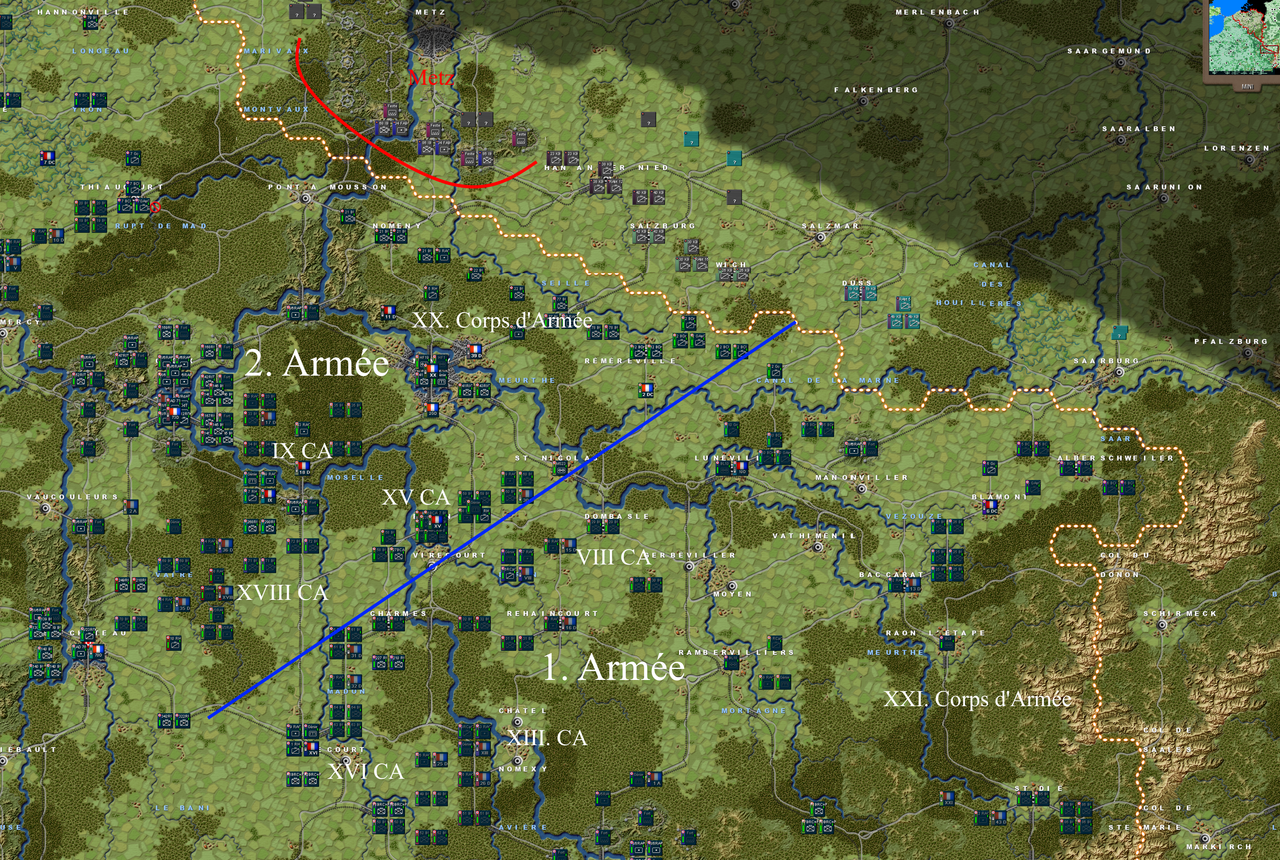
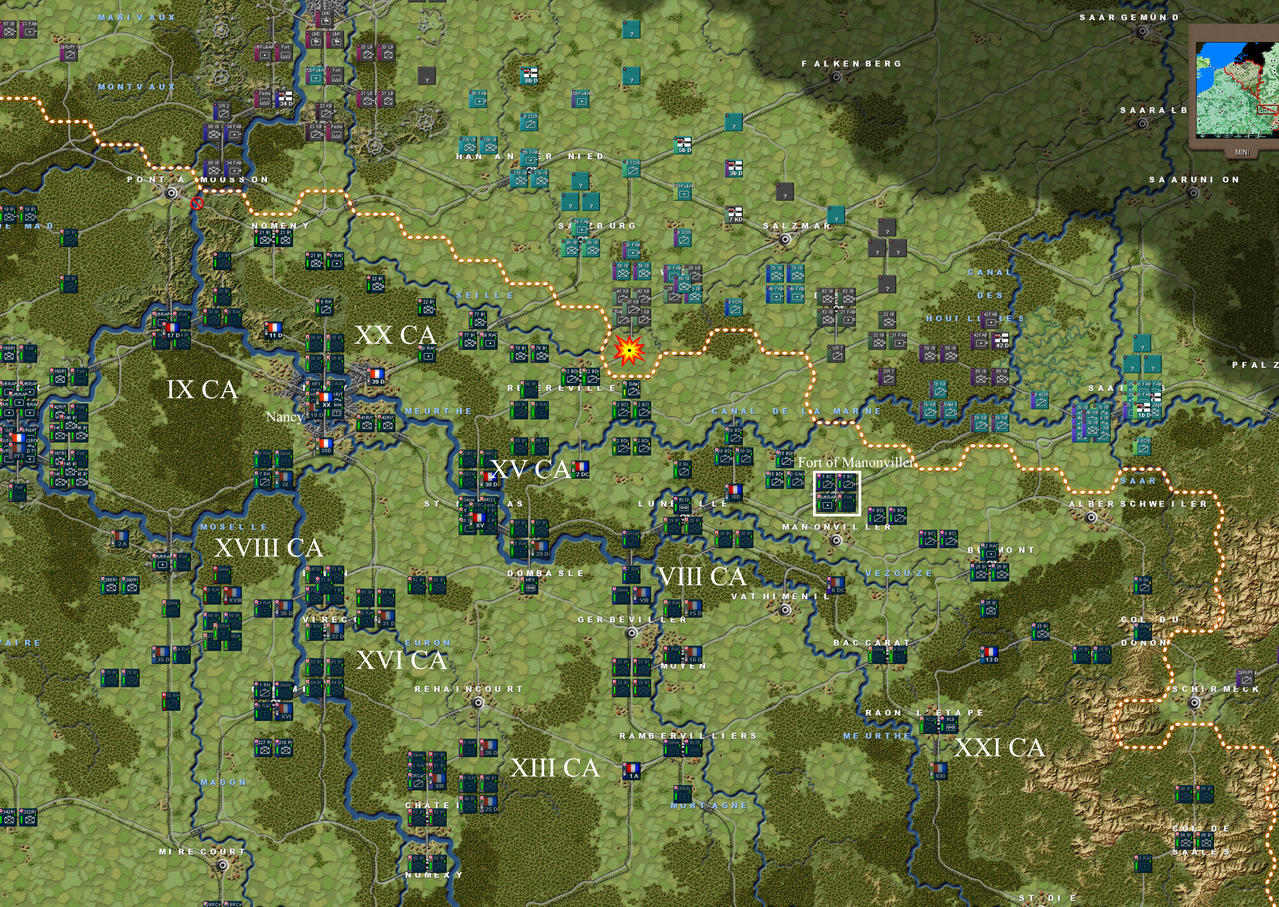
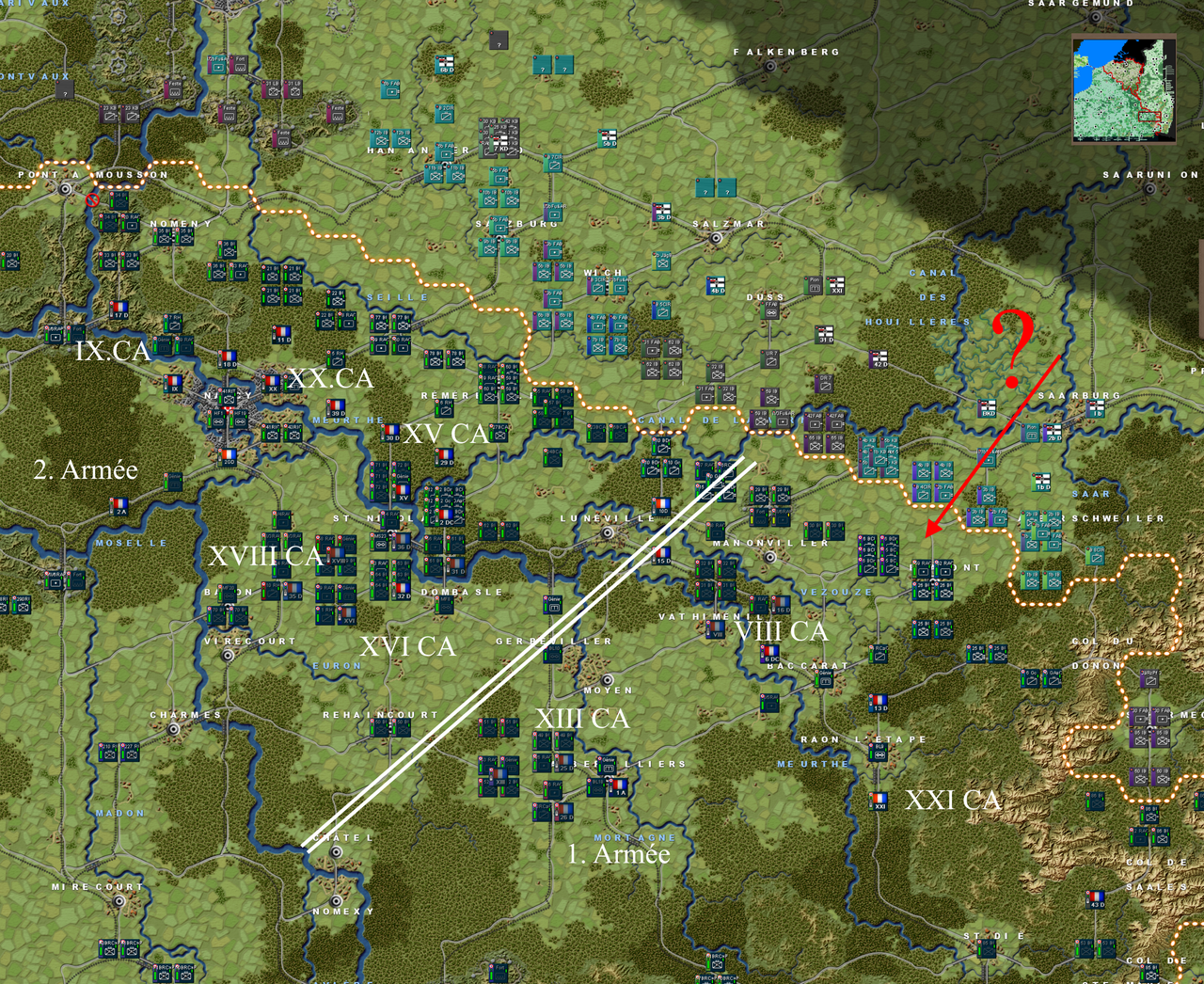
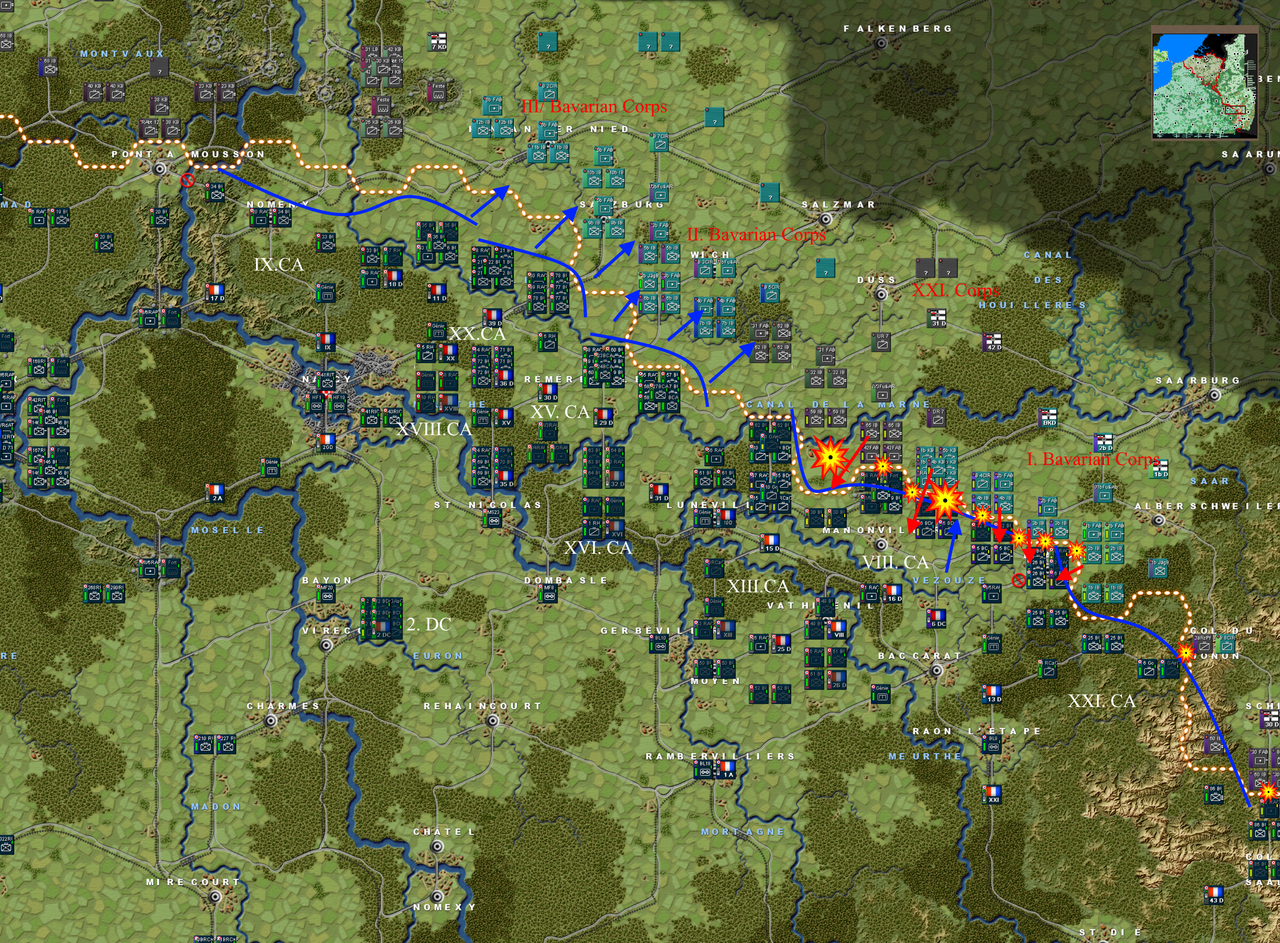
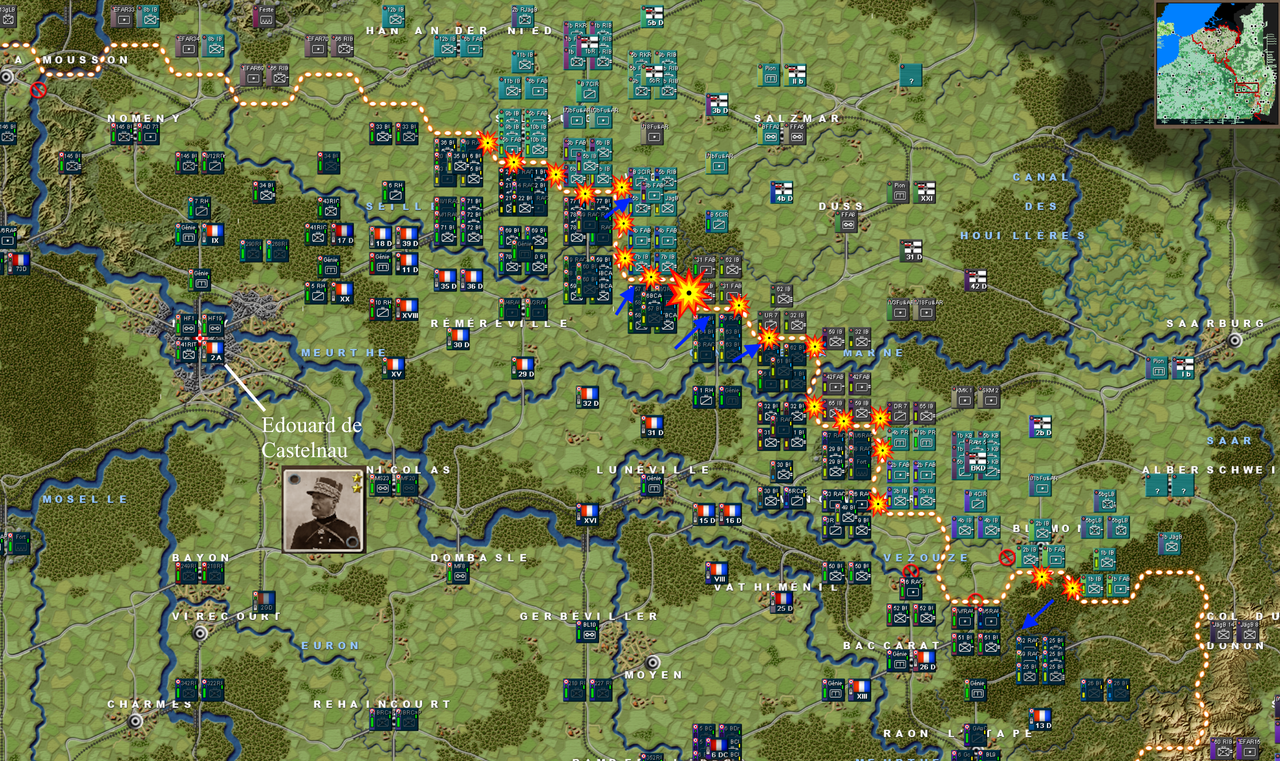
1. and 2. Armée are moving up to launch one of the two main French offensive into Lorraine. Cavalry of both sides are jockeying for position to cover the advance of six Corps d'armée moving up to the front while XX. Corps d'armée covers the Seille river and XXI. Corps d'armée rushes forward to secure the mountain passes over the Vosges of Saales and Donon.

Right flank:
Image

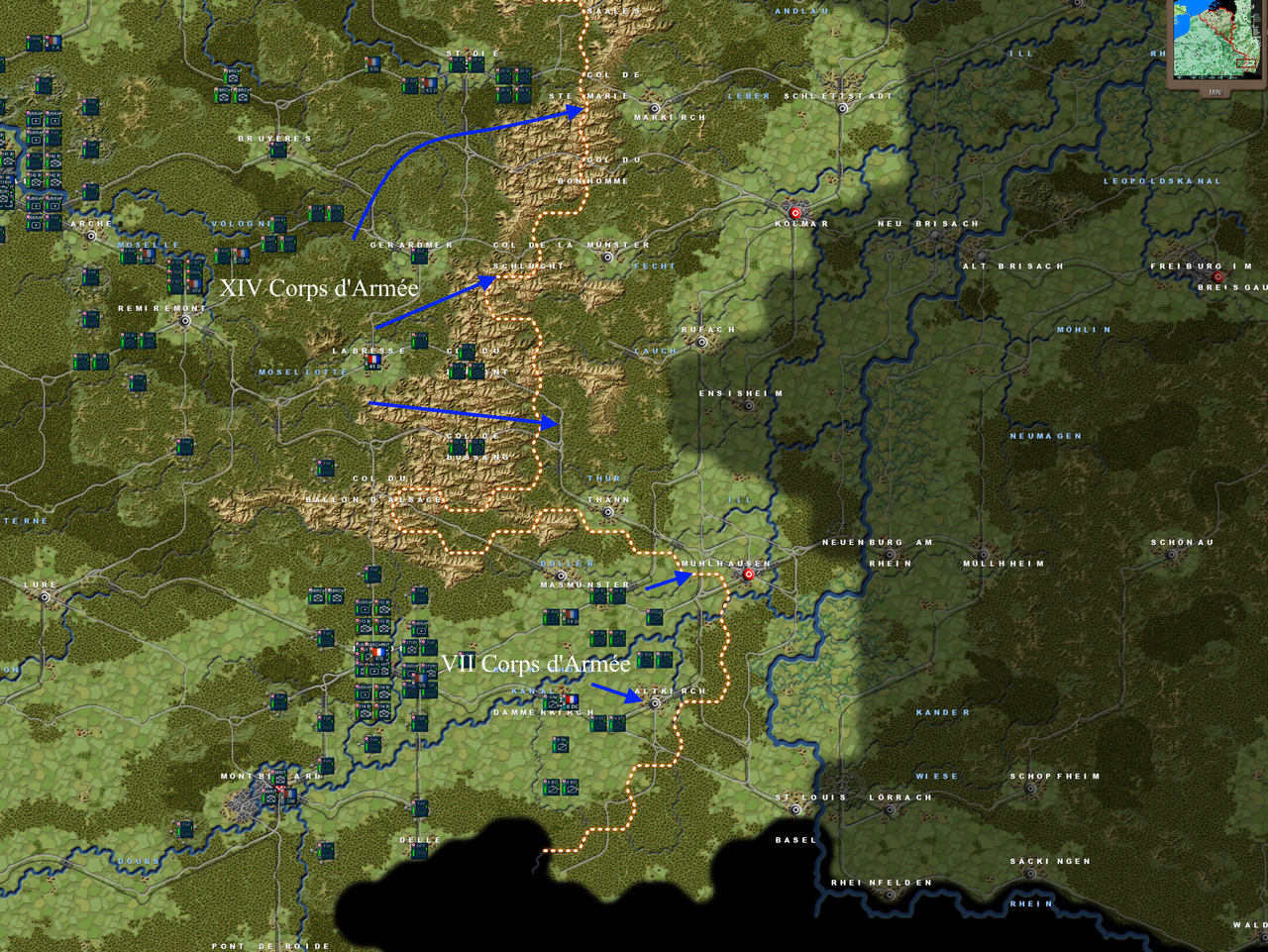
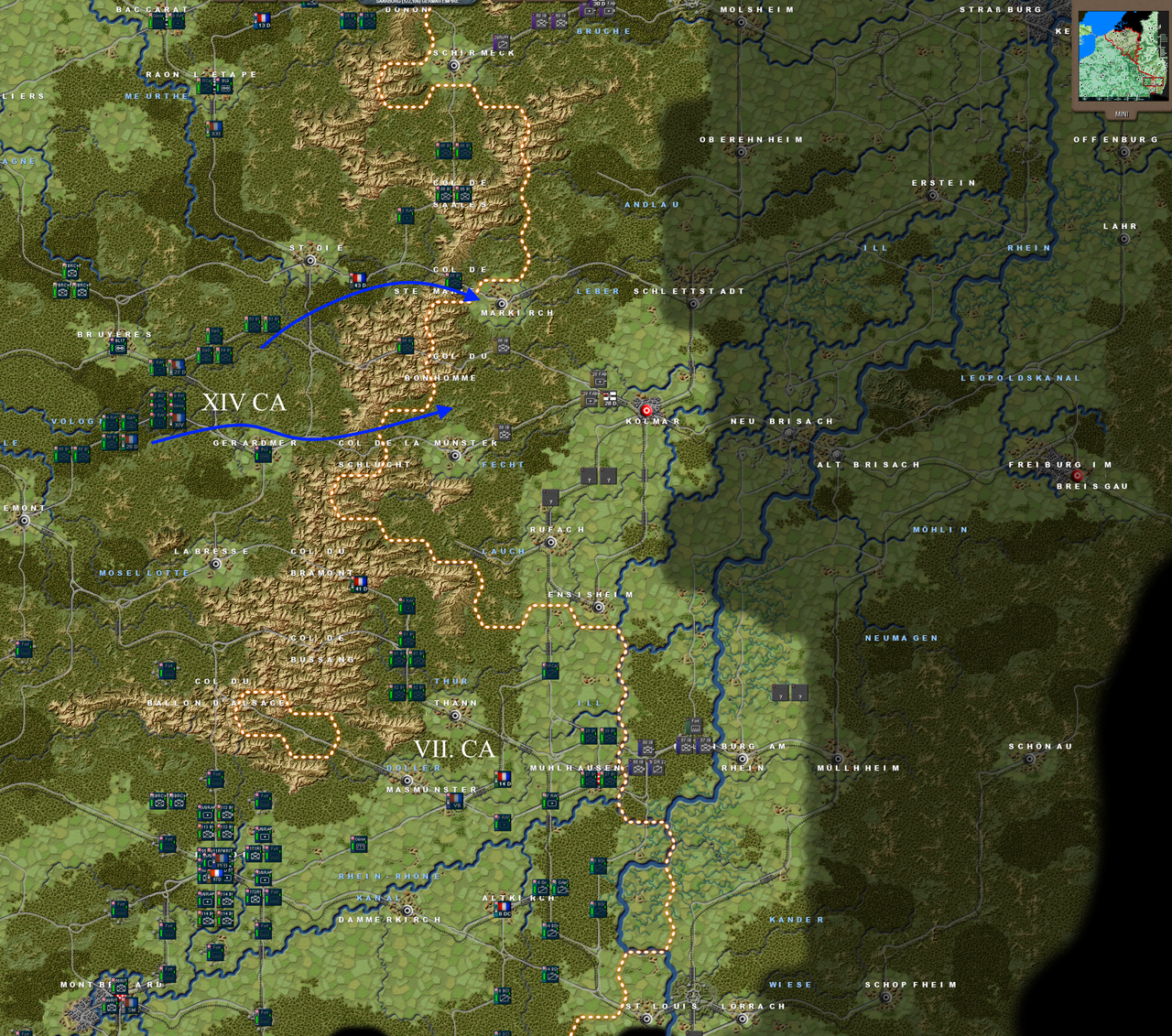
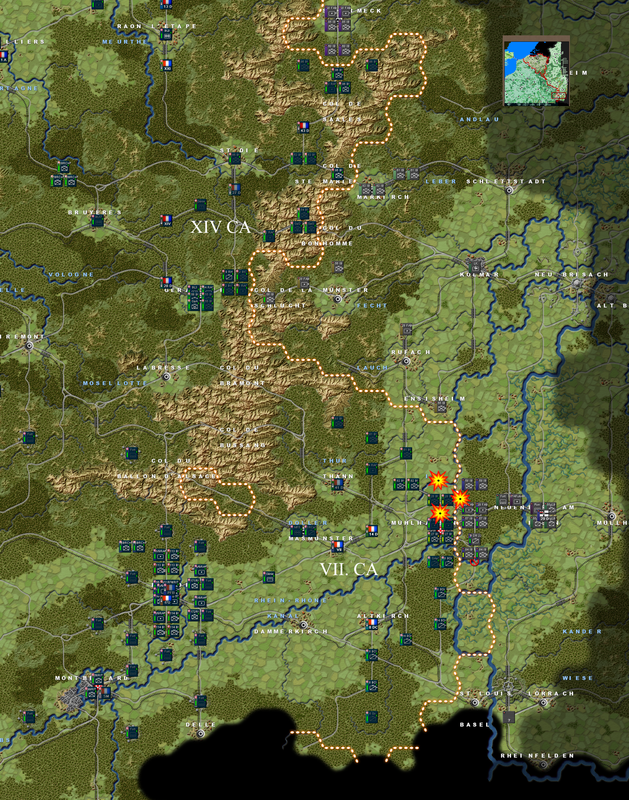
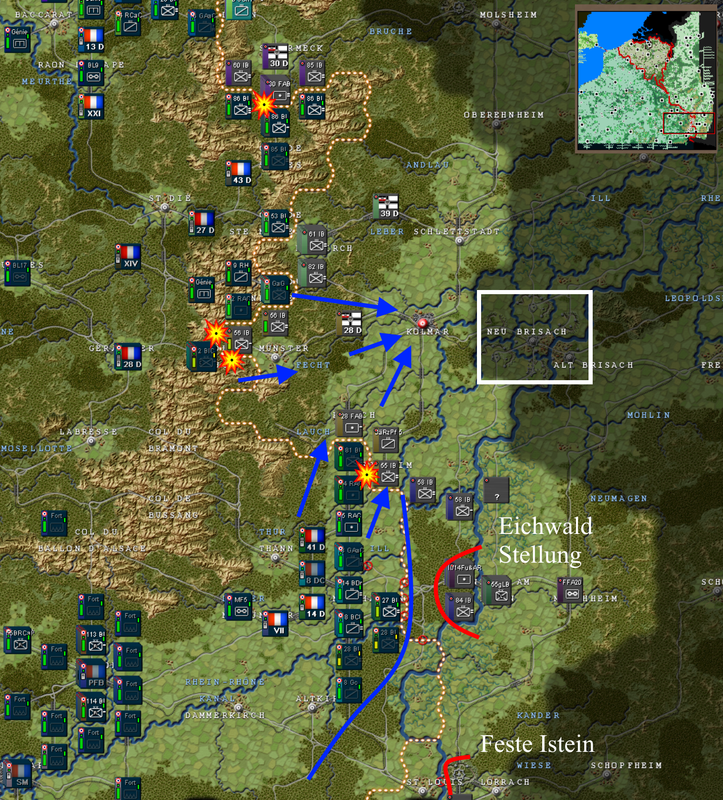
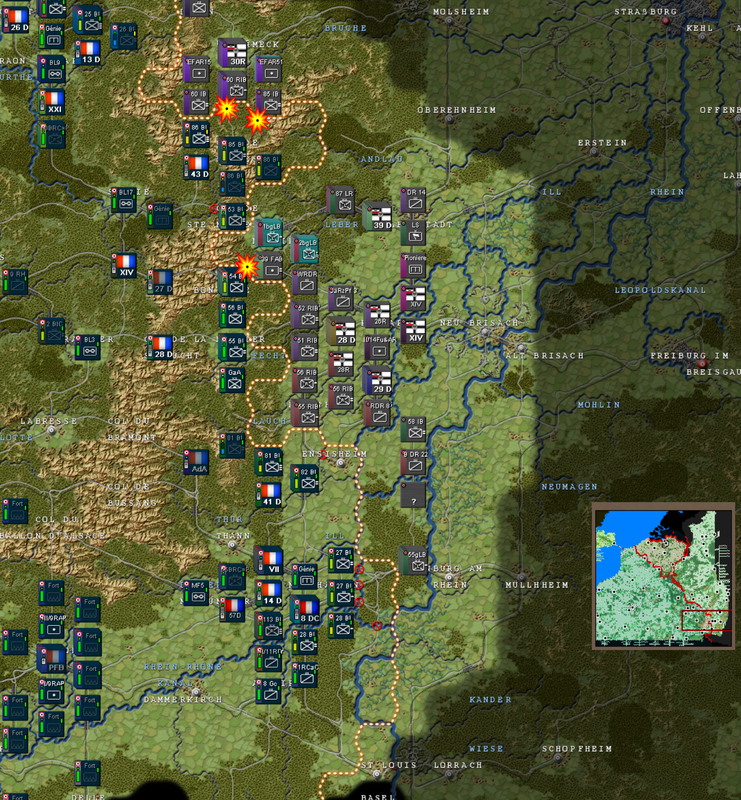
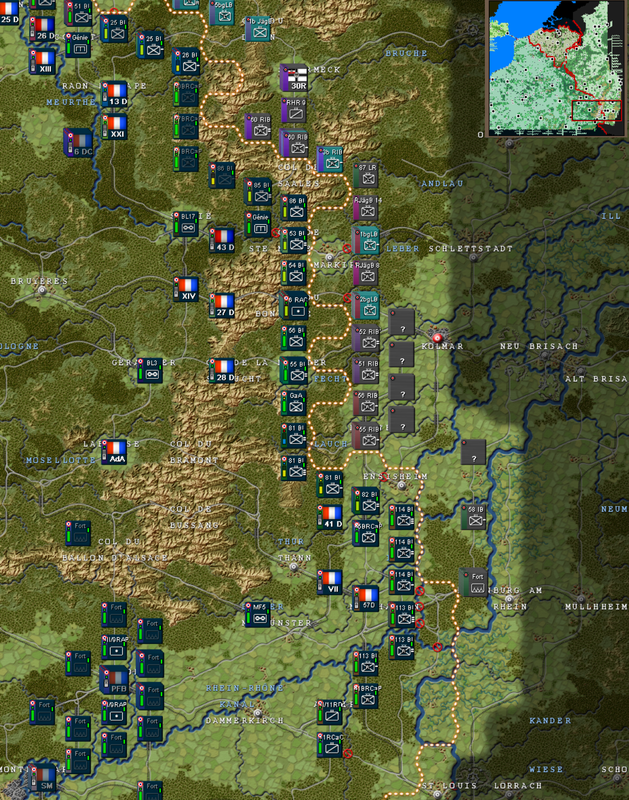
So far the right flank of the French army has not encountered any resistance in the second main effort: an offensive into the Alsace region. French mountain troops are rushing to secure the mountain passes of the Vosges while VII. Corps d'armée pushes towards Mulhouse with 8. Division de cavalerie reaching the outskirts of Altkirch.

Conclusion:

So far everything is going to plan, the war should be over by Christmas.
Last edited by Metatron on Thu Jul 16, 2026 4:48 pm, edited 1 time in total.
-There is safety in numbers.
-Well there is also death in numbers. It's called a massacre.
User avatar
Metatron
Posts: 49
Joined: Thu Jun 19, 2014 9:50 am

Re: Westfront 1914

Post by Metatron »

6august.png
6august.png (3.35 MiB) Viewed 1611 times
Source of the journals: https://gallica.bnf.fr/accueil/fr/html/accueil-fr

6 August 1914

First blood was drawn on this day. Who the first victim of this new war was is unclear, maybe future historians will be able to answer that question. The first French engagement happened near Réméréville, when 7. Kavallerie-Division attacked the 2. Division de cavalerie. Both sides suffered around 300 casualties but the French of the 2. Brigade de dragons retreated giving up a bridge over the river Seille without blowing it.

Dispatches from Belgium:
Little official news is reaching us, Belgian newspapers tout a great victory in front of Liège but it is impossible to know exactly. The only concrete news we have come from civilians that fled the German advance and reached our troops at Virton: they report bloody fighting between the Arlon Garde civique and German cavalry. The latest flyover by Escadrille C25 reported Arlon in German hands and the bridge over the Semois as intact, the fate of the Belgian militia is unclear.

Left Flank:
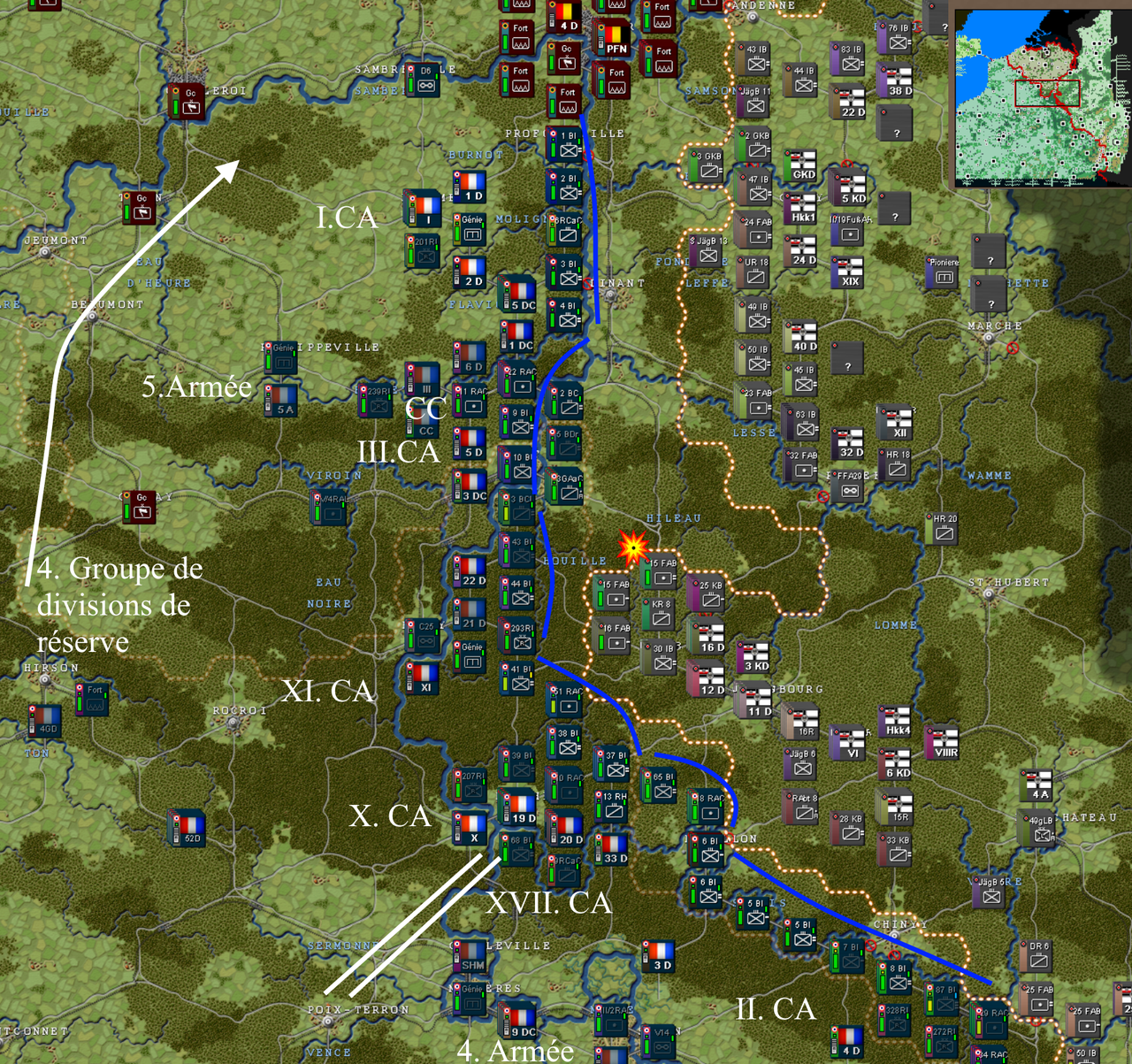
Image

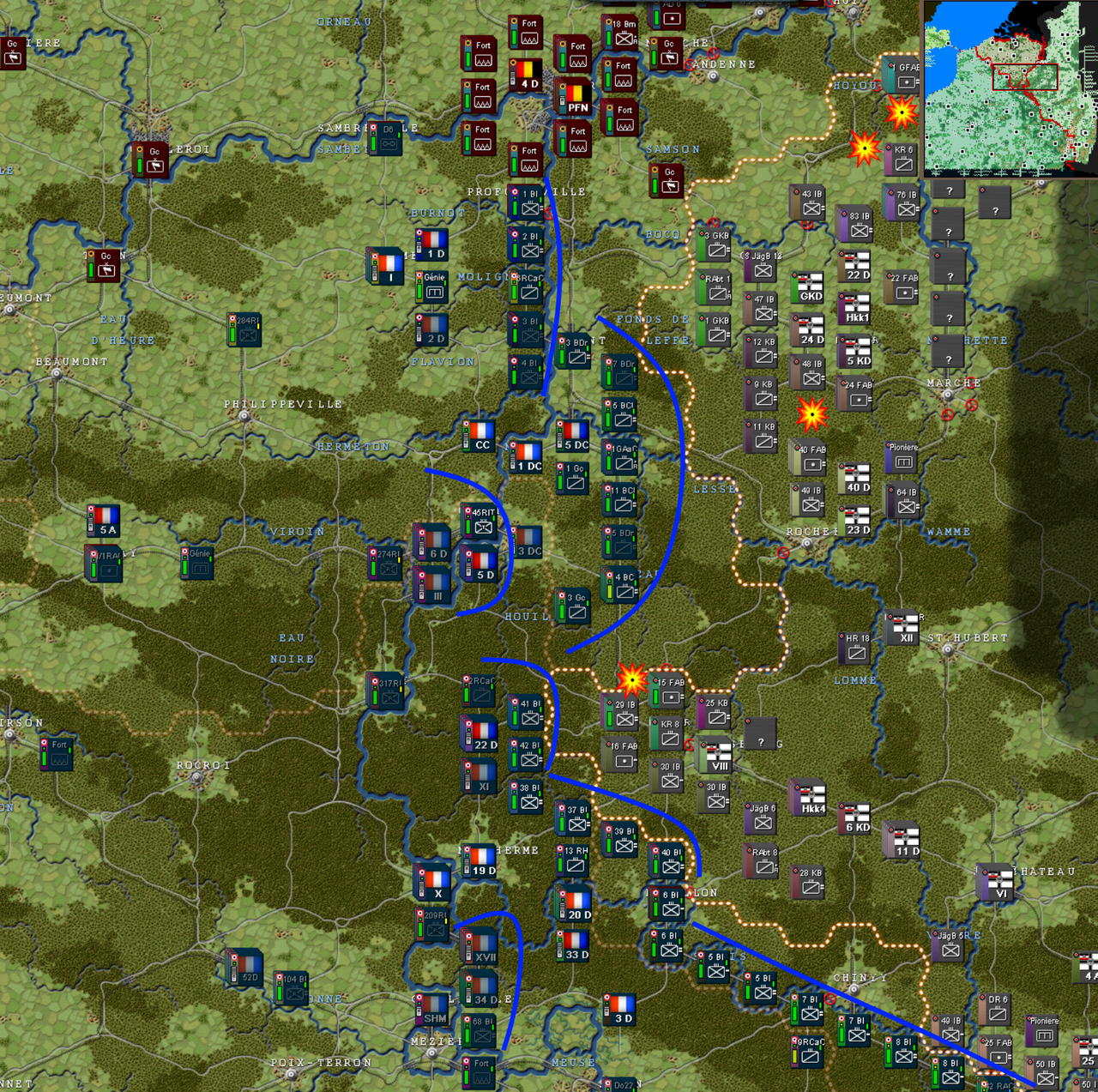
4. and 5. Armée are still moving. The Corps de cavalerie is getting close to the Givet while the German cavalry seems to be securing crossings across the numerous rivers of the Ardennes.

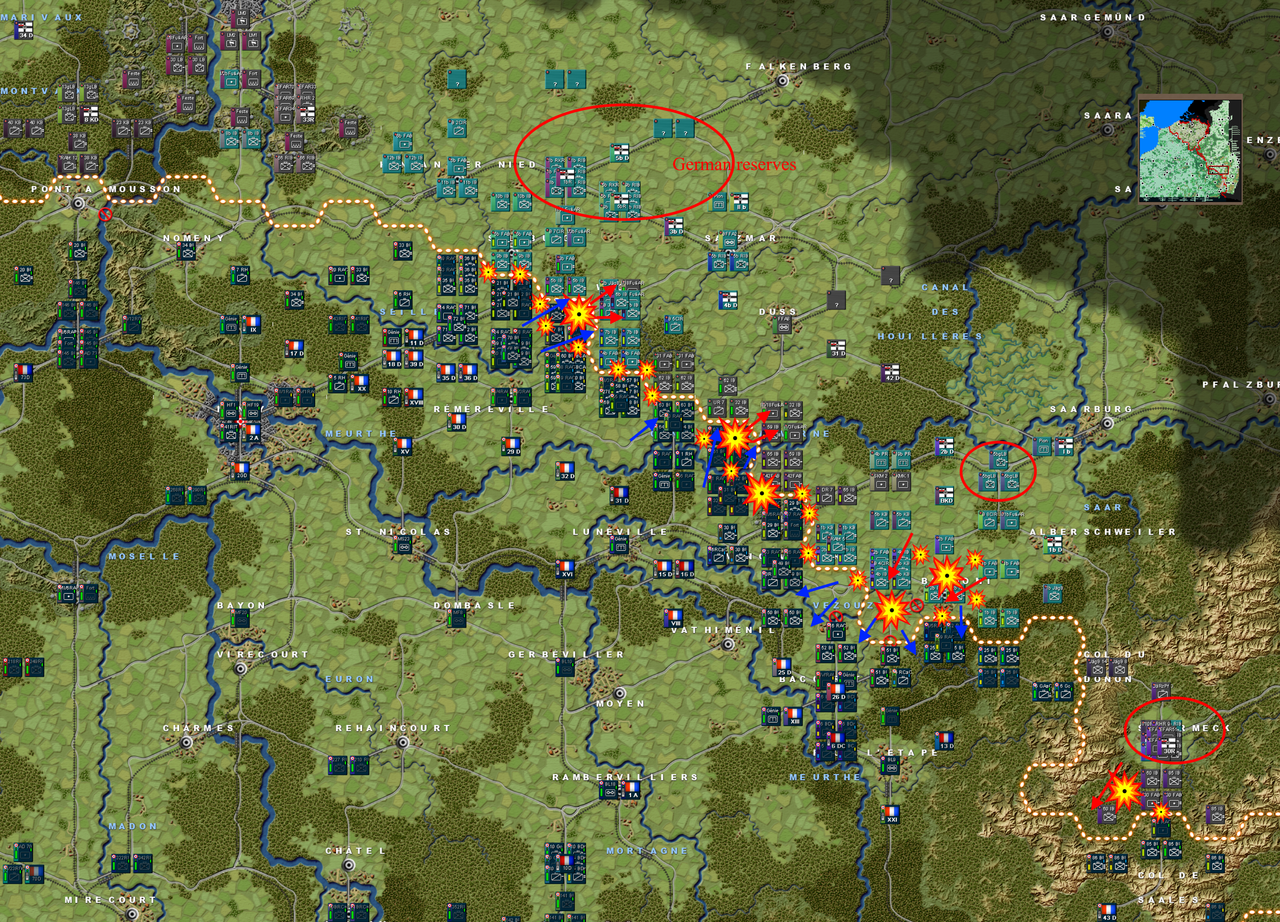
Center left:
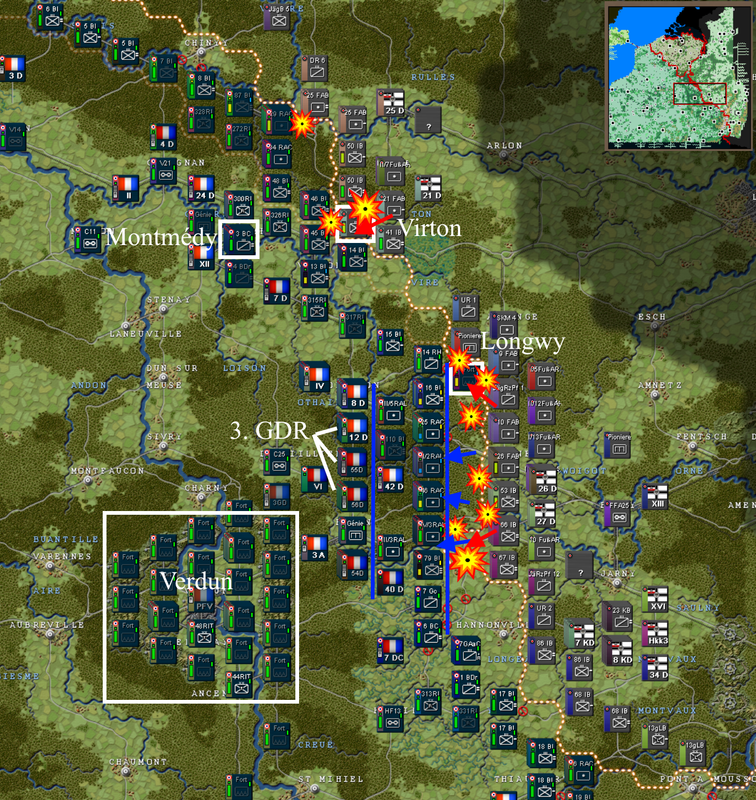
Image

3. Armée is almost completely deployed and is blowing up bridges in the Woëvre plain to force the German advance into the the artillery positions of V. and VI. Corps d'armée (CA). An entire German army corps looks to be assembled in front of Briey so we expect an attack to happen tomorrow.

Center right:
Image

1. and 2. Armée are still moving into place, it will take several more days before the main attack can happen. IX. CA is sliding into the left of the line, allowing XX. CA to concentrate it's units again along the Seille. 2. Division de cavalerie lost it's first battle but XV. Corps d'armée is arriving behind it and should relieve the cavalry tomorrow. On the right the entirety of 1st Bavarian Corps appears to be crossing the Saar at Saarburg and this forced 6. Division de cavalerie (DC) to fall back towards the fort of Manonviller. The good news is general Pierre Lanquetot pushed his 43. Division d'infanterie to move quickly and the chasseurs à pied of 86. Brigade d'infanterie managed to capture the Saales mountain pass and to push into the Bruche valley, threatening Schirmeck alongside the bicycle company and artillery group of 6. DC which secured the Donon mountain pass.

Right flank:
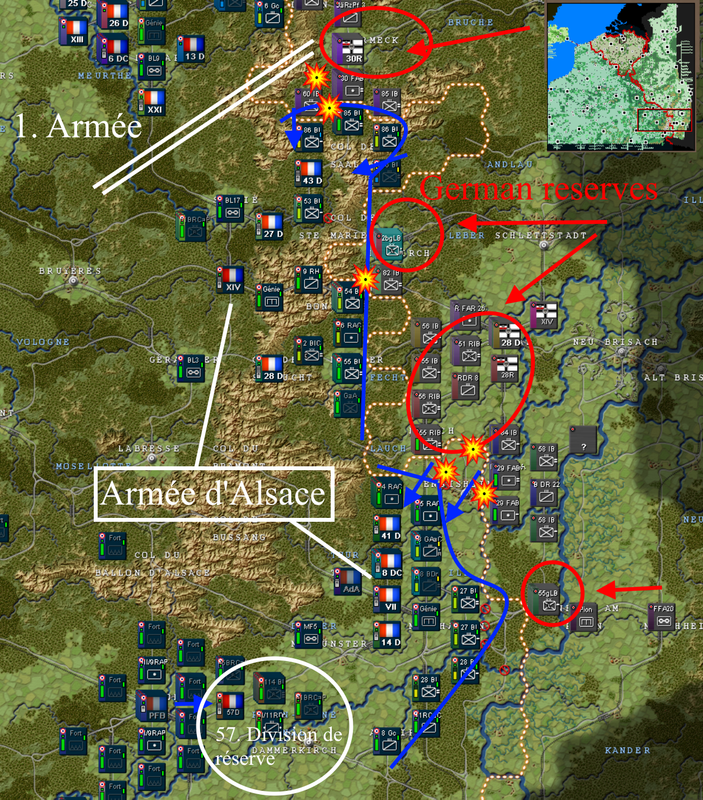
Image

Great news everyone! Mulhouse is liberated by 27. Brigade d'infanterie but a German division is at the gates of the city. A clash is surely about to happen, with French artillery still lagging behind and 41. Division d'infanterie one day away after securing the lower Vosges mountain passes. In the central Vosges the race is on for the passes with German infantry at the gates of Münster and Markirch.

In other news:

- Joseph Joffre visited the 2. Division coloniale today. We expect great things from our colonial infantry.
- The first French plane was lost today. A Blériot XI of Escadrille BL9 was either shot down or crashed in the Bruche valley during a reconnaissance flight.

Conclusion

The stage is almost set, the actors are sharpening their blade and the curtain will soon be soaked in blood. Our first engagement may have been a defeat but our quick advance seems to bear fruit in Alsace and the Vosges.
Last edited by Metatron on Thu Jul 16, 2026 4:51 pm, edited 1 time in total.
-There is safety in numbers.
-Well there is also death in numbers. It's called a massacre.
User avatar
Metatron
Posts: 49
Joined: Thu Jun 19, 2014 9:50 am

Re: Westfront 1914

Post by Metatron »

7 aout presse.png
7 aout presse.png (3.15 MiB) Viewed 1582 times
Source of the journals: https://gallica.bnf.fr/accueil/fr/html/accueil-fr

7 August 1914

The battle of Mulhouse is on and after one day of fighting the French troops still hold the city in southern Alsace. The rest of the line is still calm with some small exceptions but both sides are lining up in Lorraine and the Wöevre for a big fight. Joffre and his staff is happy with this sign that the German main effort will be indeed in the center and not in Belgium. Several heavy artillery batteries from the Grand Quartier Général (GQG) reserves are being rerouted to Verdun to support 3. Armée of general Emmanuel Ruffey.

Dispatches from Belgium:
The Belgian defense of Liège is still holding, the fighting is apparently concentrated on the forts of Barchon and Evegnée.

Left flank:
Image

Some reorganizing here, with II. Corps d'armée being assigned to 4. Armée that is still lagging behind 5. Armée. Meanwhile the cavalry corps advances in the Ardennes and might clash with German cavalry is the next few days.

Center left:
Image

German 15cm artillery fire landed on Piennes but no main attack happened. Aerial reconnaissance is noting an increasing number of enemy artillery units concentrating. Joffre is sending more of his own limited heavy artillery to counter the threat since it seems to be the main German attack; with at least 10 German divisions concentrating in the area. GQG is organizing the mouvement on some of the reserve divisions that will finish their mobilisation in the next few days to the area to have more reserves to stop any German attack towards the Meuse or to organize a counter attack.

Center right:
Image

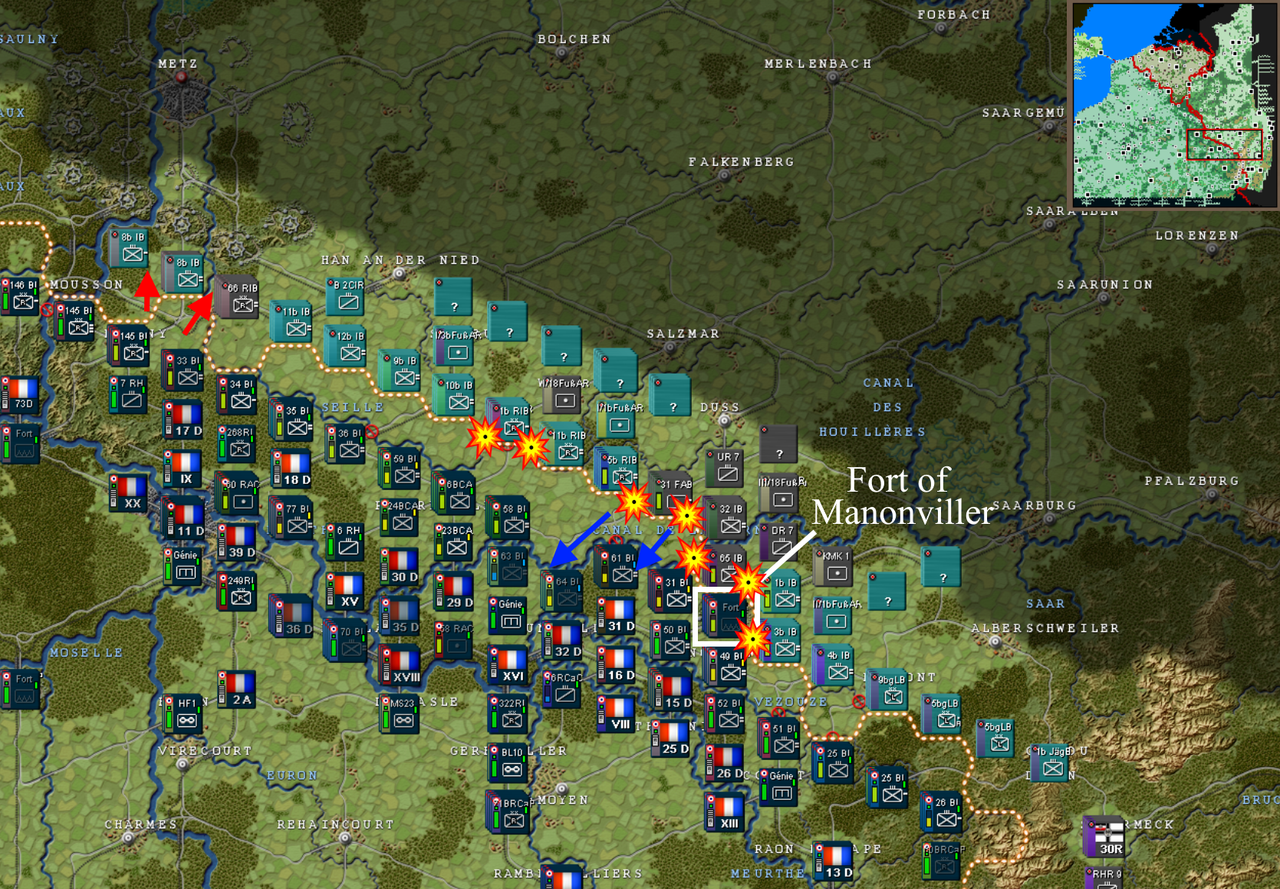
Similarly on the Lorraine plateau both sides are lining up, but while the Bavarians are now fully on the front, there is still three French army corps moving up. Once in place the French will have numerical superiority and the offensive will be launched as planned. 1. Armée left flank is in the worst position so far here and is threatened by I. Bavarian Corps near Blamont and Manonviller since the 16. Division d'infanterie is late and 6. Division de cavalerie holding the line in the meantime. Consequently 13. Division had to abandon the Donon mountain pass.

Right flank:
Image

The battle of Mulhouse was started by German artillery followed by an infantry attack just north of town, inflicting heavy casualties among 28. Brigade d'infanterie and forcing it to retreat. But the arrival of French artillery changed the battle when 5. and 47. Régiment d'artillerie de campagne and their 84 canon de 75mm hammered the German assault brigade and a countercharge by French troops forced the Germans back across the Canal du Rhin-Rhône. The results: 1900 French casualties to 2850 Germans. Meanwhile in the Vosges the race for the mountain passes is still on.

In other news:
- An 12cm armored turret of fort Barchon was knocked out by a 15cm German shell.
- An artillery duel between the fort of Manonviller and German artillery on the northern side of the Canal de Lorraine goes bad for the French, loosing two 120mm Mlle 1877 guns and one of it's four 155mm armored turrets in the exchange.

Conclusion:

A victory in Alsace will be a great propaganda coup, yet it remains to be seen if the German will continue their attacks or if the French troops will be able to start pushing towards Colmar. GQG is happy and projects a victory in Alsace if sufficient reserves are sent to strengthen the push.
-There is safety in numbers.
-Well there is also death in numbers. It's called a massacre.
Emp_Palpatine
Posts: 104
Joined: Sun Jan 01, 2006 10:49 am

Re: Westfront 1914

Post by Emp_Palpatine »

Very interesting indeed!

I guess this won't be playable against the AI? :|
I am the Senate!
User avatar
Metatron
Posts: 49
Joined: Thu Jun 19, 2014 9:50 am

Re: Westfront 1914

Post by Metatron »

Emp_Palpatine wrote: Thu Jul 16, 2026 7:52 pm Very interesting indeed!

I guess this won't be playable against the AI? :|
Unfortunately not, it will be PvP only.
-There is safety in numbers.
-Well there is also death in numbers. It's called a massacre.
User avatar
Metatron
Posts: 49
Joined: Thu Jun 19, 2014 9:50 am

Re: Westfront 1914

Post by Metatron »

8august.png
8august.png (2.64 MiB) Viewed 1560 times
Source of the journals: https://gallica.bnf.fr/accueil/fr/html/accueil-fr

8 August 1914

Mulhouse stand as a French city after two days of battle. The roar of artillery is now heard along large portions of the front but the main action of the day happened in Lorraine as the I. Bavarian Corps launched a dual pronged attack.

Dispatches from Belgium:
The defenders of Liège hold steadfast, Germans are being mowed down by artillery but now it's the four eastern forts of the city-fortress that are reported to be under attack, not just Barchon and Evegnée. Numerous massacres are also being reported as the German troops sweep across the Ardennes, with reports of civilians being killed coming out of Marche, St. Hubert and Neufchâteau.

Left flank:
Image

The French line is extending slowly north towards Namur but are yet to meet the Germans. The Belgian militias and franc-tireurs seem to have blown some bridges but the advance of the enemy has been constant the last few days.

Center left:
Image

German artillery continues to gain in intensity, hinting at an avalanche to come. Both sides are maneuvering into place strengthening their defensive line and positioning for an attack respectively. French heavy artillery batteries, including 24 Canon de 120L Mle 1878, 6 Obusier de 120C Mle 1890 and 6 Obusier de 155C Mle 1904, are now deployed around Piennes to provide counter battery fire once/if the German attacks comes.

Center right:
Image

As predicted I. Bayerisches Armeekorps launched an attack, but was supported on it's right by 42. Infanterie Division . The resulting two battles for Blamont on the right and Manonviller on the left, from French perspective, were a mixed bag: 10. Division de cavalerie being mauled on the left, loosing at least 24 canon de 75mm of it's own and from VIII. CA artillery. The Bavarian Cavalry Division in full force smashed into 30. Brigade d'infanterie forcing them to flee before 16. Division d'infanterie could re-establish the line. Near Blamont things went better with 6. Division de cavalerie and 13. Division d'infanterie holding the line despite fierce artillery fire.
The day of fighting left almost 9000 Germans, Bavarians and French dead, wounded or missing as artillery of both sides slaughtered infantry formations advancing in open fields.

Meanwhile 2. Division de cavalerie was taken out of the line to be sent west. 10. and 6. Division de cavalerie were also supposed to be extracted but the fierce fighting forced Augustin Dubail, commander of 1. Armée to leave them holding the line. Hopefully the fighting will die down and the cavalry will be able to be send west to form a new cavalry corps and support 5. Armée or the BEF once it arrives.

Edouard de Castelnau's 2. Armée at the same time is finishing it's preparation for the main French assault in Lorraine. 9 divisions should start attacking on August 9th or 10th.

Right flank:
Image

The German 29th Division is falling back leaving us in control of Mulhouse. After much debate Louis Bonneau of VII. CA ordered not to pursue the Germans towards the Rhine: the forested area east of Mulhouse would be difficult terrain for the French infantry and some concrete bunkers with machine guns, called the Eichwald Stellung, secure the bridge at Neuenburg am Rhein. Instead 14. Division d'infanterie will secure Mulhouse until a reserve division can come to relieve it while 41. Division d'infanterie and 8. Division de cavalerie pivot north and launch an offensive towards Colmar in coordination with XIV. Corps d'armée coming down the Fecht valley. Further offensives would be much more difficult with the Rhine and the forts of Neu-Brisach being major obstacles.

In other news:
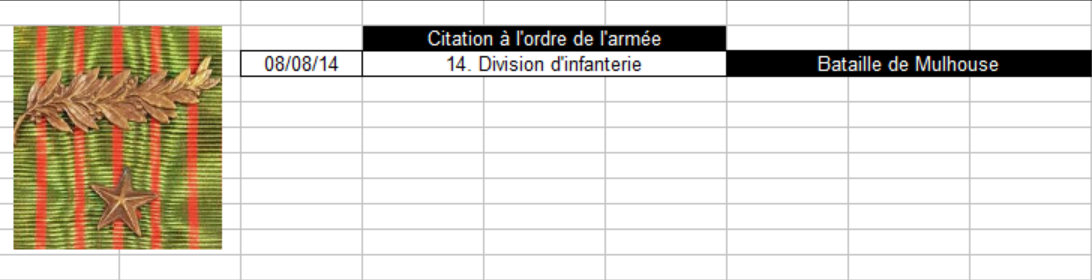
In recognition of the capture of Mulhouse 14. Division d'infanterie was mentioned in the Citation à l'ordre de l'armée of 8. August 1914. Hopefully the first of many exceptional feats of arms.

Image

Conclusion:

Casualties start to rise but the current fighting may well be just a simple skirmish compared to the titanic battles to come. Success in Alsace has lifted the mood of the nation but the next few days of this battle of the Frontiers might prove decisive.
-There is safety in numbers.
-Well there is also death in numbers. It's called a massacre.
Emp_Palpatine
Posts: 104
Joined: Sun Jan 01, 2006 10:49 am

Re: Westfront 1914

Post by Emp_Palpatine »

I see the 42th DI has started to fight in the Ardennes.
That's my great-grand father unit. Hope they make it!
I am the Senate!
User avatar
Metatron
Posts: 49
Joined: Thu Jun 19, 2014 9:50 am

Re: Westfront 1914

Post by Metatron »

Emp_Palpatine wrote: Fri Jul 17, 2026 7:00 am I see the 42th DI has started to fight in the Ardennes.
That's my great-grand father unit. Hope they make it!
Nice, I'll try not to get them all killed. I have family on both sides, two of them buried just a few kilometers away from one another in the Vosges on opposite sides.

42. DI is holding Piennes, so I'm pretty sure they about get the main attack of 5. Armee in the face.
-There is safety in numbers.
-Well there is also death in numbers. It's called a massacre.
User avatar
Metatron
Posts: 49
Joined: Thu Jun 19, 2014 9:50 am

Re: Westfront 1914

Post by Metatron »

9 aout.png
9 aout.png (2.93 MiB) Viewed 1535 times
Source of the journals: https://gallica.bnf.fr/accueil/fr/html/accueil-fr

9 August 1914

Liège stands tall and thus the French left flank since 5. Armée just linked up with the Belgians at Namur. Meanwhile the decisive battles of this war have begun according to Emile Belin and Henri Berthelot at the Grand Quartier général (GQG). In Lorraine 2. Armée attacks while 1. Armée absorbs the punches thrown by the Bavarians; around Longwy the army of the German crown prince has started it's attack.

Dispatches from Belgium:
Liège is bent but unbroken: a secret report from the headquarters of Gérard Léman's 3. Division in charge of the defense acknowledges that super heavy German artillery is now firing at the forts on the right bank on the Maas. The Belgian cavalry was routed and is falling back behind the Maas where the bridges are being blown one after another.

Left flank:
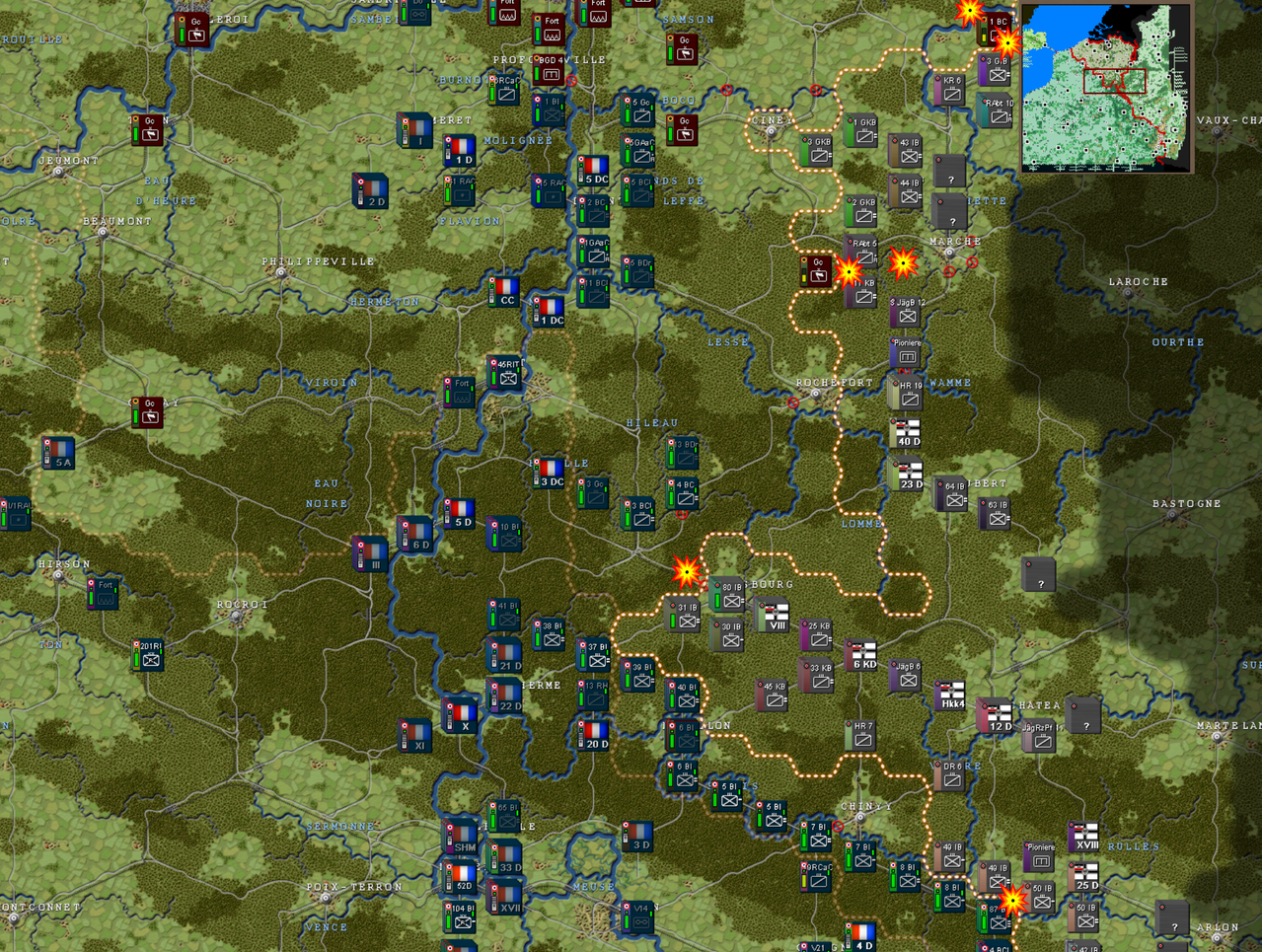
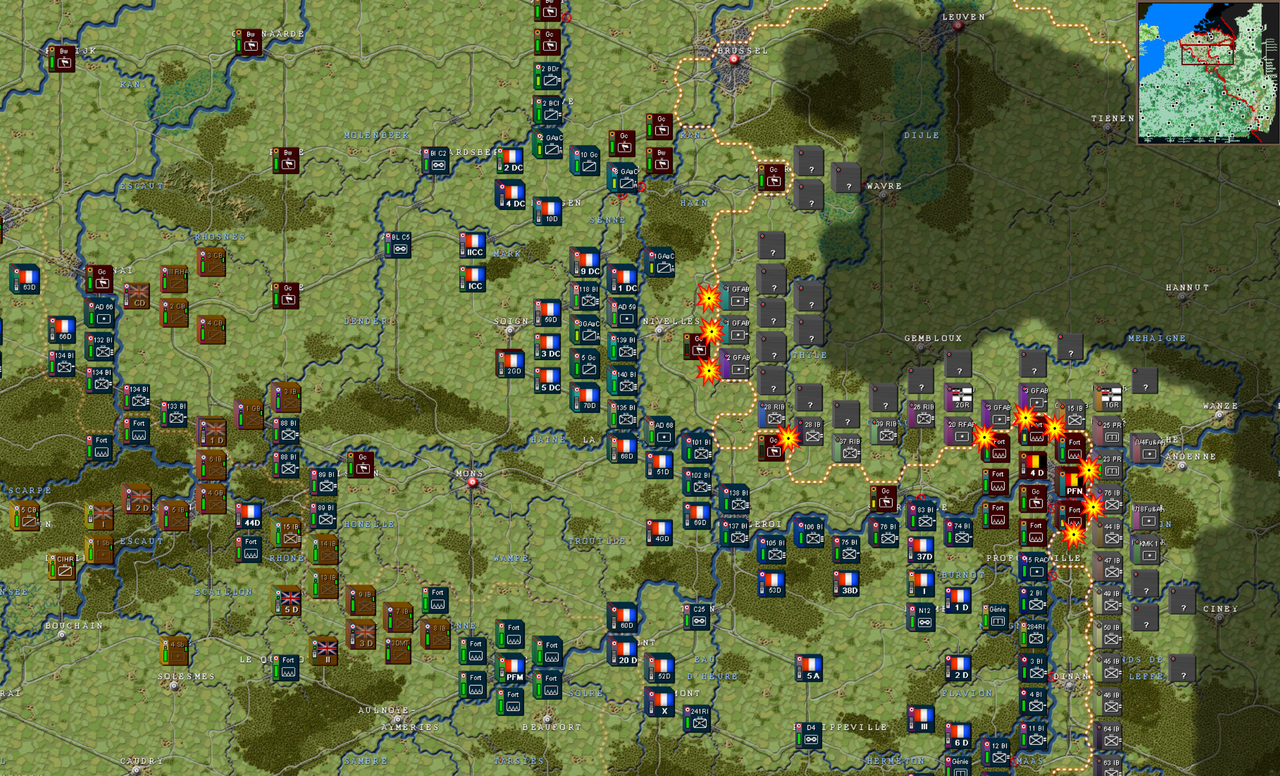
Image

I. Corps d'armée (I.CA) made the connection with the Belgians at Namur while the Corps de cavalerie is screening the Meuse crossing. The leading German column of infantry reached Carlsbourg where 3. Division de cavalerie blew the railway bridge under German artillery fire. In reaction of the battle at Longwy and to shorten it's frontline II. CA abandoned Chiny and is currently blowing up the two bridges there.

Center left:
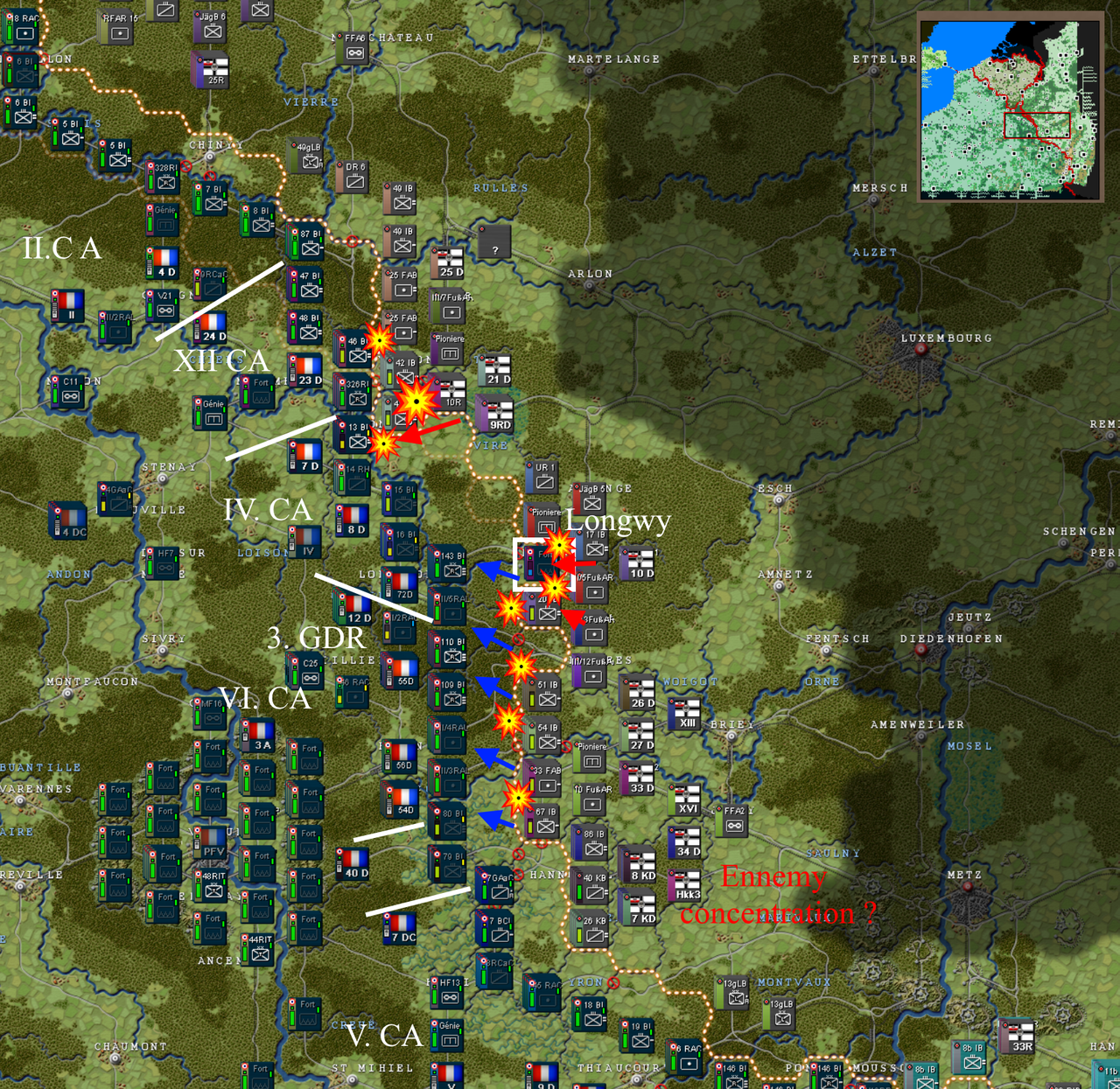
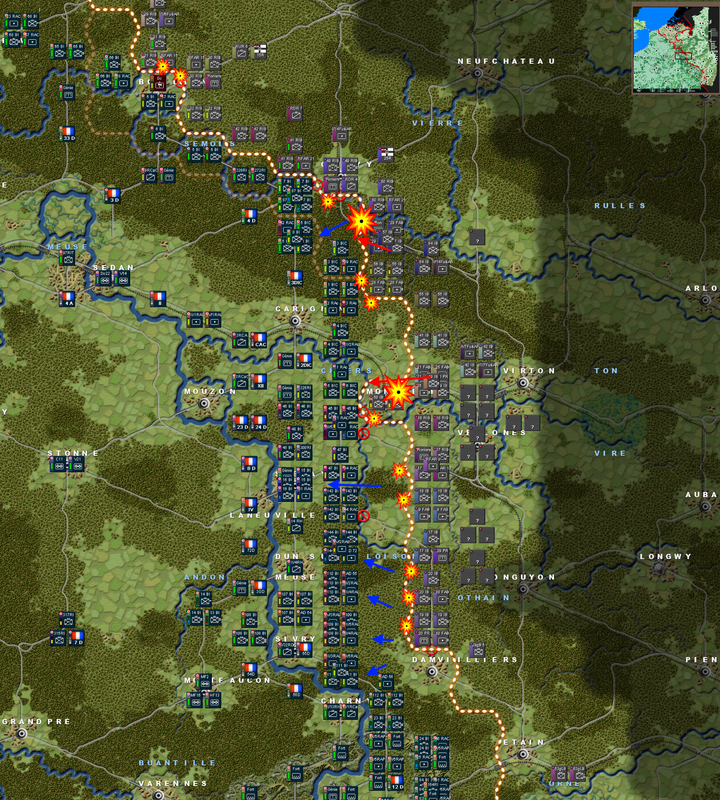
Image

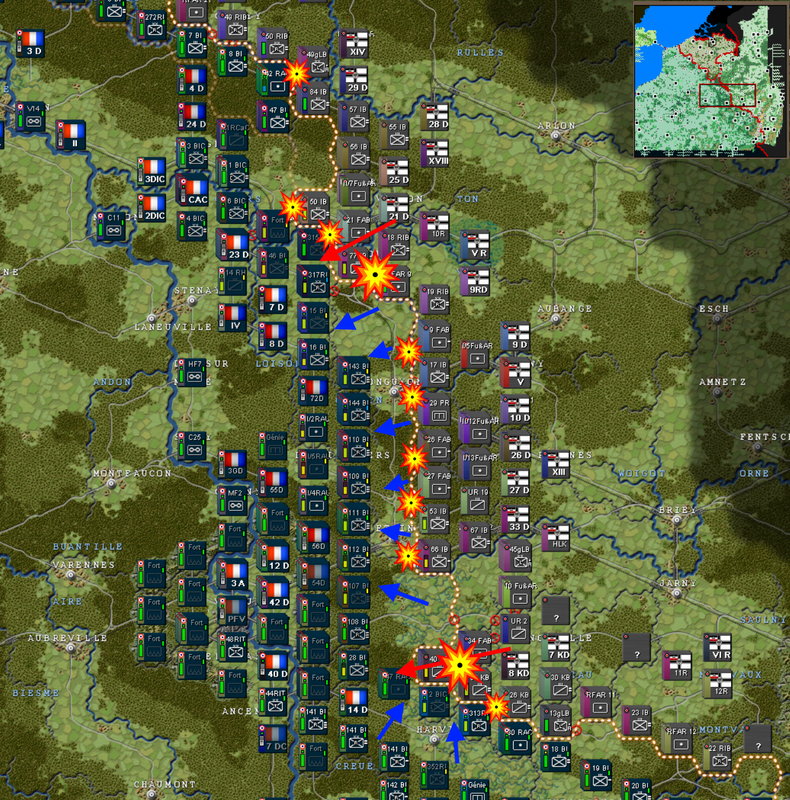
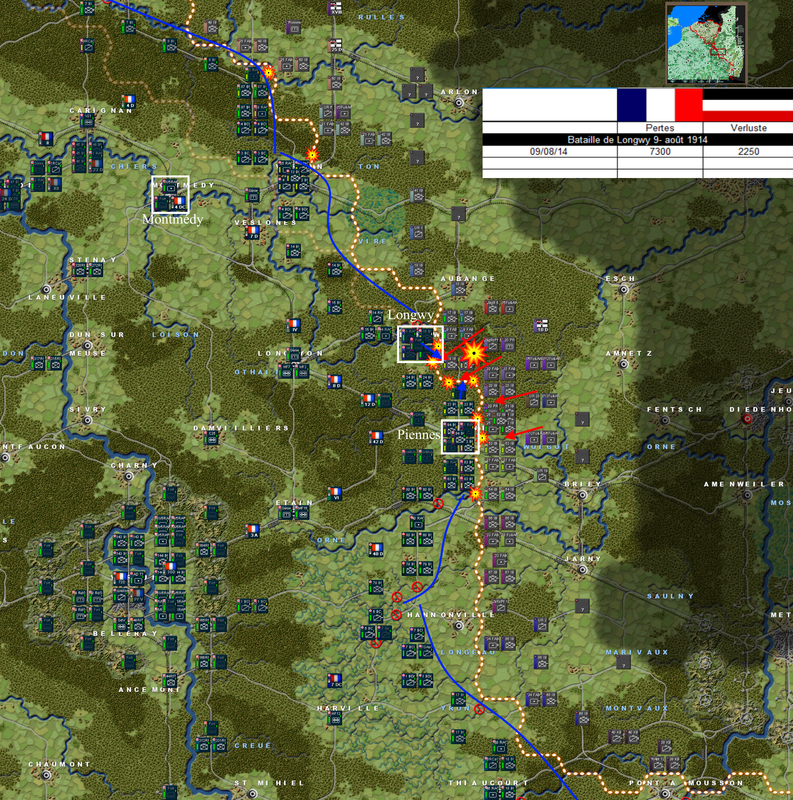
The expected German offensive in the center finally began, but the main attack occurred in the woods between Piennes and Longwy instead of hitting 42. Division d'infanterie. Thus it is Martial Verraux's 12. Division d'infanterie (12. DI) that took the brunt of the first day's offensive. Casualties where high with German heavy artillery, including 21cm Mörser shells, hammering the woods. The following infantry attack could not be stop and 24. Brigade d'infanterie (24. BI) suffered almost 40% casualties during the day. Victor Boëlle of IV. CA ordered a counter attack from Longwy to aid the endangered 12. DI but 16. Brigade d'infanterie of 8. DI suffered heavy casualties trying to repulse the spearhead of the German 10th Division. Maurice Sarrail, commanding VI. CA, sent several panicked messages to GQG asking for immediate aid from at the very least 72. Division de réserve still mobilizing as GQG reserve at Verdun.

Center right:
Image

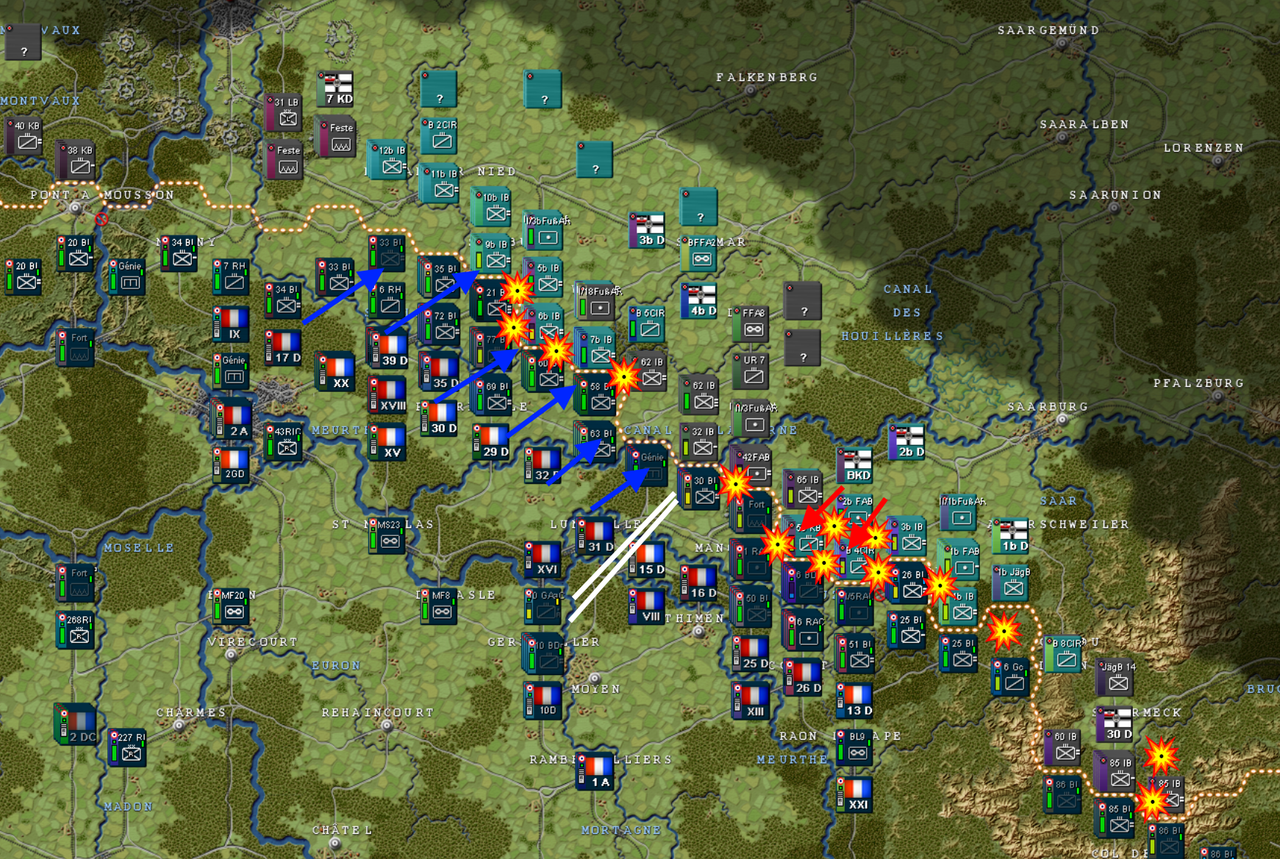
De Castelnau's offensive is starting with 6 divisions in front followed by 2 more. 39. Division d'infanterie launched the first unsuccessful assault but the real fighting should start of the 10th. 10. Division de cavalerie was pulled out of the front as initially intended and will move west with 2. Division de cavalerie in the coming days.

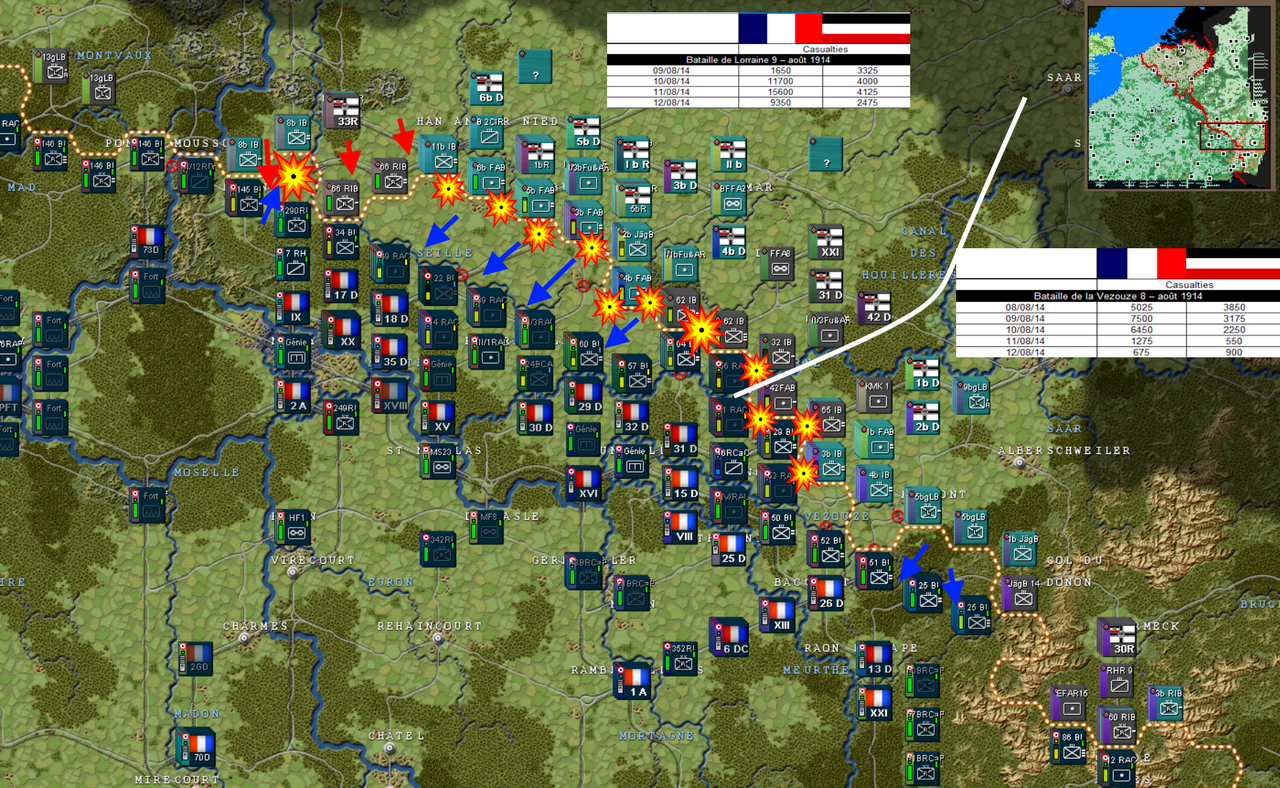
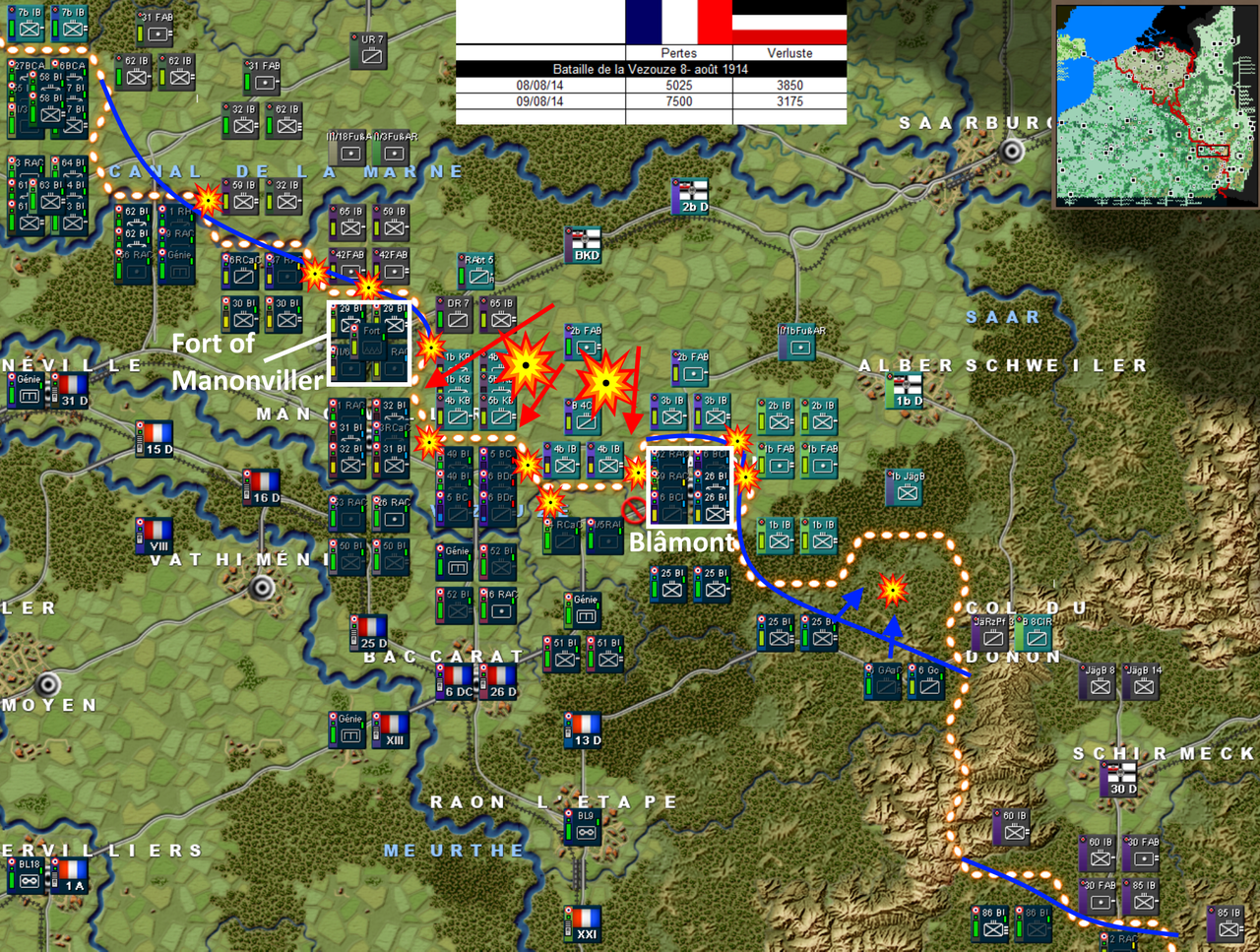
The main fighting was further east as the second day of the Battle of the Vezouze raged on:

Battle of the Vezouze
Image

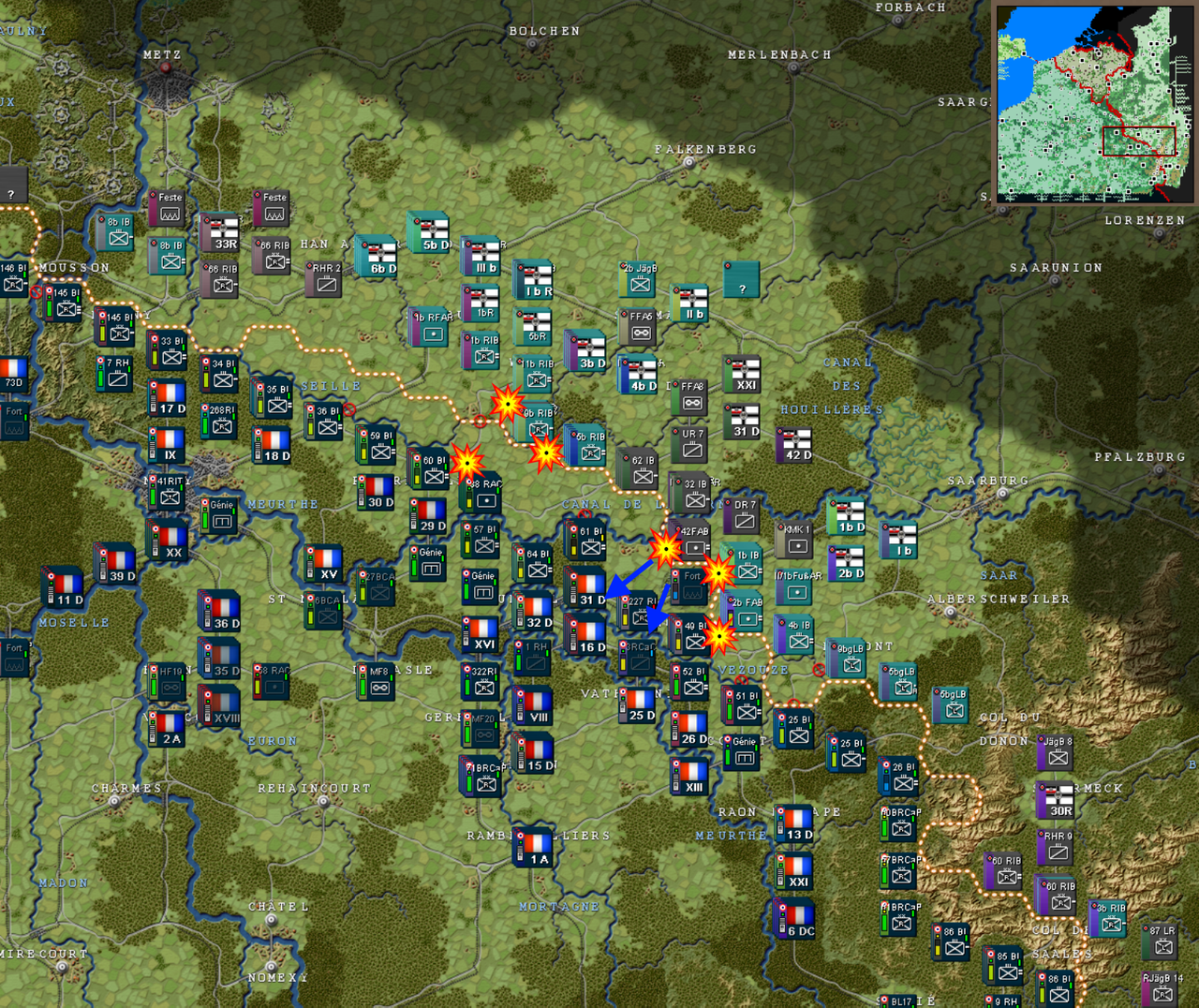
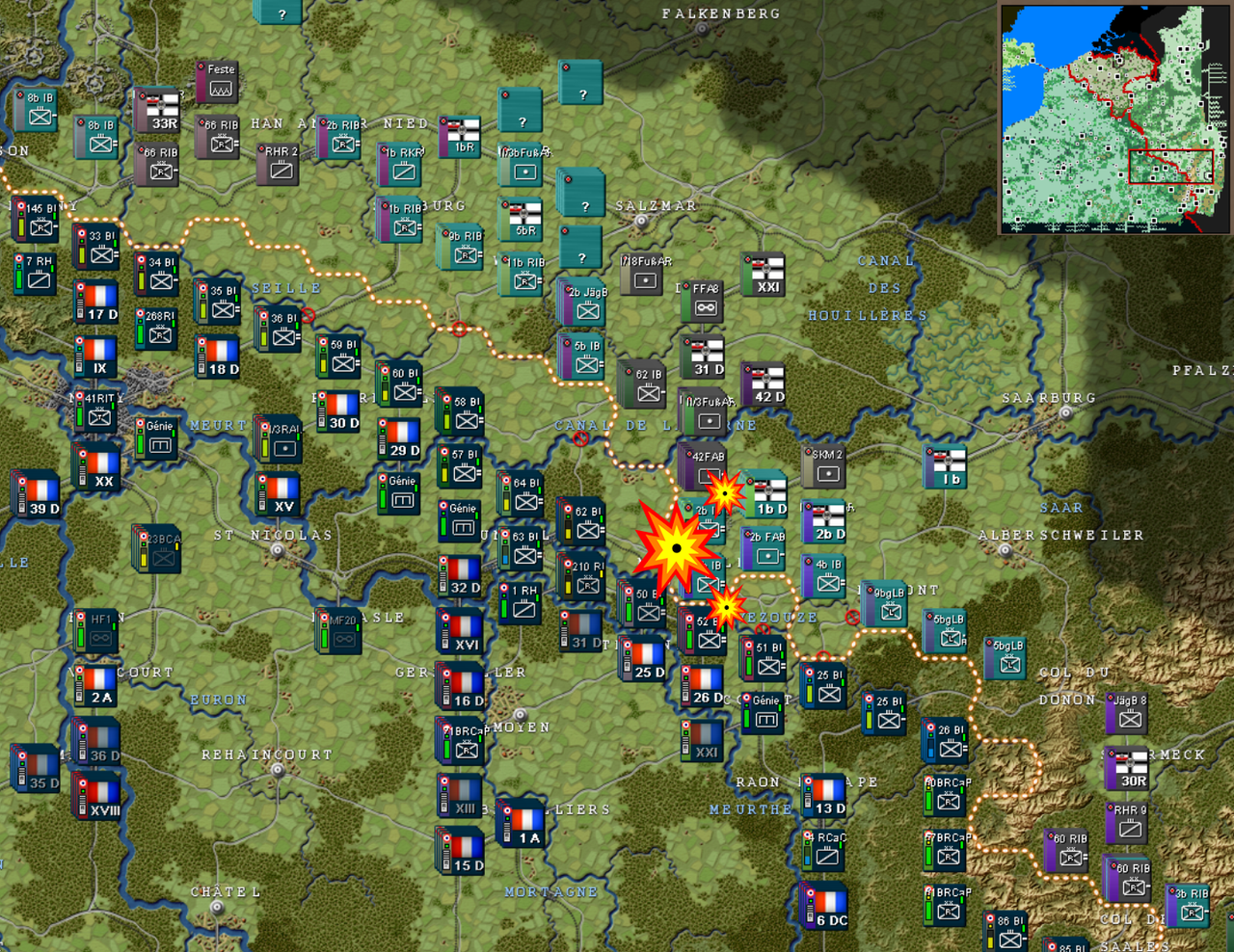
Following artillery barrages the Bavarian Cavalry division and 2nd Bavarian Infantry division renewed the attack for a second day between the fort of Manonviller and Blamont, attacking the newly arrived 16. Division d'infanterie. The Bavarian cavalry once again performed impressively and 16. DI lost 40% of it's strength during the day of attacks and counter attacks. With XIII. CA still a few kilometers away general Dubail had a choice of either abandoning Blâmont or engaging 6. Division de cavalerie (6. DC) to gain time. Refusing to give up his right flank Dubail ordered the cavalry charge and Levilain's 6. DC attacked: unfortunately he did not perform as well as the Bavarians and his attack was torn to shreds by machine guns of 4th Bavarian Infantry brigade. 5. Brigade of cuirassiers was down to 30% effective manpower by days end.

1. Armée and XXI. CA are debating wherever to abandon Blâmont or hope for XIII. CA to change the course of the battle. The effect of 2. Armée's offensive is also expected to relieve pressure from the front if the Bavarians have to reroute artillery to defend their center.

Right flank:
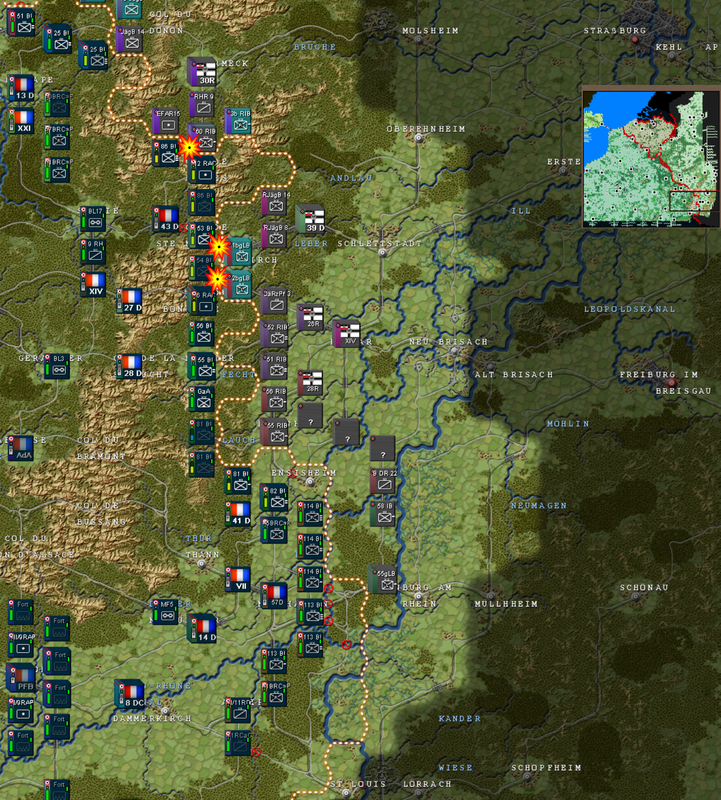
Image

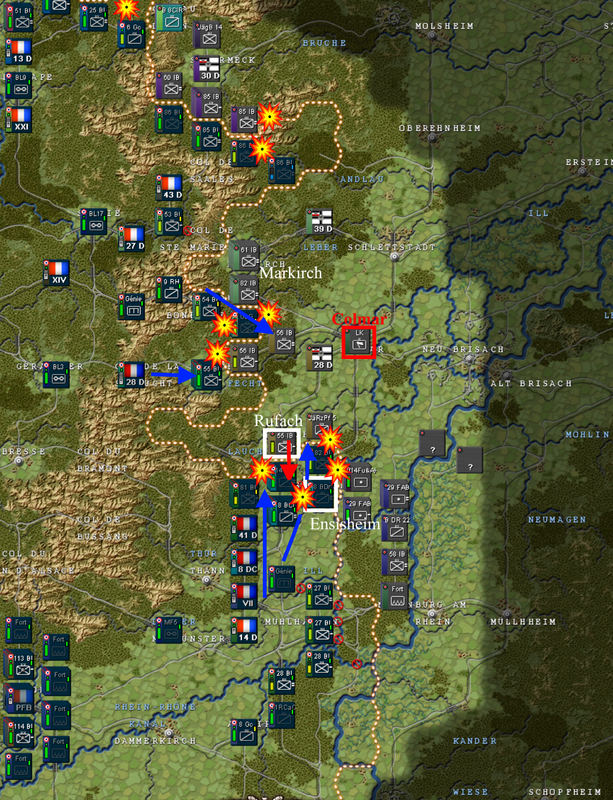
81. Brigade d'infanterie was caught off guard by a German counter attack and suffered heavy losses, especially since German artillery is occupying the right bank of the river Ill. Thankfully 82. BI with artillery support stormed Ensisheim and pushed the Germans back. Louis Bonneau is worried he doesn't have the troops to dislodge the German artillery and asks for reserves to come quickly to be able to push on. The good news is that the chasseurs alpins of Grenoble and Draguignan managed to advance and put pressure on the German 28th Division.

In other news:
- The second stage of mobilization is coming to an end, we expect reserve units to start be ready tomorrow 10. August and our railroad transport capabilities to free up for redeployment of our units.
- General Paul Pau is rumored to have been recalled from retirement and to be traveling east from Paris to take over a new army in Alsace to coordinate the offensive towards Colmar. This would allow 1. Armée to concentrate on the Battle of the Vezouze.

Conclusion:

Heavy casualties due to artillery seems to be defining the initial battles, although the Bavarian cavalry is making the case that cavalry is in fact not obsolete. Rising casualty numbers worry the GQG though, for Joffre did not intend to commit reserve divisions to active frontlines immediately. Calls from his army commanders, like Sarrail, are mounting to mitigate losses and replace active divisions on quiet frontlines with the reserves: they may experience the steel thunderstorm of artillery rather sooner than later.
-There is safety in numbers.
-Well there is also death in numbers. It's called a massacre.
User avatar
Metatron
Posts: 49
Joined: Thu Jun 19, 2014 9:50 am

Re: Westfront 1914

Post by Metatron »

10august.png
10august.png (2.4 MiB) Viewed 1440 times
Source of the journals: https://gallica.bnf.fr/accueil/fr/html/accueil-fr

10 August 1914

The battle of the frontiers is continuing with ferocity: the fire of artillery is raging on in Lorraine and the Ardennes. Meanwhile the French offensive in Alsace seems to loose momentum. There is now a continuous front from Switzerland to the Netherlands but for how long? The Belgians report an increasing number of German divisions in front of Liège and the French cavalry and pilots in the Ardennes report an equaly great number of Germans moving towards Namur. Is the battle of Longwy not the main German effort after all ? There is much debate at GQG, with the first reserve divisions being moved up to the front to counter what Joffre perceives to be the greatest threat: 5. German Army. 57. 71. 72. and 73. Divisions de réserve (DR) are detached from their initial duty of fortress mobile reserve for Epinal, Toul, Verdun and Belfort to shore up their respective local frontlines, while reserves units from all over France start planing or begin moving to northern France.

Dispatches from Belgium:
The city of Liège is still in Belgian hands but the first forts seem to have fallen: Evégnée and Barchon. The entire right bank on the Maas seems to be under extreme pressure by German heavy artillery. Will Liège be able to hold?

Left flank:
Image

5. Armée is arriving into position on the middle Meuse south of Namur. Two of the army corps are still catching up but soon there should be a solid line stopping any German breakthrough near Dinant. As long as Liège and Namur hold this line should be unbreakable. 4. Armée is also still not fully on the frontline, thus our front should be even stronger in a few days.

Center left:
Image

The German offensive gains some ground near Longwy thanks to overwhelming artillery superiority. 10. German division continues to push back 12. Division d'infanterie (12. DI) forcing IV. Corps d'armée (IV. CA) to commit more and more resources on it's right flank to support the retreating division. Fed up by the performance of Martial Verraux, Joffre dismisses him and sends him to the central officer reserve at Limoges; he is replaced by Oliver Mazel.

The retreat of 12. DI also forces 42. DI to fall back, abandoning Piennes. In answer to the panic of 3. Armée Joffre prioritized the transport of all the divisions (i.e. 54. 55. and 56. DR) of the 3. Groupe de divisions de réserve (3. GDR) to the Verdun area, leaving other army commanders, especially in Alsace, fuming.

Center right:
Image

Both the French and German offensives in Lorraine continue today. On the Vezouze the Bavarians act faster than French reserves can arrive and take Blâmont in a direct assault. Near Manonviller attacks and counterattack continue inflicting some pain on the 42nd German division and the Bavarian cavalry division but without Blâmont the fort of Manonviller is increasingly vulnerable to flanking attacks. During the day the first super heavy shells from 42cm and 30.5cm guns hit the fort, disabling one of the 15cm armored turret. How long can it hold and protect the road to Lunéville?

The battered 6. Division de cavalerie in finally taken out of the frontline, as XIII. CA takes up position; although the position is now behind the Vezouze. Very unhappy with how the battle is going Joffre has several of the commanders here replaced (see below in other news)

2. Armée's offensive is doing a bit better but at a terrible cost. 31. and 39. Division d'infanterie manage to advance and push back German infantry but the Bavarian and German line is well positioned in and around villages and forests of along the Nied and Seilles rivers. The French infantry advancing en masse is slaughtered by the accurate German shells. The exact number of casualties being so enormous no one really knows so far what the blood tally of the day was.

The worst news reaching de Castenau comes from his pilots reporting several German and Bavarian reserve divisions arriving behind the frontline. It seems the Germans are not afraid to use their reserves as frontline units at army corps level. Maybe if 2. Armée can break through the first line the price paid so far will be worth it and the French infantry will be able to overwhelm the Bavarian reserves on the plains.

Right flank:
Image

Similarly in Alsace the bad news is the arrival reported by pilots and cavalry reconnaissance of at least three reserve divisions and some Landwehr brigades stopping cold any hope of further advances towards Colmar. With only the 57. DR moving up from Belfort so far the newly created Armée d'Alsace is at best at parity numerically, at worst locally inferior to the Germans. Paul Pau, commanding the new army, is pushing GQG to commit 1. Groupe de divisions de réserve (1. GDR) as fast as possible so as to maybe still make it to Colmar. For the time being VII. and XIV. CA take up defensive positions.

In other news:
The following officiers were sent to Limoges:
- 13. DI: Frédéric Bourdériot is replaced by Henri de Cadoual
- 25. DI: Gaston Delétoille is replaced by Louis Baquet
- 26. DI: Gustave Silhol is replaced by Auguste Duchêne
- VIII. CA: César Alix is replaced by Jean de Mondésir
- XIII. CA: Joseph Castelli is replaced by Henri Requichot

Conclusion

It seems that Généralissime Joffre and his staff has made a fatal miscalculation: while his reserve and territorial units were mobilized in dispersed order and to mostly serve in the second line the German army appears to have mobilized it's reserves in army corps structures adding to their frontline power. Moreover the lack of French heavy artillery has been felt keenly both in offense as in defense; especially the reports of 3. Armée emphasize that the German 10.5 howitzer and 15cm canons at division and army corps level are inflicting heavy casualties, notably on the 75mm batteries trying to counter battery. Will the French army be able to adapt quickly to this new reality ?
-There is safety in numbers.
-Well there is also death in numbers. It's called a massacre.
User avatar
Metatron
Posts: 49
Joined: Thu Jun 19, 2014 9:50 am

Re: Westfront 1914

Post by Metatron »

11aoutjour.png
11aoutjour.png (1.62 MiB) Viewed 1405 times
Source of the journals: https://gallica.bnf.fr/accueil/fr/html/accueil-fr

11 August 1914

The hopes of a swift victory and of glorious French offensives seems to have vanished in cordite smoke. The slaughter in Lorraine astonished 2. Armée headquarters that calls for a stop to the frontal assaults. In the Ardennes the fight for the border towns and fortresses also appears to favor the Germans. Joffre and his staff have plenty of gripes with the field commanders at this point and we can expect many more generals to follow Verraux's example of a forced retirement in Limoges, no matter how deserved this fate might be. At the same time the Généralissime is starting to deploy his reserves in a more defensive way.

Dispatches from Belgium:
Liège still holds but the first shells hit the citadel itself. The right bank is near collapse and the first German troops on the left bank signal maybe the end of the Maas-line. Belgian divisions fall back slowly to avoid being encircled in Liège. The French left might soon not be so secure after all.

Right flank:
Image

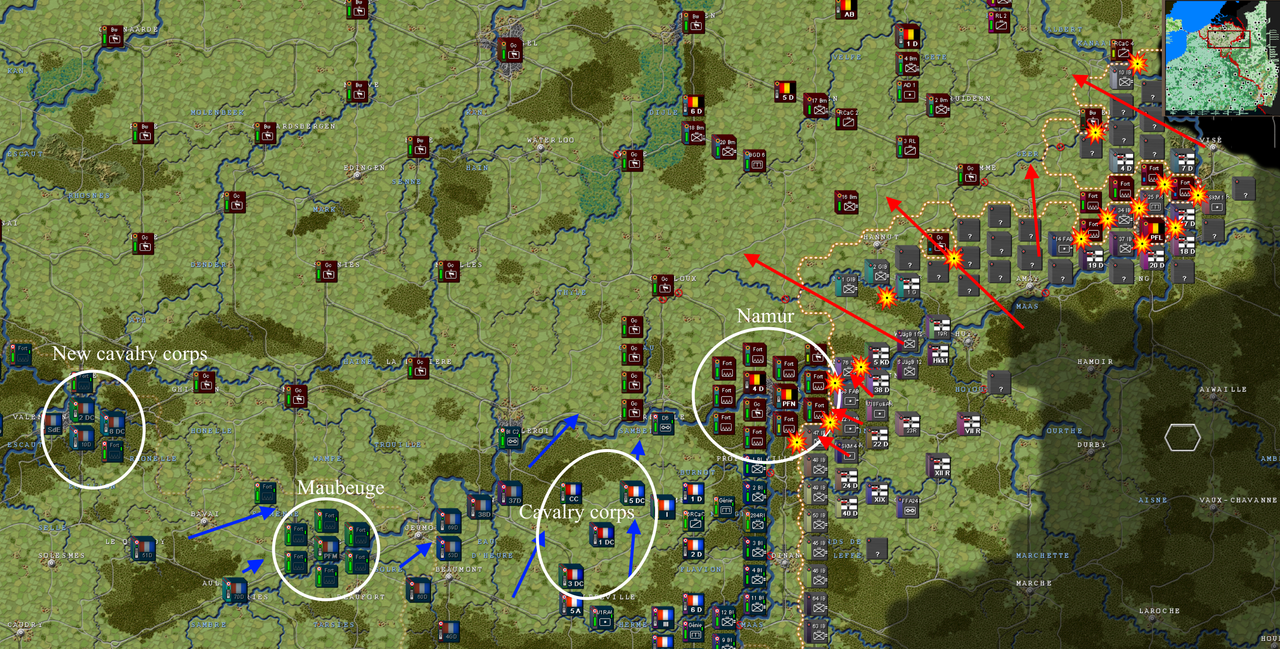
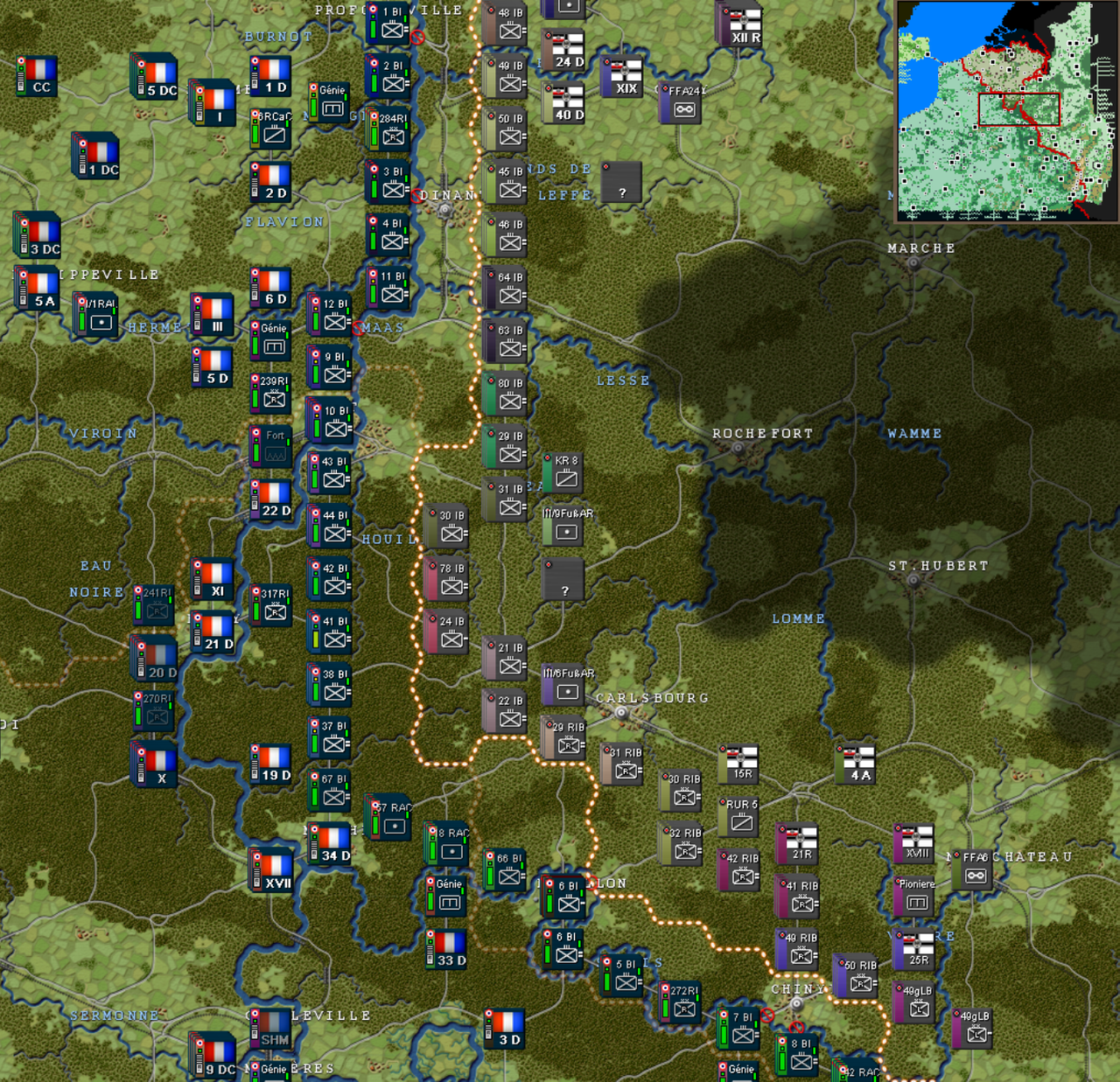
5. and 4. Armée are finishing their set up on the Meuse. Reconnaissance indicates that 3. German army is converging towards Namur. The changing situation in Belgium also now makes the Sambre an important obstacle for 5. Armée to control. GQG sets up 6 reserve divisions ( 51. 52. 53. 60. 67. and 69. Division de réserve) in the rear of 5. Armée. They will serve as mobile reserve and link the forts of Maubeuge to 5. Armée along the Sambre river. The arrival of the BEF in the coming week should strengthen our left flank even further.
Center left:
Image

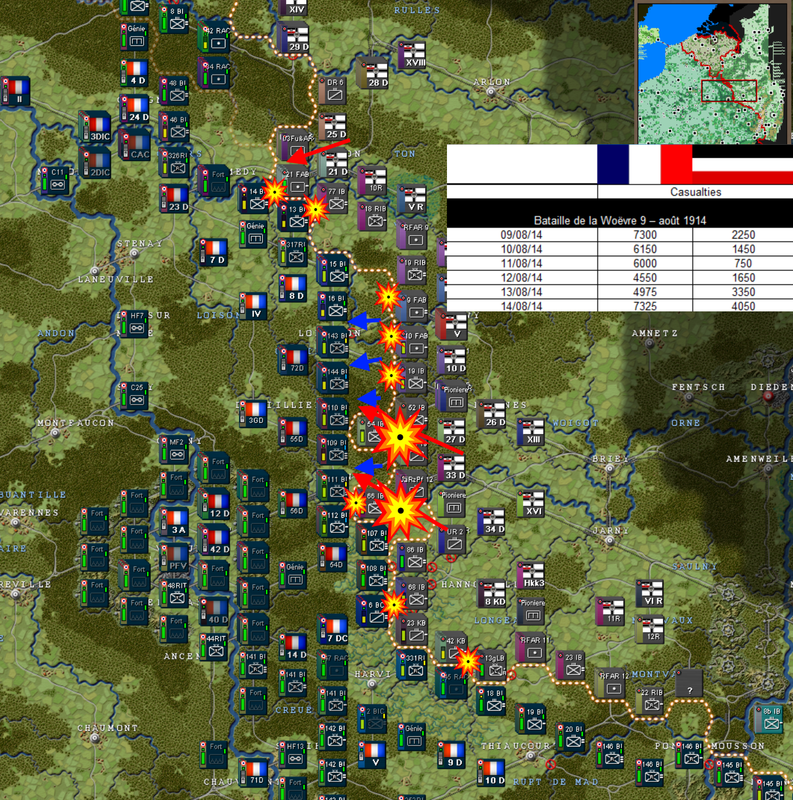
The heavy casualties forces Ruffey's 3. Armée to begin a fighting retreat around Longwy, leaving the citadel exposed. Nonetheless the defenders of the citadel manage to repulse the first German assault by 10. German infantry division.

XII. Corps d'armée (XII. CA) enters the frontline between II. CA and VI. CA, too late to stop a German frontal assault on Virton, which falls to the 21. German infantry division. Individual reserve regiments arrive to plug some gaps and this allows 4. Division de cavalerie to leave the front.

While Joffre accepts Ruffey's decision to begin a fighting retreat towards the Verdun area he still replaces some commanders in this area: namely of 40. DI Emile Hache replaced by the aptly named Louis Guerrrier and VI. CA's Maurice Sarrail replaced by Edouard Bolgert.

The 3. Groupe de divisions de réserve is moving up behind the line to take over part of the frontline tomorrow and give some rest to the embattled units of VI. CA.

Center right:
Image

The battle of Lorraine is the most ferocious of the war so far, with casualties in the tens of thousands but the German/Bavarian line won't budge. De Castelnau, commander of 2. Armée, is appalled by the carnage and has decided to abandon the offensive. He is now even worried that a Bavarian counter attack could breach his lines and threaten Nancy if the doesn't reform his army.

XVI. CA on his right was the only formation to score significant wins and inflicting heavy casualties on the XXI. German corps, relieving some of the pressure on the fort of Manonviller since the German guns can no longer fire against it from the northern bank of the canal of the Marne. In recognition of that feat Jean-Jacques Vidal's 31. Division d'infanterie is named in the Citation à l'ordre de l'armée of 11. August 1914.

The battle of the Vezouze is quieting down as a consequence of the flaring up of the battle in Lorraine and the fall of Blâmont. The bulk of the fighting is now around the fort of Manonviller that is still holding so far, with Bavarian pioneers deploying trench mortars to try to disable the armored turrets of the fort.

Right flank:
Image

The fighting in Alsace has mostly subsided, with both forces forming a line. It is clear that without substantial forces and artillery Paul Pau cannot advance on Colmar but with the situation in Belgium in flux it is unclear if those reinforcement will come. On the contrary Joffre has signaled that he might take 8. Division de cavalerie and even 14. DI away from this front if he needs to reinforce other points of the frontline. Similarly the 2. Brigade d'infanterie colonial of XIV. CA is leaving the frontline to serve as GQG reserve.

In the Vosges small skirmishes still take place, mostly to consolidate the frontline.

In other news:
67. Division de réserve has arrived in northern France, coming up from Montauban (Occitania).

Conclusion:

The spirit of the offensive did not carry the French infantry to victory in Lorraine. Horrific casualties forces the French armies to get back on the defensive. The arrival of even more German reserve army corps and the news from Belgium are compounding the result of the first six days of operations: the initiative is German. But GQG is still hopeful: 4. and 5. Armée have yet to meet the enemy in any serious way and a victory on the left flank would be surely decisive since the center of the French army is anchored on the forts of Verdun, Toul and Epinal.
-There is safety in numbers.
-Well there is also death in numbers. It's called a massacre.
User avatar
Metatron
Posts: 49
Joined: Thu Jun 19, 2014 9:50 am

Re: Westfront 1914

Post by Metatron »

12aoutjourn.png
12aoutjourn.png (4.59 MiB) Viewed 1362 times
Source of the journals: https://gallica.bnf.fr/accueil/fr/html/accueil-fr

12 August 1914

The scale of the German right flank's attack is slowly becoming clearer, although Berthelot still maintains the center is the main German offensive, moving 71. Division de réserve (71. DR) south of Verdun to guard the Meuse crossings there. The Belgians on the other hand claim to be facing two full armies and are falling back towards their national redoubt: Antwerp. The day is less bloody than the previous ones as 2. and 3. Armée slowly fall back to reform their lines.

Left flank:
Image

The Belgian situation according to the headquarter of the King of Belgium is deteriorating quickly. Liège still stands but the forts are falling one after another under the heavy artillery fire. Half of 3. Belgian division managed to fall back to avoid being encircled and is now retreating north with the main Belgian force towards Antwerp. Thankfully all the bridges over the Maas were blown and the Belgian army and Garde civique are blowing as many bridges as possible to slow down the German advance.

The Belgian military also informed us that they intend to announce Brussels to be a open city to spare it from the fighting. 5. Armée of Lanzerac now finds itself with an opening left flank but 4. Belgian division still holds firm in Namur; the forts of which have begun firing at the approaching German troops. The French reserves arriving by rail will need some days to reform and cross the frontier into Belgium and line up on the Sambre, in the meantime the Garde civique of Charleroi and Thuin are moving up to form a picket line on the Orneau river.

Center left:
Image

The French cavalry corps is reforming behind the Meuse and planing to move up north to counter any threats of German cavalry in the Belgian plain. They should be soon reinforced by a second cavalry corps currently forming out of the cavalry divisions taken out of the line in Lorraine and Alsace. The rumors say that Louis Conneau of 10. Division de cavalerie (10. DC) will be taking command of the new corps.

On the Meuse itself both sides are lining up. Unclear if a clash will happen or if both sides are waiting to see how the fight for Namur will develop.

Center:
Image

Around Virton attacks and counter attacks on a smaller scale still continue; causing around 3000 casualties on both sides but a German reserve corps appears to have arrived by rail to support the advance towards Montmédy. Pierre Roques' XII. Corps d'armée (XII. CA) was thus tasked with a fighting retreat towards the Chiers river.

Longwy still stands after two German assaults were bloodedly repulsed today but the end is near for the valiant garrison. VI. CA's three battered divisions are being pulled out of the line replaced by four reserve divisions. The calls for 3. Armée's commander general Ruffey to be replaced are growing at GQG and the hunt for a replacement is according to the rumor mill well under way.

Aerial recon also notes here a new German concentration including two cavalry divisions on the left flank of the German 5. army. A push towards the Meuse there may be coming.

Center right:
Image

After four days of carnage the fighting dies down in Lorraine, but not completely.

Around the fort of Manonviller both sides vie for position with VIII. CA and XVI. CAstill pressuring the German XXI. Army corps with success; stopping the German artillery from concentrating on reducing the fort further.

In Lorraine proper the French divisions fall back towards the Seilles river under Bavarian artillery fire. De Castelnau is regrouping his divisions and concentrating his artillery in case the Bavarians try to launch an offensive of their own.

On the left flank the 33. German reserve division tried to counter attack in coordination with 6. Bavarian Division but Marie-Joseph Chatelain's 73. DR performed a textbook counterstroke, inflicting heavy casualties on the 8. Bavarian infantry brigade. It was the first engagement for a French reserve unit of this war.


Right flank:
Image

Both sides seem to be content with the results in Alsace, the fall of Mulhouse was a nice moral boost for the French but German reserves stopped any push on Colmar. Now both sides seem to be pulling out divisions for use elsewhere, only the Vosges still sees some fighting for position on the mountain tops around the Saales, Bonhomme and St. Marie mountain passes. The solid position around Mulhouse still leaves the door open at a future offensive from Joffre's perspective though; time will tell.

In other news:
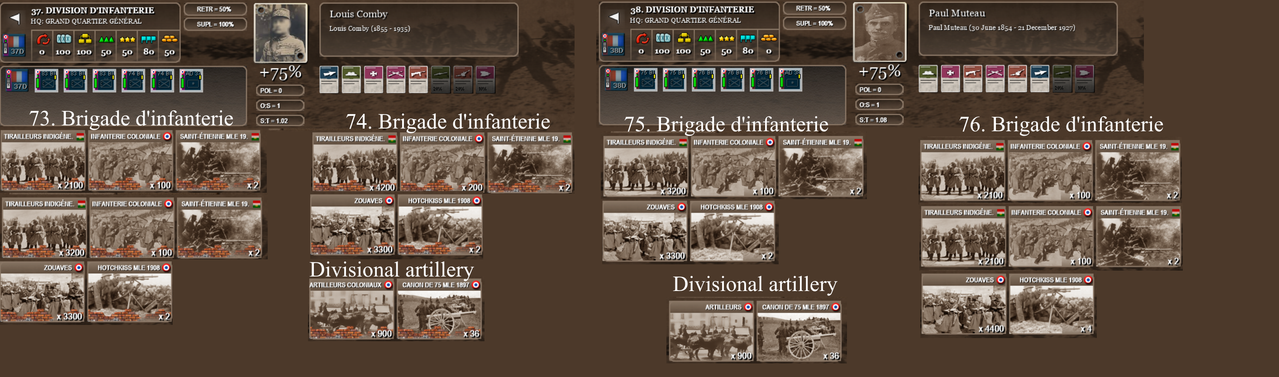
37. and 38. Division d'infanterie which landed at Marseille at few days ago were urgently transported by rail to the Belgian border at Maubeuge. The two divisions hail from the Armée d'Afrique and are composed of veteran colonial troops, both French zouaves and indigenous Algerian, Moroccan and Tunisian troops. They will provide a solid core of battle hardened troops for the defense of the river Sambre.
Image

Conclusion:

The fight for Alsace seems to be at an end, but the fight for Belgium might just be starting. The French railroad system is working at full capacity to transfer units around and redeploy divisions to the Sambre. These activities won't slow down any time soon and the arrival of the BEF, that will also need trains to move to the Belgian border, will put even more strain on French railroads. Hopefully Namur will hold longer than Liège and give the GQG enough time to gather sufficient forces to counter any attack through Belgium while holding on to the Meuse from Verdun to Namur.
-There is safety in numbers.
-Well there is also death in numbers. It's called a massacre.
User avatar
Metatron
Posts: 49
Joined: Thu Jun 19, 2014 9:50 am

Re: Westfront 1914

Post by Metatron »

13aout.png
13aout.png (2.99 MiB) Viewed 1306 times
Source of the journals: https://gallica.bnf.fr/accueil/fr/html/accueil-fr

13 August 1914

After several days of bloody conflict a lull in the fighting seems to be occurring. French offensives have stopped while German attacks focus on the central front and around Manonviller.

Left flank:
Image

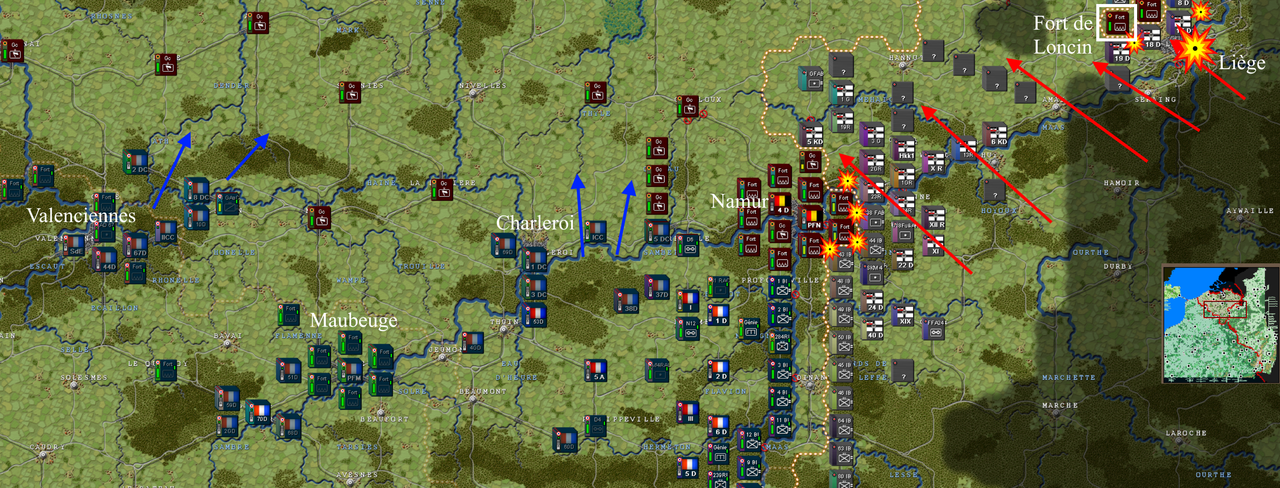
Liège still holds while it's outer forts fall one after another, some that haven’t taken any artillery fire so far like the forts of Loncin and Lantin might hold on for a few more days, but with crossings at Huy and Amay secured the German cavalry is flooding into the flatlands fighting against the Belgian rear guards. The French cavalry is being assembled near Charleroi and Valenciennes to counter this threat with a new corps being formed from 2. 8. and 10. Divisions de cavalerie (2. DC etc)

Namur is defending against German attacks against fort d'Andoy, but luckily the German super heavy artillery doesn’t appear to have arrived yet.

Center left:
Image

A quiet frontline so far. X. Corps d'armée (X. CA) gave up one of it's divisions to XVII. CA and is taken out of the frontline to move north to the Sambre and take command over two of the reserve divisions there.

Center:
Image

The only big operation still going is in the center where the Crown Prince's 5. Army continues to push towards Verdun and the Meuse. Around Virton and the Chiers river the French fall back, with 4. Armée moving the Corps colonial, still in reserve, up to counter any major push in the coming days.

Longwy finally falls to the German attacks after two days of brutal fighting. This should free up the German heavy artillery and we expect the German push to continue with renewed furor in the coming days against the four French reserve divisions now holding the central line.

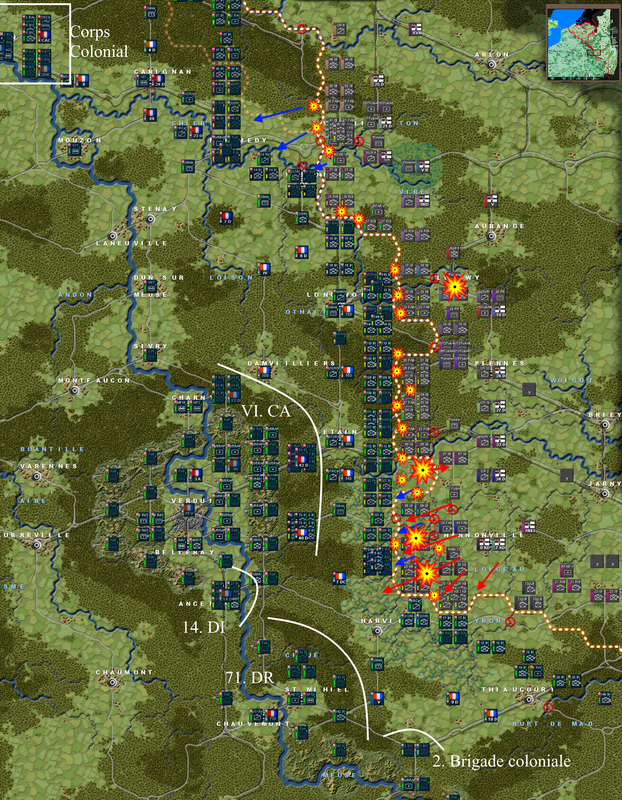
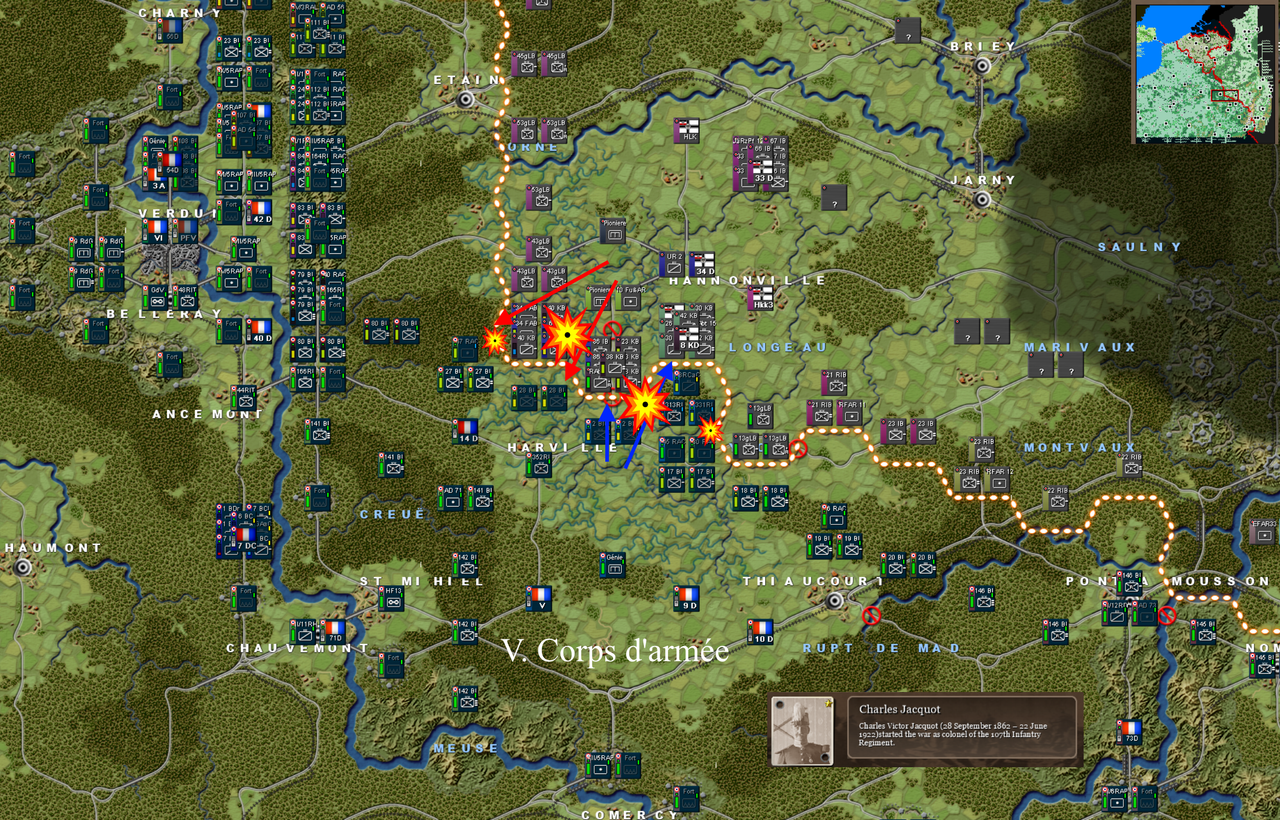
The main German effort today actually came around Hannonville, where XVI. German corps and two cavalry divisions attacked. The French line didn't break but 7. Division de cavalerie took heavy casualties. It's retreat threatening to open up a gap between V. CA and 3. Groupe de division de réserve (3. GDR). Reserves are consequentially being brought up to counter the threat to the Meuse crossing of St. Mihiel and Comercy, including 14. DI and 2. Brigade coloniale.

The battered VI. CA is falling back towards the fort belt of Verdun, the three weakened divisions will provide the fortified area with mobile infantry reserves.

Center right:
Image

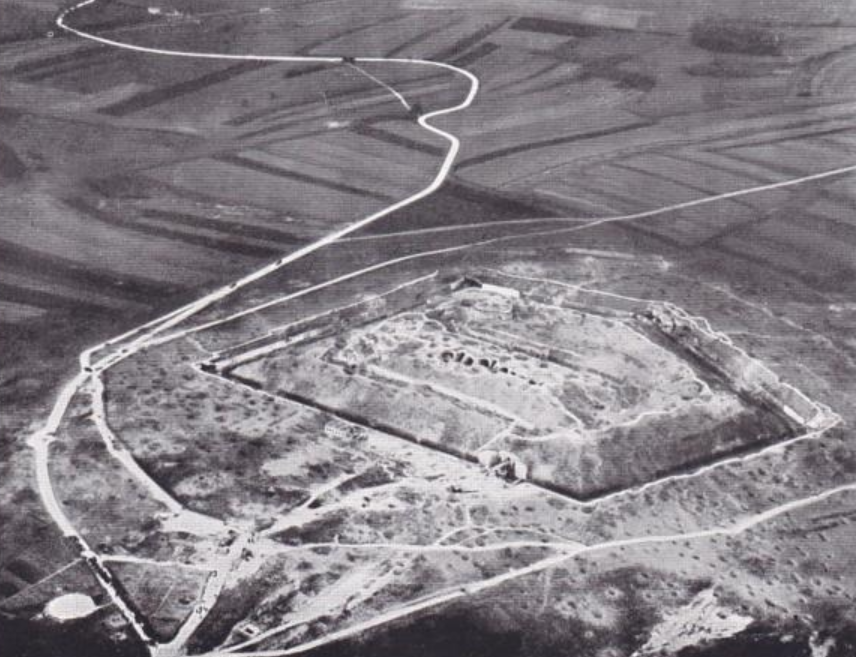
With the end of the French offensive the the fighting for the fort of Manonviller resumes with a vengeance. 15. Division d'infanterie which had held the fort so far is taken out of the line. VIII. CA sent in 210. and 227. Régiment d'infanterie de réserve into the meat grinder to relieve the 15. DI and hold the fort. At this point only one armored machine gun turret and one Bussière 57mm armored turret are still intact but the rest of the forts garrison is still quite intact (75% integrity).

Image
An aerial view of the fort of Manonviller.

In Lorraine the French artillery is setting up on the Seilles, including 120 and 155mm guns. XX. CA and XVIII. CA were pulled out of the frontline to serve as reserves or be transported to another front depending on what the Bavarians will do over the next few days.

Right flank:
Image

Alsace and the Vosges are mostly quiet now. 14. Division d'infanterie left for Verdun, 8. DC was transported to Valenciennes.

In other news:
V. CA commander Charles Brochin was sacked and sent to Limoges, replaced by Charles Jacquot.

Conclusion:

The calm before the storm along large parts of the front. The clash in Belgium should decide if further French reserves can be used to counter attack in the center or resume the offensive towards Colmar in Alsace. Meanwhile in the center the Germans seem determined to reach Verdun, which draws in some of the rare French reserves.
-There is safety in numbers.
-Well there is also death in numbers. It's called a massacre.
User avatar
Metatron
Posts: 49
Joined: Thu Jun 19, 2014 9:50 am

Re: Westfront 1914

Post by Metatron »

Some feedback from the testing results so far: overall feel is very close to what I wanted, historically faithful but with opportunity of deviation. The real game begins only really now with the fight in open country west of the Meuse. Important over the next 30 turns will be if a battle of the Marne style situation develops, i.e. can the Germans actually push far and/or can the allied player recover and how does the British side factor in.

Technically I've been finding and fixing all sorts of small general production mistakes (a few wayward bridge not deleted, a wrong short name or a wrong headquarters attachment at scenario start, etc)

The Belgian side still has a small problem, I think it's because I have them act before the French and France being their Uberregime, so units taking artillery fire stay at 0 AP and the supply may not flow correctly. It's playable like this but not perfect. I'll try to find a fix.

Fighting the forts feels nice, with the super heavy artillery doing the trick once they arrive; The fort units themselves are quite solid and only break after heavy casualties. Liège's last fort should fall around the same time as historically, i.e. the 16th, maybe a day earlier.

Casualties are high as intended, maybe a smidge too high. I think the main culprit is the 77mm, 75mm etc guns; I may nerf them a little bit, I'll see when I look at overall casualties by the end. Overall the artillery balance feels great with the German 10.5 cm Howitzer doing exactly what it did historically: giving German artillery brigades an edge over the French 75mm units. The German dominance in heavy artillery is also very clear and you feel it as the French, especially in forested terrain. To be seen if all the reserve French artillery pieces in the forts that unlock in September will actually help stabilize the situation for the French player.

Stacking limits in combat might be a problem I did not consider with units much bigger than regular Case yellow scenario for example. Right now you can only attack with about 6000 men into a hex, which is not unreasonable and it doesn’t feel completely wrong but I wonder if a stacking limit of 200 or 400 would make infantry attacks more viable (I think I can change that in scenario setup). Right now concentrating forces is not necessarily the best idea because it makes you vulnerable to horrific artillery casualties without being able to bring you entire division into a fight. This is probably the biggest gameplay change that I’m still looking at, everything else feels very good.

French political points balance is either exactly right (that definitely totally happens to nail it the first time) or maybe I need to give the French 4 pts per turn instead of 3; will be decided at the end.

The house rules also are working quite well and I'm just adjusting small stuff. The delayed activations is very good for the rhythm of the game as is the railroad limitations.

So I'm rather pleased with some smaller stuff still needing fixing/adjusting before general consumption is viable.

If I'm missing some information in the turn reports that you feel is needed for better comprehension please let me know.
-There is safety in numbers.
-Well there is also death in numbers. It's called a massacre.
User avatar
Metatron
Posts: 49
Joined: Thu Jun 19, 2014 9:50 am

Re: Westfront 1914

Post by Metatron »

14aoutjourn.png
14aoutjourn.png (2.28 MiB) Viewed 1110 times
Source of the journals: https://gallica.bnf.fr/accueil/fr/html/accueil-fr

14 August 1914

Liège has fallen but some of the Belgian forts still stand, primarily fort de Loncin which guards the Liège-Bruxelles railroad line. It might resist a couple more days and slow down the advance of the German 1st Army crossing the Meuse.

The Belgians continue to fall back while our pilots flying over the Meuse report an increasing number of German divisions crossing the bridges being repaired one after another. Ludicrous reports reach the GQG and Berthelot is fuming at estimates by the 2ème Bureau, that at least eight German divisions crossed the Meuse today. Slowly but surely though the truth that the German main attack will be coming from their right flank is setting in as Joffre orders more and more divisions towards Charleroi, Maubeuge and Valenciennes to counter the threat.

Left flank:
Image

It looks like a race at this point: the Germans are trying to outflank Namur while the French are assembling divisions to form a line on the Sambre and Haine rivers. Six French cavalry divisions are assembling and beginning their move into Belgium to slow down the German advance guards between Bruxelles and Namur.

Namur itself repulses another frontal attack against fort d'Andoy. It is clear that the limited artillery the Germans have at this point in front of Namur will not suffice to break the city. But with Liège soon completely in German hand this might only be a stay of execution, since the French look unlikely to commit any of their rare heavy guns to the static defense of the Belgian forts.

Center left:

All quiet of the Meuse.

Center:
Image

The German attacks continue, although the French artillery managed to deliver today it's best results yet in the area, inflicting significant casualties while falling back slowly. This unfortunately didn't stop the German infantry from successfully forcing two French brigade from 55. and 56. Divisions de réserve to retreat with heavy casualties.

Worryingly the 2ème Bureau's intelligence report suggests that the XVIII. German Corps from Alsace has been spotted near Virton, which might indicate a further German push towards Montmédy.

Near Harville the German cavalry on the other hand was stopped cold and shelled heavily allowing French reserves to move up and stop any break happening there.

VI. Corps d'armée (VI. CA) is now occupying the first line of forts of Verdun. Backed up by the fortress' mobile artillery and the armored turrets of the forts it should be almost impossible for the Germans to breakthrough here as long as the Meuse is guarded upstream and downstream too.

Center right:
Image

German artillery now again focusses on the fort of Manonviller and a frontal assault by 1st Bavarian division managed to isolate the fort from the French reservists and supporting batteries around the fort. Under pressure Augustin Dubail made the decision to pull back his infantry: the fort will have to stand on it's own now.

For the first time in the war French heavy artillery wins a long rang duel near Réméréville, where several 21cm Mörser and 15cm sFH 02 are destroyed.

Heavily depleted VIII. Corps d'armée (VIII. CA) is pulled out of the front to be redeployed to the quiet front of Alsace, liberating some units there for redeployment north.

Right flank:

All quiet of the southern front.

In other news:
- 44. Division d'infanterie arrived from Lyon and is deploying alongside 67. Division de réserve in the Valenciennes area.
- 4. and 9. Divisions de cavalerie from 4. Armée are also being transferred to the two cavalry corps the French are deploying into Belgium.

Conclusion:

One might almost forgive the generals of both sides to feel like Marshall’s of Napoleon of old or like Blücher riding on Waterloo since the Belgian plains are seeing a massive influx of cavalry formations that surely will clash in spectacular fashion, but the massacre performed by the artillery in Lorraine should remind us that the equine clash about to happen is just the beginning of a much more bloody struggle for northern France and Belgium.
-There is safety in numbers.
-Well there is also death in numbers. It's called a massacre.
User avatar
Metatron
Posts: 49
Joined: Thu Jun 19, 2014 9:50 am

Re: Westfront 1914

Post by Metatron »

15aoutjourn.png
15aoutjourn.png (1.49 MiB) Viewed 1072 times
Source of the journals: https://gallica.bnf.fr/accueil/fr/html/accueil-fr

15 August 1914

The fort of Manonviller falls to the Bavarians while the last forts of Liège fall prey to panic and surrender to IX. German Corps.

News from Antwerp:
Image

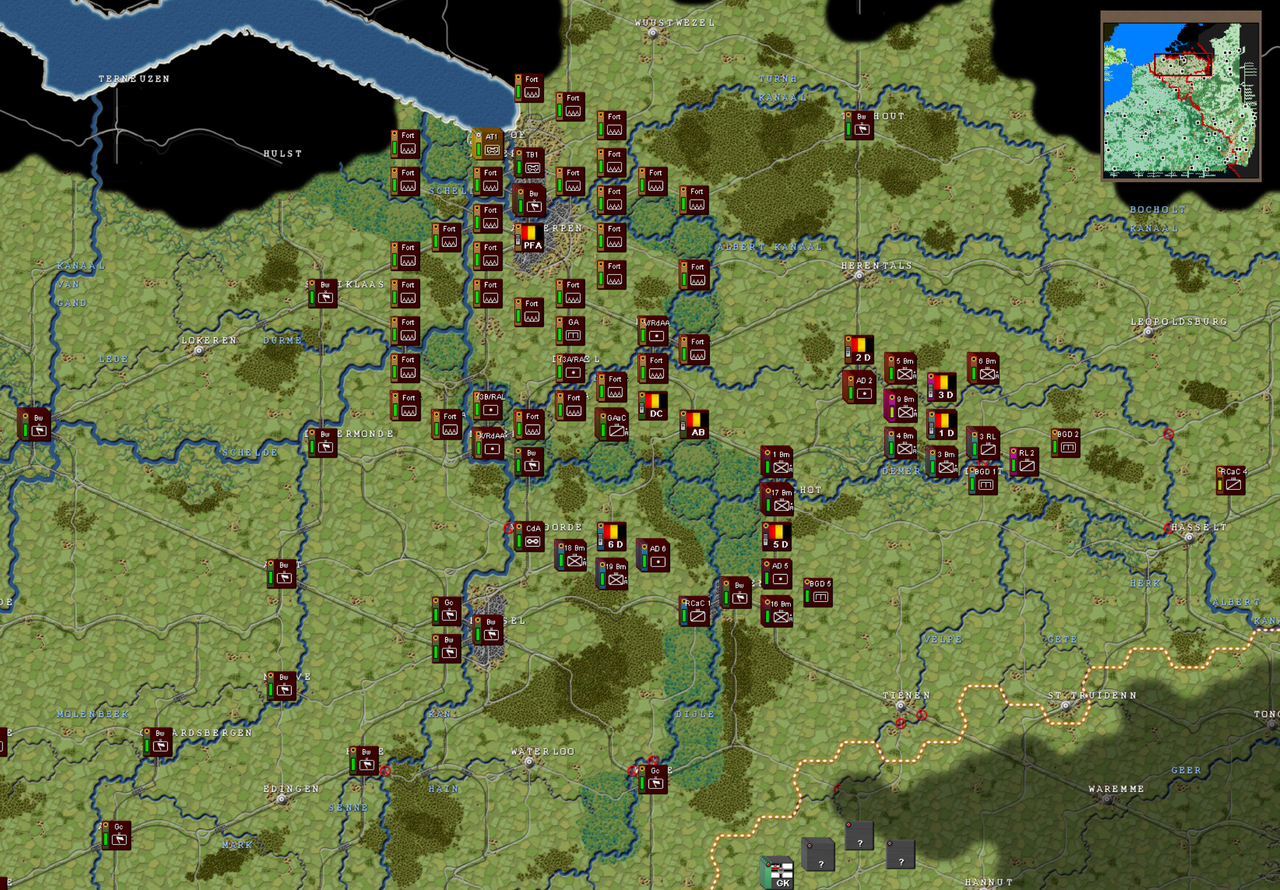
The Germans don't seem to immediately pursue the Belgian army, thus the King of the Belgians expect to be able to set up his defenses on the outer ring of the national redoubt. Bruxelles was declared an open city and the Bürgerwacht and Garde Civique are preparing to leave the city to rally Mechelen.

Left flank:
Image

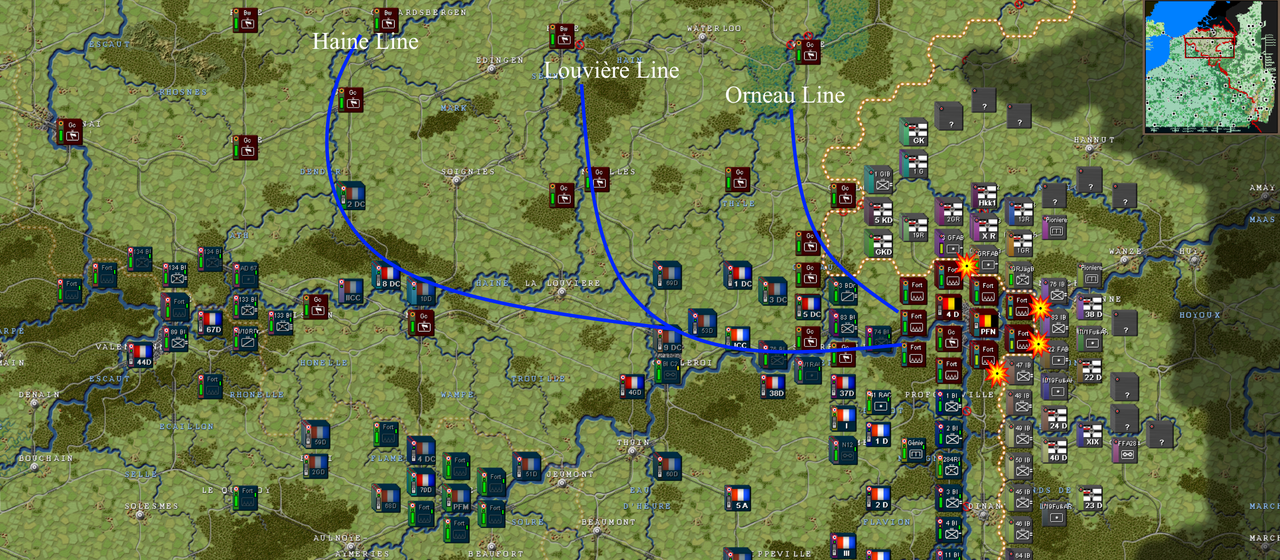
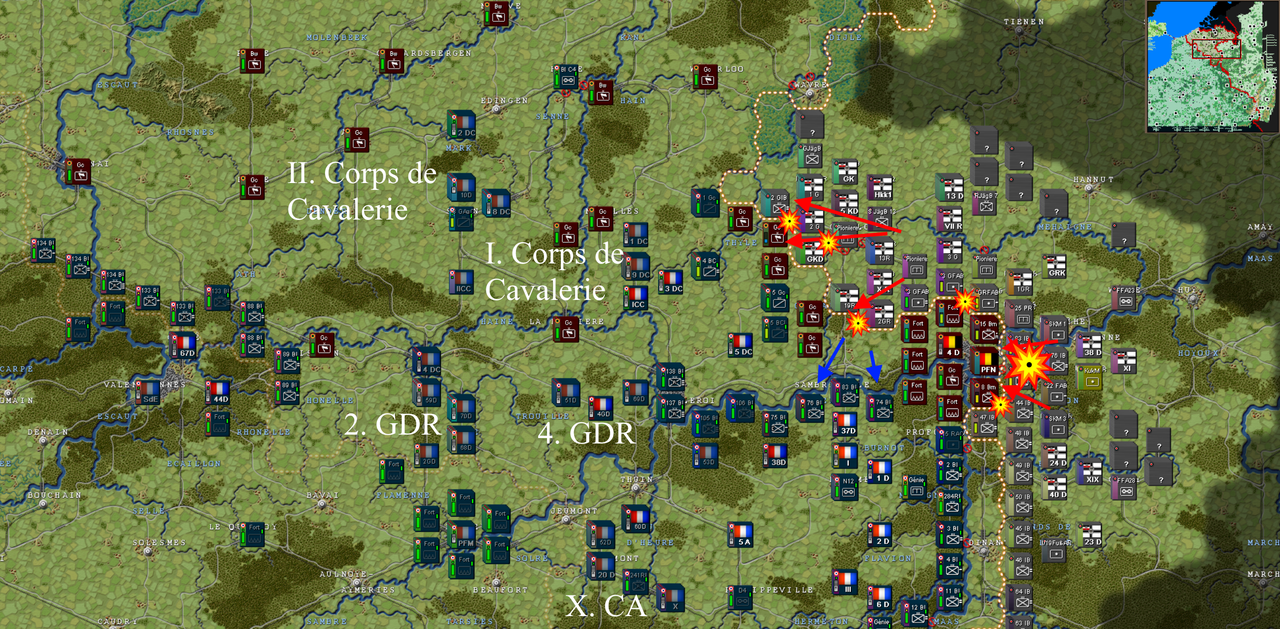
GQG projects to hold one of the three river lines west of Namur with six, soon to be eight cavalry divisions covering the arrival of 2. and 4. Groupe de divisions de réserves (GDR), each with three Division de réserve (DR). 37. and 38. Division d'infanterie (DI) are already arriving on the Orneau river, with X. Corps d'armée (X. CA) with two more DR and a DI. All together eight cavalry divisions and eleven infantry divisions should be able to stop the German advance on the Sambre. Further west two divisions are creating an additional defensive anchor around Valenciennes and 1. GDR is assembling around Douai to stop any further enveloping attack west by the German cavalry. Joffre and the GQG are confident that this should stop the German offensive and then 5. Armée would be able to counter attack on the Meuse and flank the Germans west of the river in a counterstroke.

Center left:

All quiet of the Meuse.

Center:
Image

3. Armée is continuing it's fighting retreat and is now getting in range of the Verdun artillery support. The Germans still managed some local gains against 7. Division de cavalerie that was subsequently pulled out of the front but with the forts behind it 3. Armée is confident the Germans won't be able to advance much more.

Meanwhile 4. Armée is focussed on the German offensive on Montmédy. The German 10. Reserve Division managed to storm the town on Veslones which forces XII. CA to pull back behind the Othain river. The good news is the Corps colonial is being inserted into the line northwest of Montmédy. Ultimately it is imperative to hold the crossings on the Meuse river north of Verdun, thus 4. Armée will stand and fight as much as possible.

Center right:
Image

Left without support the fort of Manonviller and the village of Manonviller were hammered by the German artillery; 2. and 3. Bavarian Brigades launched frontal assaults capturing the embattled terrain while XXI. CA reorganized it's line on the Vezouze river. The enemy now controls the approach to Lunéville and is threatening to cut the Lunéville-St. Dié railroad line but it is unclear if the Bavarians will continue their attack, having suffered quite a lot to reach the Vezouze.

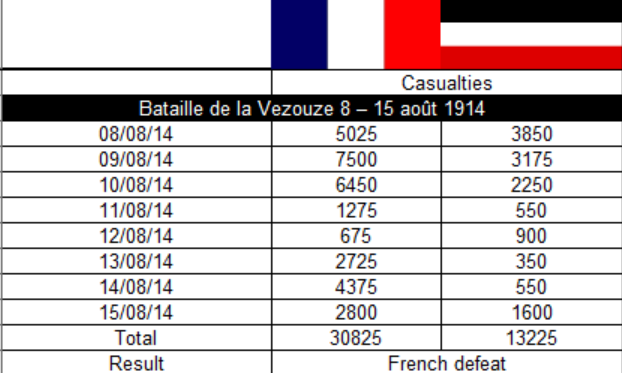
The battle of the Vezouze has been the longest of the war so far, raging on for eight days, causing 30 825 French casualties and 13 225 Germans and Bavarians.
Image

Right flank:

All quiet of the southern front.

In other news:
- 10. Division de cavalerie was taken over by general Georges Claret de la Touche, while Louis Conneau is expected to be announced as commander of II. Corps de cavalerie tomorrow. (the Corps de cavalerie being renamed to I. Corps de cavalerie)
- The final phase of mobilization is coming to an end, we expect the territorial units to become available for deployment by tomorrow.
- Rumors abound in Paris that the general in chief of the Expeditionary Force, Sir John French, is in route to the French capital; sign perhaps, that the British army might soon join in the fight.

Conclusion:

The Germans clearly have put to their faith in a strong right wing punch, hoping for a quick KO. This leaves GQG unimpressed, the French army shall defeat them on the Belgian fields enabling a counterstrike to win the war before Christmas.
-There is safety in numbers.
-Well there is also death in numbers. It's called a massacre.
User avatar
Metatron
Posts: 49
Joined: Thu Jun 19, 2014 9:50 am

Re: Westfront 1914

Post by Metatron »

16aoutjourn.png
16aoutjourn.png (1.72 MiB) Viewed 1022 times
Source of the journals: https://gallica.bnf.fr/accueil/fr/html/accueil-fr

16 August 1914

The first shot of the (presumably) battle of the Sambre has been fired near Sambreville. Large cavalry formations of both sides are moving between Namur and Bruxelles while the German Guard Corps arrives at the Orneau and Thyle rivers convincing I. Corps d'armée (I. CA) to form it's primary line on the Sambre and not in the woods west of Namur. In the center the battle for Montmédy flares up in brutal charges and counter charges causing massive casualties on both sides.

Left flank:
Image

The first super heavy shells fall on the forts of Namur as the German XI. Corps and Guard Reserve Corps pressure now both banks of the Meuse. 30.5cm shells from the Austrian Skoda guns land on fort de Maizeret and the fort's garrison panics, surrendering the fort to 38. German Division. An even larger artillery barrage hits fort d'Andoy and a similar panic sets in allowing the 22. German Division to capture the fort, leaving only fort de Dave on the right bank. The bad news is aerial reconnaissance is reporting a large number of artillery guns being unloaded on the left bank of the Meuse.

Center:
Image

The Germans don't seem crazy enough to frontally attack the Verdun area and German Landwehr units are reported to set up a frontline: that means the active troops are reforming behind to attack on the flanks of Verdun.

On the right flank of Verdun the German cavalry supported by 34. Infantry Division continues it's attack but V. CA is throwing it's reserves into the fight and 14. Division d'infanterie, 2. Brigade coloniale, 313. and 331. Régiments d'infanterie de réserve counter attack inflicting heavy casualties, reclaiming a forest and destroying a German cavalry regiment in the process. Newly promoted Charles Jacquot is praised by Joffre for his leadership of V. CA.

Image

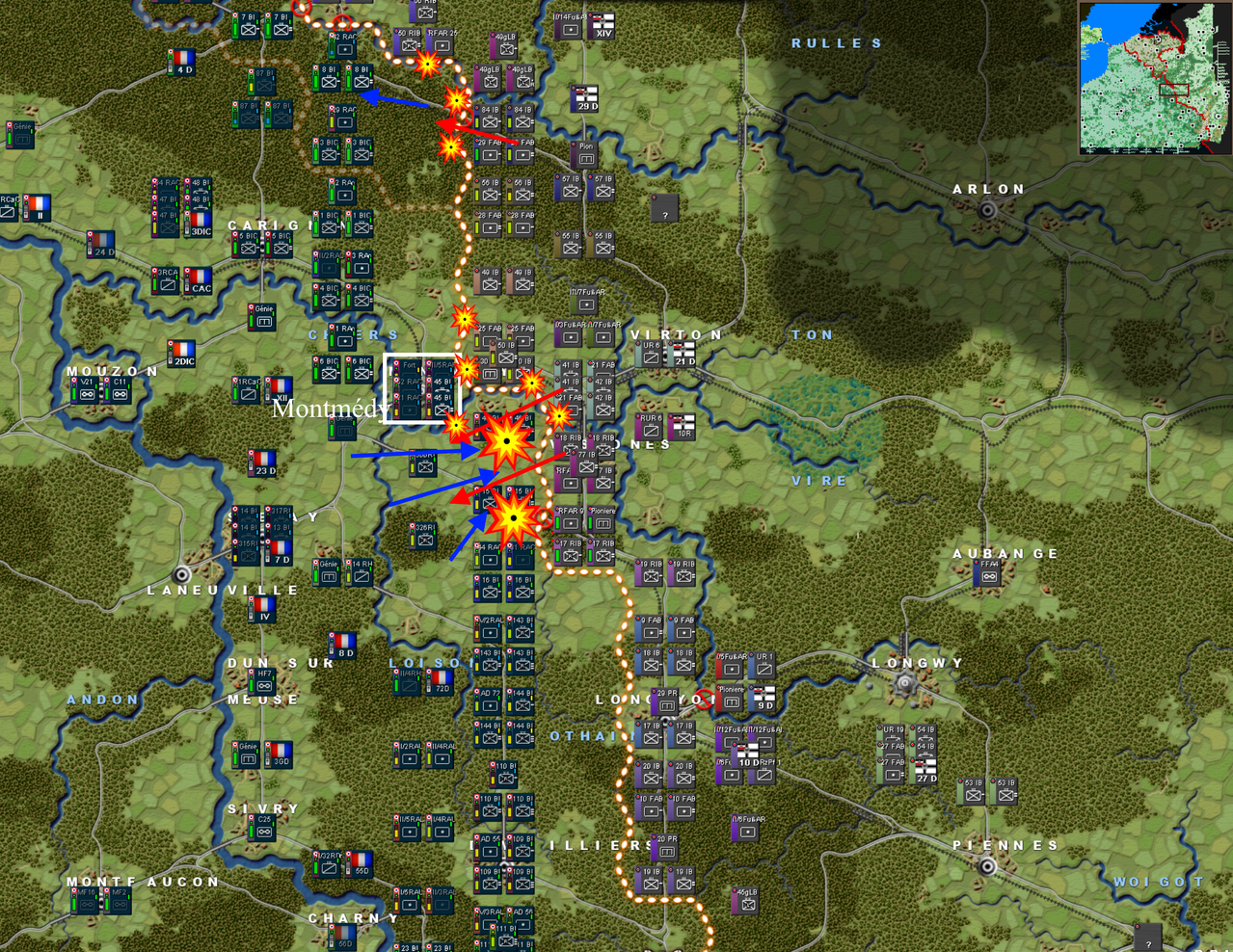
On the left flank of Verdun the battle of the Chiers and Semois continues with renewed ferocity seeing the highest daily casualty count of the war since the battle of Lorraine. Two German Divisions attack on the Othain river and drive back 7. Division d'infanterie which is on it's last leg and pulled out of the frontline as 8. Division d'infanterie and 23. Division d'infanterie launch a counter attack and drive back the Boches (Pejorative: Germans). Along the Semois the 87. Brigade d'infanterie (87. BI) manages to barely hold on against a coordinated attack by 29. German Division but has to fall back behind 8. BI to avoid destruction.

Image

Sitrep:

Except for Namur and the Verdun front most of the line is going quiet: both sides are pulling units to feed the carnage up north. The Armée d'Alsace, 1. and 2. Armée are asked to pull out individual regiments or battalions to send to Verdun or the Sambre. This is the case for 1. 6. 7. and 9. Régiments de hussars; 268. 322. and 342. Régiments d'infanterie de réserve; 6. 23. 24. and 27. Bataillon de chasseurs alpins; and 41. 43. 50. 57. 60. 61. and 71. Bataillons de chasseurs à pieds de réserve so far, with more to come no doubt. Railroad allotment being tight with the arrival of the BEF it's unclear when these reserves will be able to join their new frontline assignment.

Image

In other news:
- Louis Conneau is indeed now commanding II. Corps de cavalerie
- the BEF is landing in France while Sir John French visits Paris, the first units assembling after rail transport behind Valenciennes.

Conclusion:

The small British army is finally arriving and will be posted on the French left. Hopefully their fighting skill matches their commanders arrogance. Surely the Entente cordiale will translate into perfect harmony and cooperation on the battlefield.
-There is safety in numbers.
-Well there is also death in numbers. It's called a massacre.
User avatar
Metatron
Posts: 49
Joined: Thu Jun 19, 2014 9:50 am

Re: Westfront 1914

Post by Metatron »

17aoutjourn.png
17aoutjourn.png (1.85 MiB) Viewed 937 times
Source of the journals: https://gallica.bnf.fr/accueil/fr/html/accueil-fr

17 August 1914

The first five divisions of the BEF (technically called the Expeditionary Force at this point) are unloading near Valenciennes, a stark reminder of the ever expanding scope of this conflict. A decisive battle in Belgium is looking more likely by the day. In the center the Germans are still hammering 3. Armée though and calls for Ruffey's removal are increasingly loud. The Ministère du Commerce et de l'Industrie is particularly upset about the loss of the plateau of the Pays-Haut around Longwy and Briey where 20-25% of the world iron ore is mined, leaving French industry with a massive production deficit for the forceable future.
mines.png
mines.png (2.74 MiB) Viewed 937 times
Map of the coal, iron and salt deposits of Lorraine.

Coastal situation:
Image

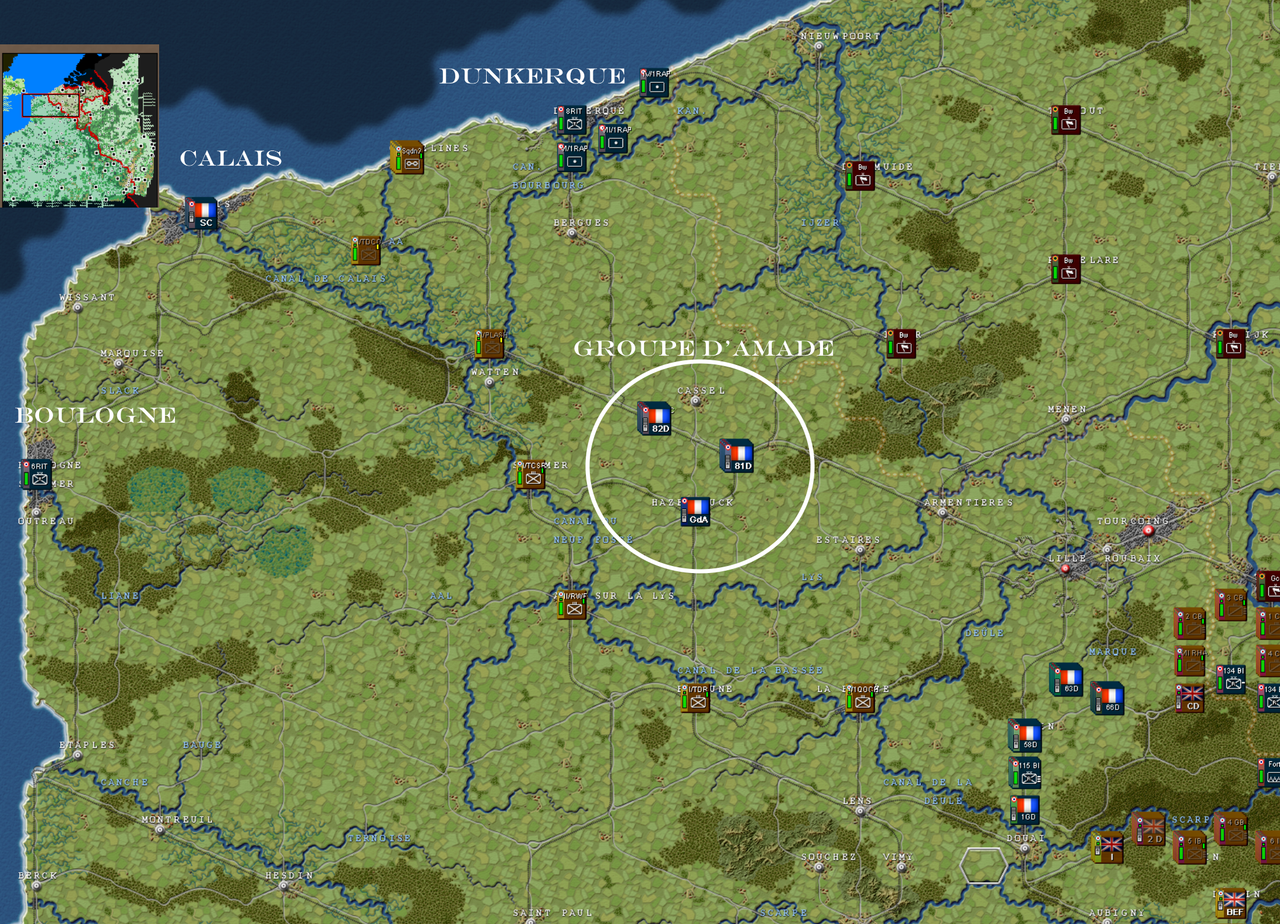
As the British landed they deployed some battalions of infantry to protect their lines of communication from the ports. In this they are aided by the Groupe d'Amade that is assembling with 81. and 82. Divisions territoriale.

Left flank:
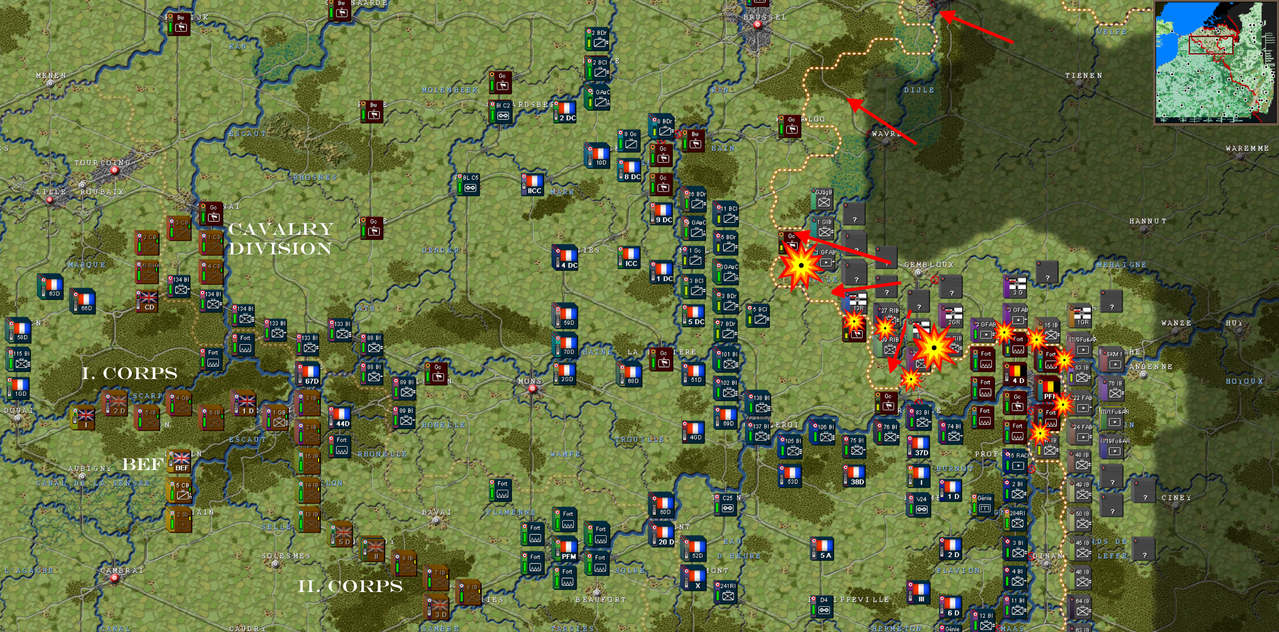
Image

The German artillery fire is intensifying around Namur hitting mainly the forts de Dave, de Marchovelette and Cognelée.

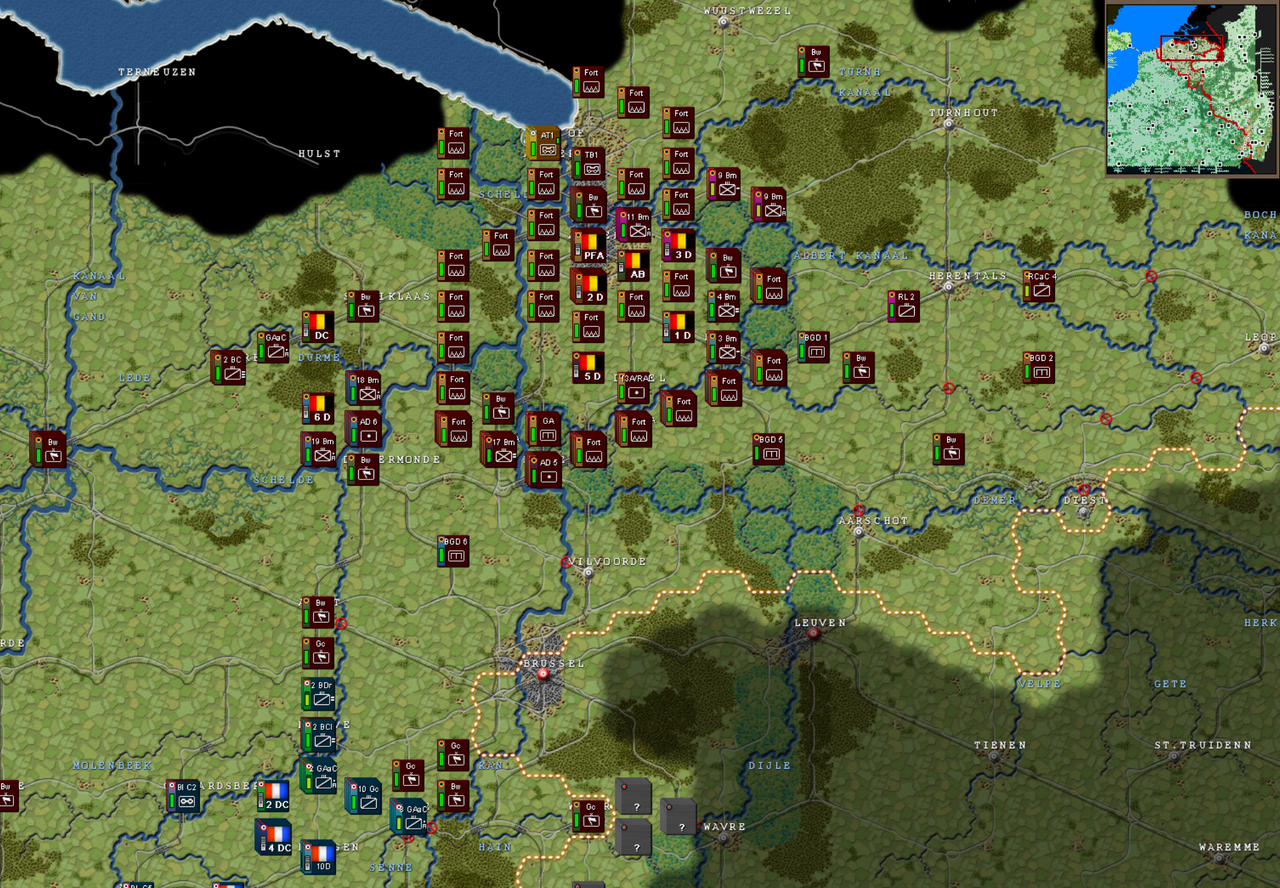
A German Reserve Corps and the Guard Corps are being harassed on the Orneau river by Belgian Franc-Tireurs and Garde Civique but there is little they can do to stop the onslaught. German cavalry crosses the Thyle and Dijle rivers and will most likely enter Bruxelles tomorrow.

French reserves form up on the Louvière line with the British coming up behind them. Joffe and GQG are confident that they have amassed enough strength to stop any German push and maybe even counter attack and get back to Liège, cutting off any German troops west of the Meuse.

Center:
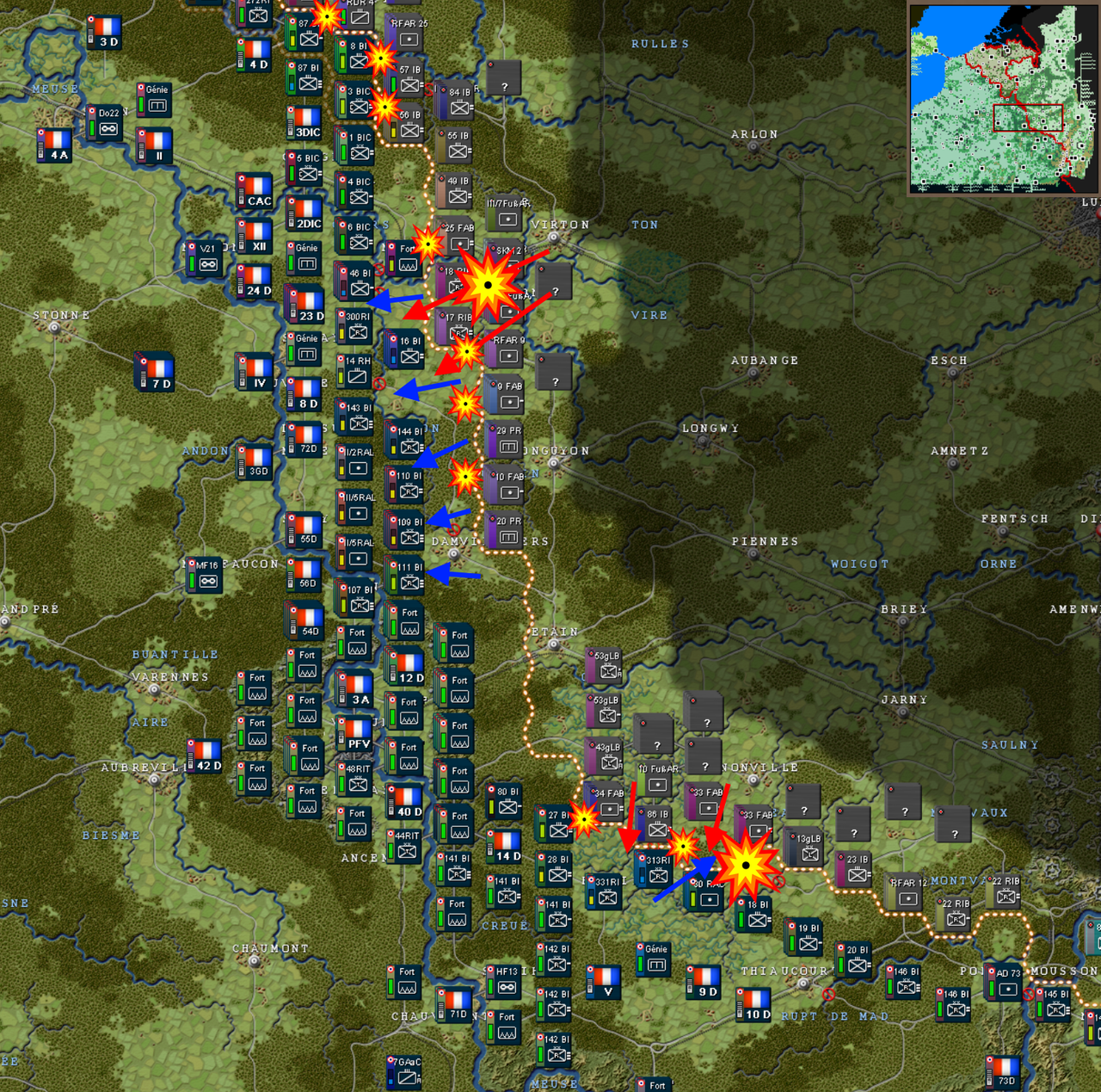
Image

Without further reinforcement 3. Armée continues it's fighting retreat suffering under the long range heavy German artillery. General Ruffey is pleading with GQG for more troops. IV. Corps d'armée (IV. CA) has been basically annihilated and reserve regiments of fed into the meat grinder to hold at this point.

General Langle de Cary commanding 4. Armée also calls for reinforcement since he is now additionally starting to feel German pressure on the Semois around Chiny. Joffre promises that with the BEF mostly arrived more trains will be reallocated to bring in the reserves of 1. and 2. Armée to the Meuse.

After yesterdays successful counter attack the French south of Montmédy are again forced back by two German reserve divisions supported by the depleted 21. German Division. The Germans keep pushing at the junction between 3. and 4. Armée and only the arrival of the Corps colonial a few days ago made it possible to hold east of the Meuse. But now there remains only the Loison river as a natural barrier in front of the strategic towns of Mouzon and Stenay.

On the Verdun right flank the fighting on the Longeau river east of Harville continues with sucessive attacks and counter attacks between V. Corps d'armée and XVI. German Corps. Pilots flying over Metz report Bavarian divisions crossing the Moselle river, so the Boches might not let up their offensive here. General Jacquot is confident he can hold but also asks for reinforcement to compensate for his losses.

In other news:
- Four squadrons of British planes crossed the Channel today from Dover to Gravelines.
- 1. Armée takes over the entire front from Blâmont to Metz. This liberates 2. Armée headquarters for new assignment around Verdun or up north in Belgium.
- The headquarters of 7. and 42. Divisions d'infanterie are pulled out of the line, the remains of the infantry of those divisions given over to the Verdun fort garrisons, while new regiments arriving from Alsace and Lorraine will be reorganized under these two headquarters.

Conclusion:

While a stream of French reserves have been arriving in Belgium, it looks like Berthelot and the 3ème Bureau might have been right to worry about the Verdun front. German artillery superiority has enabled constant progress and soon the French army will have to fall back on the Meuse, giving up any chance of quickly retaking the iron mines of western Lorraine.
-There is safety in numbers.
-Well there is also death in numbers. It's called a massacre.
User avatar
Metatron
Posts: 49
Joined: Thu Jun 19, 2014 9:50 am

Re: Westfront 1914

Post by Metatron »

18aoutjorun.png
18aoutjorun.png (2.11 MiB) Viewed 890 times
Source of the journals: https://gallica.bnf.fr/accueil/fr/html/accueil-fr

18 August 1914

A day similar to the previous one, with mostly calm but intensifying fighting locally at Namur and Montmédy.

News from Antwerpen:
Image

The Belgian army is mostly secure behind the outer fort belt of Antwerpen at this point with Garde civique and Bürgerwacht unit arriving daily to reinforce the outer defenses. 1. 3. and 5. Belgian Divisions will be holding the fort line while 2. and 6. Divisions supported by the remnants of the cavalry division will set up on the Schelde to keep the railroad to Gent open.

Left flank:
Image

Namur still holds despite heavy bombardment. Fort de Dave and Cognelée might fall soon but so far as long as the forts garrisons don't panic they manage to hold even for several days of heavy bombardment.

The German cavalry enters Bruxelles while the French cavalry corps cover the arrival of 2. and 4. Groupes de divisions de réserve (2. and 4. GDR). 1. GDR is moving up to the Escaut but these reserve divisions won't be able to hold a frontal assault by the active German divisions. They will fall back to the Haine and Sambre and let 5. Armée and the BEF do the main fighting.

Center

Chiers front:
Image

Montmédy falls after the citadel's garrison panics letting 50. German Infantry Brigade capture the town.

On the Semois German pressure continues with artillery continuously shelling 4. Division d'infanterie and German reserve divisions approaching Bouillon.

XVIII. Corps d'armée (XVIII. CA) is starting to be transferred over to 3. Armée but the lack of railroads in the Argonne makes it harder to bring up reinforcement quickly.

Wöevre front:
Image

The fighting dies down after several days of heavy losses. De Castelnau and his 2. Armée headquarters arrive to take over the Verdun and Woëvre area, letting 3. Armée concentrate on the area north of Verdun.

XX. CA arrives to reinforce the beleaguered V. CA of general Jacquot because it looks like at least four Bavarian divisions are setting up to renew the offensive soon.

In other news:
- 10. Division d'infanterie was visited by Joffre today, while general Augier was removed and the division was taken over by Philippe Pétain.
- XX. Corps d'armée: Ferdinand Foch was replaced by Etienne de Villaret. Foch is traveling to Vouziers to take over 3. Armée tomorrow.
- 7. and 42. Divisions d'infanterie were reformed with reserves regiments coming from Alsace and Lorraine. XIII. Corps d'armée took charge of the reformed divisions and is assigned to 2. Armée.

Conclusion:

The board is set and the pawns are moving, soon the plains of Hainaut will see a clash of fools and rooks.
-There is safety in numbers.
-Well there is also death in numbers. It's called a massacre.
Post Reply

Return to “After Action Reports”